
China's Tech Giants Wage a New PC War — This Time, AI Is the Weapon
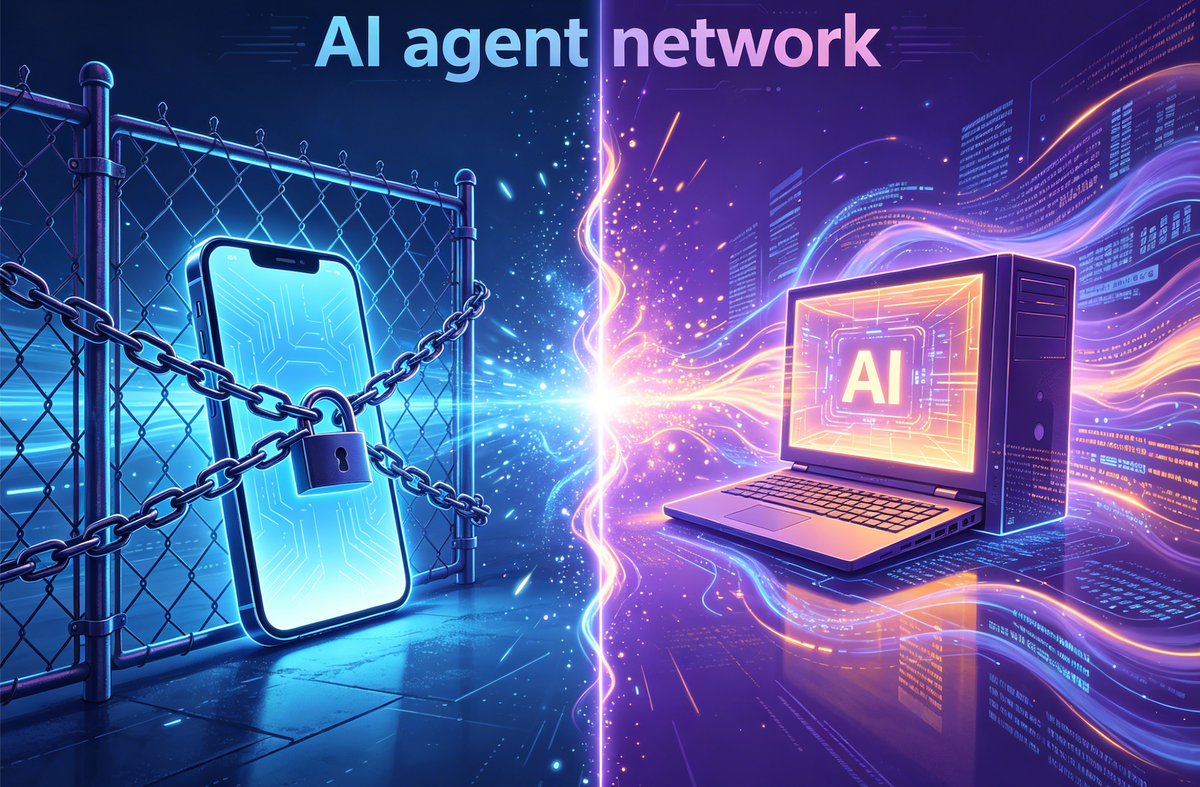
Tencent, Alibaba, and ByteDance are racing to plant AI agents on desktop operating systems, betting that the PC — long dismissed as a legacy terminal — may be the most defensible gateway to the next computing paradigm.
The pivot is striking in its unanimity. Within months of each other in 2026, three of China's largest internet companies have launched dedicated PC-first AI products, signaling that the decade-long mobile supremacy may be approaching a structural inflection point — not because smartphones are retreating, but because AI's productivity demands are outpacing what mobile architecture can deliver.
Market observers note the timing is no accident. As AI agent capabilities mature from novelty chatbots into systems that can autonomously execute multi-step tasks, the hardware and software constraints of the mobile ecosystem are increasingly exposed as a ceiling rather than a foundation.
Tencent, Alibaba, ByteDance Converge on Desktop AI
On May 21, 2026, Tencent launched Marvis, an OS-level AI assistant simultaneously available on Windows, macOS, and Android. The product's architecture is deliberately PC-centric: its Android version functions primarily as a chatbot in standalone mode, but unlocks what the company describes as its "ultimate form" only when tethered to a desktop environment. Tencent has also released QClaw and WorkBuddy as part of a broader PC-facing AI product suite in 2026.
Alibaba has deployed Qoder Work, Baidu has introduced DuMate, and ByteDance has shipped Trae — all targeting the PC as a primary interface. The cluster of launches within a single quarter suggests coordinated awareness of a platform shift, not coincidental product roadmaps.
Overseas peers are moving in parallel. Anthropic's Claude Code, OpenAI's Codex, and Google's Gemini CLI all represent PC-native AI tooling that has gained significant developer traction in the same window.
OpenClaw's Viral Adoption Validates the PC-AI Thesis
The most striking data point validating this strategic pivot comes from OpenClaw, an open-source PC AI agent. Within roughly two months of its listing on GitHub, OpenClaw accumulated more than 300,000 stars on the platform — surpassing Linux to become GitHub's most-starred open-source project.
More tellingly, adoption extended well beyond the developer community. In early March 2026, Tencent hosted a free OpenClaw installation event in Shenzhen that drew participants ranging from children to elderly users, many of whom had no background in programming or cloud computing, according to Shenzhen News Network. The event's turnout illustrated that AI agent utility on PC is beginning to resonate with general consumers, not just technical early adopters.
Hardware Gap Explains Why Mobile AI Hits a Ceiling
The technical rationale for the PC-first strategy is quantifiable. Nvidia's flagship RTX 5090 GPU packs 92 billion transistors and delivers 3,352 TOPS (tera operations per second) of AI compute — effectively a private token factory on a user's desk. By contrast, Qualcomm's Snapdragon 8 Elite (fifth generation), currently the leading mobile processor, delivers approximately 80 TOPS. That is roughly a 40x gap in raw AI inference capacity.
Beyond raw compute, the systemic difference matters as much as the hardware specs. Windows and macOS grant applications system-level execution privileges, enabling AI agents to operate across files, browsers, and third-party software without the permission walls that fragment the mobile ecosystem. China's mobile internet, in particular, has evolved into a collection of walled gardens — Alibaba, Tencent, and ByteDance each operate largely closed platforms — making true cross-app AI orchestration structurally difficult on smartphones.
Li Xiang, chairman and CEO of Li Auto, articulated the problem directly during a mid-May 2026 appearance on the podcast Luo Yonghao's Crossroads: "A critical requirement for agents is that they must operate within a real working and production environment to generate meaningful feedback. Ordinary users lose interest quickly because there is no productive output loop."
PC's Marginalization Was a Mobile-Era Artifact, Not a Permanent Condition
To understand why the current reversal is structurally significant, context matters. Between June 2010 and June 2014, China's mobile internet user base expanded from 277 million to 527 million — a 90.25% increase — while mobile's share of total internet users rose 17.5 percentage points to 83.4%, according to data from the China Internet Network Information Center.
That demographic surge rewrote corporate strategy. Alibaba anchored its future in mobile Taobao; Tencent secured its next-era franchise through WeChat; ByteDance emerged as a mobile-native challenger through Jinri Toutiao. PC became an afterthought. TikTok, launched in 2016, did not release a web version until June 2021 — only after mobile traffic growth plateaued. Xianyu, Alibaba's secondhand marketplace, abandoned its web version entirely in 2019, only relaunching a limited desktop interface in 2024.
That neglect is now being reversed at speed.
Hybrid Architecture Emerges as the Likely Endgame
The strategic logic is not that PC will displace smartphones — it is that the two will operate as complementary nodes in a hybrid computing architecture. Former Honor CEO Zhao Ming stated in June 2024 that on-device AI possesses capabilities cloud models cannot replicate, specifically in processing personal data and protecting user privacy. His framing anticipated the current industry consensus: local compute handles sensitive, personalized workloads; cloud models handle scale and complexity.
Under this model, the PC evolves from a productivity tool into what analysts are calling a "home compute hub" — storing personal data, running local AI agents, and dynamically routing complex tasks to cloud infrastructure via home Wi-Fi when local capacity is insufficient. Wearables and smartphones serve as lightweight input and monitoring interfaces, capturing intent and surfacing agent outputs, while the PC executes the underlying computation.
This architecture implies a fundamental reordering of platform power. Whoever controls the PC-based AI agent layer controls the orchestration of a user's digital life — their data, their workflows, and their interface with every downstream service. The stakes are not incremental product differentiation; they are control over the human-computer interaction paradigm for the next decade.
The Ecosystem Entrance Is Being Contested Now
The current race among Tencent, Alibaba, ByteDance, and Baidu is not primarily about AI product features. It is about replicating, in the AI era, the kind of platform dominance that Baidu once held through PC search — a position that translated directly into market capitalization. In March 2011, Baidu's market cap reached US$48.1 billion, briefly surpassing Tencent to become China's most valuable internet company, a position built entirely on owning the PC search gateway.
The company that secures the AI agent layer on PC in 2026 is positioning for an analogous structural advantage. Whether that prize goes to Tencent's Marvis ecosystem, Alibaba's Qoder Work, or an as-yet-unproven challenger remains open. What is no longer open is the question of whether PC matters. It does — more than it has in fifteen years.
Related Coverage:
Tencent Launches Marvis Beta, Betting OS-Level AI Agent Can Reclaim PC Screen Time from Mobile