
China's Tech Giants Wage War Over AI-Animated Short Drama Apps
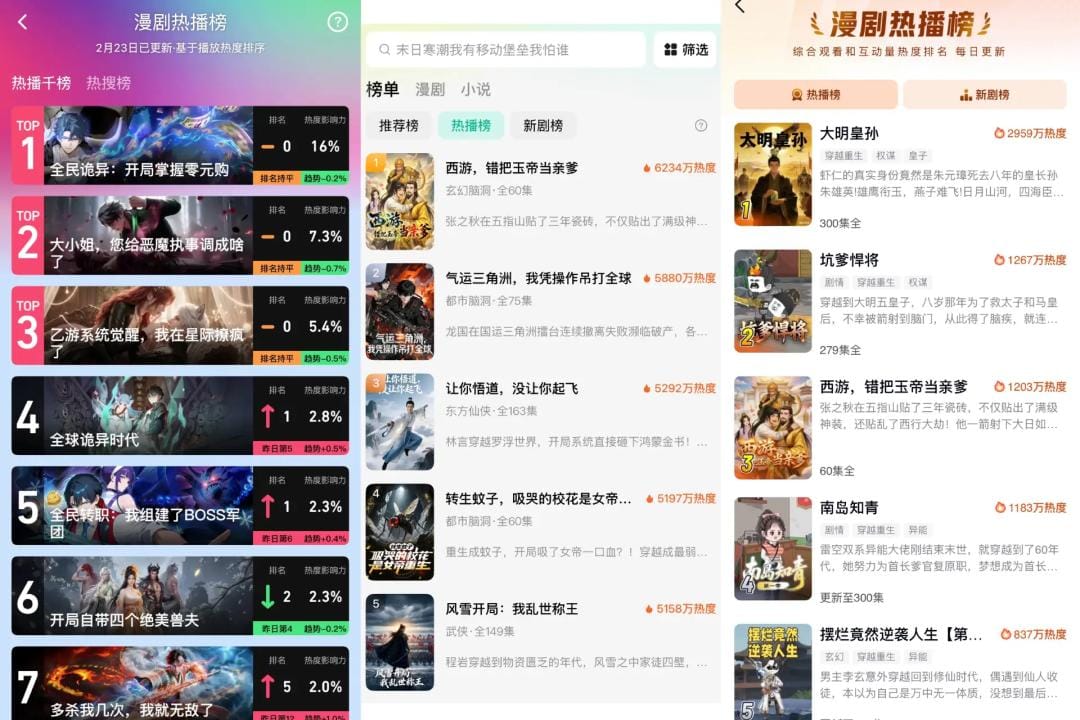
China's internet majors are racing to claim territory in a fast-emerging content format that blends animation aesthetics with short-drama storytelling, as advances in generative AI slash production costs and ignite a new battleground for user attention and platform dominance.
Tencent launched its dedicated animated short drama app "Huolong Manju" on February 4, 2026, pairing the debut with a licensing agreement with China Literature Online valued at RMB 23.2 million yuan (approximately US$3.2 million). The move signals Tencent's intent to build a full content pipeline in the so-called "manju" — or animated short drama — segment, a format where each episode runs roughly one minute and is engineered for maximum narrative impact within seconds.
The launch positions Tencent as the second major heavyweight in a race already underway, with ByteDance holding a commanding early lead and Baidu accelerating its own push. The competitive stakes extend well beyond entertainment: analysts and investors see control of this format as a proxy battle for the next generation of digital content consumers.
ByteDance Leads, Tencent Challenges
ByteDance moved first, quietly launching its standalone animated drama app "Honguo Manju" in November 2025, an evolution of its earlier free short drama product. Backed by the vast IP library of Tomato Novel and the algorithmic distribution power of Douyin, ByteDance replicated its proven short-drama playbook — flooding the platform with low-cost content, using data to identify breakout themes, then scaling winners rapidly. Monetization is anchored in advertising, reinforced by high-guarantee, incentive-heavy revenue-sharing arrangements designed to lock in creators.
The results were immediate. According to QuestMobile data, Honguo Manju reached 8.54 million monthly active users within its first month on the market, placing it among the top three short drama apps in China.
Tencent's entry, while later, carries comparable structural firepower. The company's IP reserves — accumulated through Reading Group, QQ Reading, and WeChat Reading — include numerous long-running franchises with established fan bases. WeChat's Video Account and other distribution channels provide diversified traffic entry points. Industry insiders told the publication Dingjiaoone that Tencent has already stockpiled a substantial slate of premium animated drama projects for phased release, with content scope defined broadly: any non-live-action format falls within Huolong Manju's remit.
The platform's reported revenue-sharing model is notably aggressive. According to industry sources, exclusive content may carry a revenue-sharing multiplier of up to 200% of advertising traffic proceeds, supplemented by platform bonuses for breakout titles and sustained creator incentive programs — a structure designed to build long-term creator loyalty rather than simply acquire content on a transactional basis.
Baidu has also entered the field with two products: "Youmanju", launched in December 2025, and "Qimao Manju", introduced in January 2026 under its content platform Qimao, which launched with the slogan "watch dramas free for 100 years." Baidu began assembling a dedicated team in November 2025 and has opened access to a library of over 100,000 IPs alongside creator incentive programs. At a recent Baidu AI Cloud event, an executive disclosed that within less than a year, Baidu's animated drama business grew at one-quarter the pace it took short dramas three years to achieve — while content representing one-quarter of its volume accounted for one-third of total platform distribution.
The Strategic Logic Behind Standalone Apps
The decision by ByteDance and Tencent — both of which already operate massive video platforms — to build dedicated animated drama apps rather than integrate the format into existing properties reflects a deliberate user behavior strategy. A source close to Tencent explained that embedding content within a main app results in passive discovery, while a standalone product cultivates active, habitual engagement, which is far more valuable for long-term platform stickiness.
The demographic calculus is equally important. Data from DataEye Research Institute shows that animated drama users aged 18 to 40 account for roughly 79% of the total audience, with the 31-to-40 cohort representing the largest single segment at 31.81%, followed closely by the 24-to-30 and 18-to-23 groups. This skews meaningfully younger than the core short drama audience, which has historically leaned toward older female users in lower-tier cities.
Investor Ke Yu, quoted by Dingjiaoone, argues the real bet being placed is on the migration patterns of the next generation of content consumers — not just current monetization. She notes that the two-dimensional animation user base exhibits strong willingness to pay, a characteristic that sets it apart from the broader short drama market. On Tencent Video, animated series have consistently ranked at the top of its bestseller charts, representing one of the few content verticals where return on investment reliably turns positive.
iQIYI and Alibaba Group are also positioning themselves, though through different approaches. iQIYI is internally testing an AI video generation tool and selectively inviting external teams to participate, while also planning to incubate AIGC content creation teams with dedicated office space in Shanghai. Alibaba, meanwhile, has been rolling out a series of WeChat mini-program animated drama channels — including "Midou," "Tiandou," "Mengdou," and "Huandou" — all linked to its Shuqi Novel platform under Alibaba Literature, signaling an intent to leverage its extensive copyright holdings as an entry point.
A Competitive Hierarchy Takes Shape
Industry observers are already sketching the outlines of a tiered competitive structure. ByteDance occupies the first tier by a significant margin, with its integrated IP-technology-platform loop from source material through production to distribution. Tencent is widely regarded as the only near-term challenger with comparable ecosystem depth.
Baidu, with its dual-app strategy and AIGC full-workflow solutions — including the formation of an AIGC content creator alliance — is seen by many practitioners as having the potential to join the top tier. The common thread across all three is a convergence toward what Ke Yu describes as the three decisive assets: IP ownership, traffic distribution, and production technology.
Traditional long-video platforms including iQIYI, Youku, and Bilibili form a second tier, competing through premium revenue-sharing rather than standalone apps. iQIYI offers up to 100% revenue sharing for exclusive content; Youku has raised its combined membership-plus-advertising share ceiling to 80% with per-title bonuses of up to RMB 1 million yuan (approximately US$138,000); Bilibili's "Awakening Plan" covers 30% to 100% of production costs with an 80% revenue share for qualifying creators. Their inherent advantage lies in existing creator networks and, particularly in Bilibili's case, deep-rooted two-dimensional cultural communities.
A third category of players — technology companies entering through tooling rather than content — adds another dimension to the landscape. 360 Group, for instance, has launched an AI animated drama agent production platform. Ke Yu argues this segment is betting on a window in which tools monetize ahead of content, targeting production companies and short-drama operators looking to transition into the format.
Racing to the Bottom on Price, Racing to the Top on Quality
The rapid influx of capital and participants has compressed production economics with unusual speed. Finished animated drama content that initially commanded RMB 2,000 to 3,000 yuan per minute has fallen to a few hundred yuan, with some orders reportedly clearing at over RMB 100 yuan per minute. While pricing for top-tier, platform-rated content has remained relatively stable — with most high-grade slots going to professional animation studios — everything below that threshold has seen relentless downward pressure.
AI entrepreneur Wu Jieqian, who oversees a team handling large-scale platform projects, described the dynamic plainly: as production tools mature, fewer people are needed, efficiency rises, and studios compete on price to secure volume. The inevitable result is accelerating commoditization of standardized content.
The human cost of this efficiency gain is not lost on practitioners. Documentary and advertising director Ding Yi, who spent a month researching the animated drama market before deciding against entry, described the format as currently resembling a "product" more than "content." He noted that while storytelling talent remains scarce and valuable, the long production chains that once created broad employment are being compressed — widening the value gap between creative talent and everyone else.
Jiang You Animation, a leading animated drama studio, reportedly generates monthly revenues of RMB 50 million yuan (approximately US$6.9 million) with a headcount of 1,000 — a ratio that has prompted industry observers to question whether its economics depend heavily on low-cost labor. The company's founder simultaneously posted a job listing offering an annual salary of RMB 1 million yuan for a senior animated drama editor, illustrating the diverging fortunes within the same organization.
The consensus among observers is that the industry is entering a phase of rapid consolidation. Standardized, low-barrier content will be displaced by technology at an accelerating pace, while genuinely differentiated creative work — rooted in narrative craft and aesthetic judgment — will command an enduring premium. The platforms and IP holders that control the distribution layer will, as Ke Yu frames it, capture the majority of value regardless of which individual titles succeed.