
MiniMax Surges as M2.5 Model Unlocks Pent-Up AI Agent Demand
MiniMax, the Shanghai-based artificial intelligence developer, experienced a dramatic market surge after its latest M2.5 model broke through critical cost and performance thresholds, triggering an explosion of previously suppressed demand for AI agent applications. The company’s Hong Kong-listed shares surged 14.52% on Feb. 20, the first trading day after the Lunar New Year holiday, lifting its market capitalization above HK$304.2 billion (US$39 billion).
The rally reflects more than market sentiment. Within a week of M2.5's release, the model topped OpenRouter's usage charts with 3.07 trillion tokens in weekly calls—exceeding the combined volume of Kimi K2.5, GLM-5, and DeepSeek V3.2. The surge represents a fundamental shift in AI adoption dynamics, as developers who had shelved agent workflows due to cost constraints found a viable production-grade alternative.
OpenRouter confirmed that M2.5 drove incremental demand specifically in the 100K to 1M token range, the typical consumption pattern for agent workflows. These multi-step automated tasks consume far more tokens than simple conversational queries, creating substantial volume when economically feasible deployment becomes possible.
The breakthrough positions MiniMax as a critical enabler for the next wave of AI applications, particularly in Silicon Valley's emerging open-source agent ecosystem where developers prioritize practical deployment economics over brand recognition.
Silicon Valley Adoption Signals Competitive Shift
Leading AI development platforms moved swiftly to integrate M2.5 following its open-source release on HuggingFace. Kilo Code, the coding assistant widely regarded as Cursor's strongest challenger, had already designated MiniMax's M2.1 predecessor as its default model across a catalog of over 500 available options.
Breitenother, Kilo's co-founder and CEO, cited the model's performance in actual coding workflows as matching frontier models in developer-facing evaluations. Following M2.5's launch with full model weights available for local deployment, Kilo immediately integrated the upgrade.
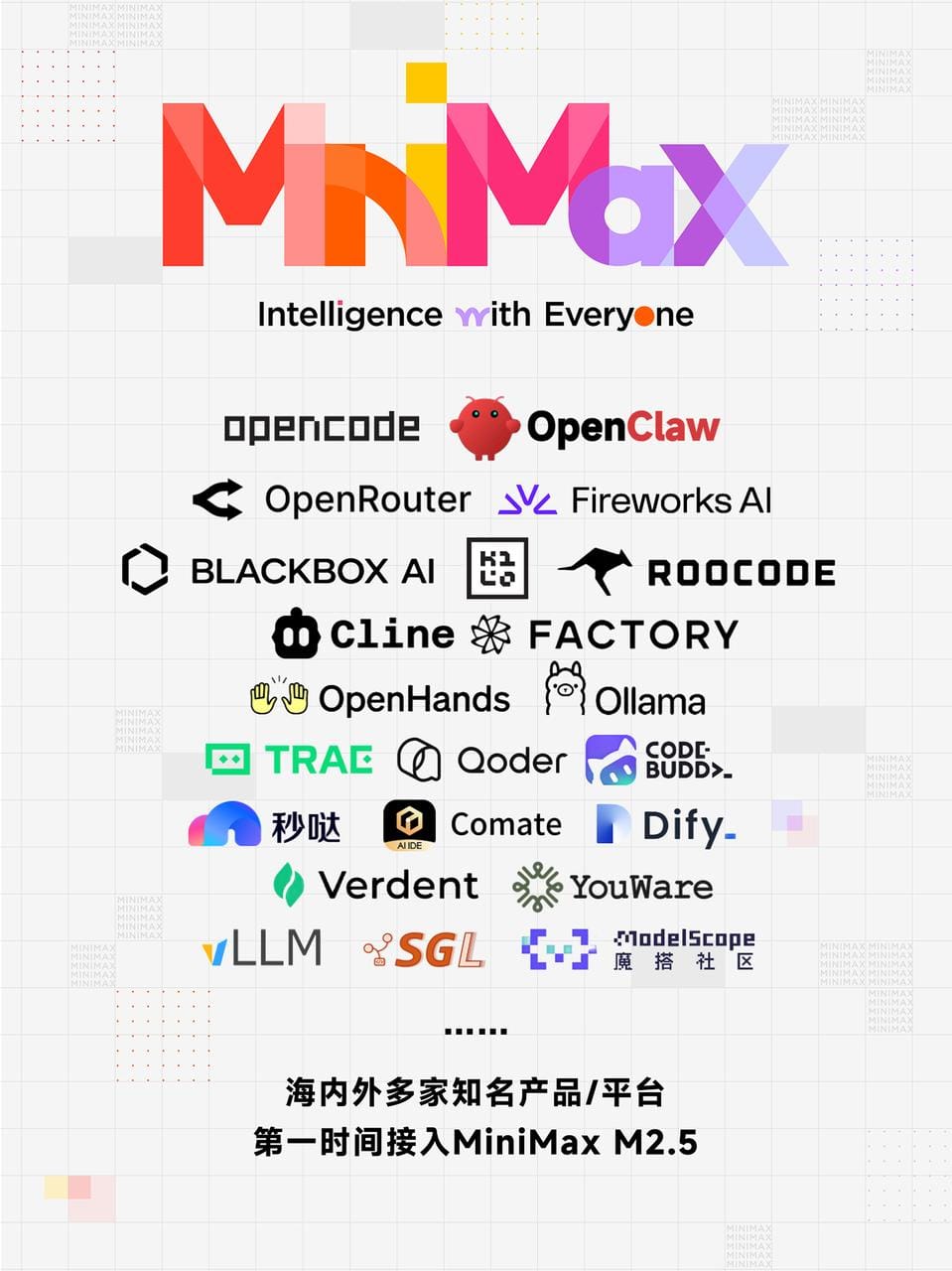
The adoption extended rapidly across critical infrastructure. OpenCode, OpenClaw, Fireworks, Factory, TRAE, Cline, OpenHands, and Roo Code incorporated M2.5 into their platforms. Open-source tooling providers including Ollama, vLLM, SGLang, Dify, and China's ModelScope community followed suit.
OpenClaw, representing the latest generation of agent operating systems, and Kilo's next-generation programming tools both maintain stringent model selection criteria. Their prioritization of M2.5 demonstrates validation in production environments where performance directly impacts product viability.
On SWE-Bench Verified, the programming field's definitive benchmark, M2.5 achieved an 80.2% pass rate matching Claude Opus series performance, while ranking first on the multi-language Multi-SWE-Bench evaluation. Independent testing by technology blogger Simon Willison using mini-swe-agent placed M2.5 third overall behind only Claude Opus 4.5 and Gemini 3 Flash, and first among open-source models.
Execution Efficiency Enables Commercial Viability
Performance improvements translated directly into deployment economics. SemiAnalysis testing demonstrated that M2.5 sustained approximately 2,500 tokens per GPU per second throughput on eight H200 cards within reasonable first-token latency parameters. Even under strict 20 tokens per user per second interactivity requirements, the model maintained stable decoding speeds processing contexts exceeding 10,000 tokens.
Pricing structure proved equally critical for agent framework adoption. M2.5 offers two configurations: a 100 TPS rapid version priced at US$0.30 per million input tokens and US$2.40 per million output tokens, and a 50 TPS version with output costs reduced by half. For long-running, high-frequency tool-calling agent frameworks, these rates fall within commercially sustainable thresholds that previous frontier models could not match.
The convergence of capability, speed, and cost created OpenRouter's first near-exponential adoption curve. The open-source agent community's rapid integration reflected this economic breakthrough—complex multi-agent systems previously confined to demonstration projects gained realistic commercial deployment potential for the first time.
Native Agent Architecture Drives Technical Advancement
The performance gains stem from MiniMax's ground-up redesign of reinforcement learning infrastructure for agent applications, designated Forge. The system fundamentally decouples agent execution logic from underlying training and inference engines.
Traditional RL frameworks treat agents as white-box components requiring deep internal state sharing, creating exponential engineering complexity in dynamic context management or multi-agent coordination scenarios. Conventional token-in-token-out patterns force tight coupling with tokenizer implementations, imposing substantial overhead to maintain training-inference consistency.
Forge introduces middleware abstraction layers circumventing both constraints. A Gateway Server provides standardized communication isolation between high-level agent behavior and model complexity, while a Data Pool asynchronously collects training trajectories, completely separating generation from training processes. This architecture enables MiniMax to integrate hundreds of frameworks and thousands of tool-calling formats without modifying agent code.
Training efficiency improved through Prefix Tree Merging, which reconstructs training samples from linear sequences into tree structures. The approach eliminates redundant context prefixes across multi-turn agent requests, delivering approximately 40x training acceleration while significantly reducing memory requirements.
Asynchronous scheduling employs a Windowed FIFO strategy maximizing system throughput while constraining sample off-policy degree through sliding window controls. This prevents training distribution from skewing excessively toward fast, simple samples, balancing efficiency with stability.
Algorithmically, MiniMax applies its proprietary CISPO algorithm ensuring MoE model stability during large-scale training. For agent scenarios' long-trajectory credit assignment challenges, the system implements composite rewards combining process rewards, task completion time rewards, and Reward-to-Go components. Process rewards provide dense supervision of intermediate agent actions beyond final outcomes. Task completion time rewards use relative completion time as signal, incentivizing models to actively exploit parallel strategies selecting shortest execution paths. Reward-to-Go substantially reduces gradient variance through standardized returns, stabilizing optimization.
Context management mechanisms integrate directly into RL interaction loops, treating them as functional actions driving state transitions. Models learn to anticipate and adapt to context evolution during training, fundamentally resolving attention dilution problems emerging across extended interaction sequences.
Fastest Iteration Cycle Captures Demand Window
Over the past 108 days, MiniMax released M2, M2.1, and M2.5 in succession. On SWE-Bench Verified rankings, the M2 series advanced faster than Claude, GPT, and Gemini series, establishing the industry's most rapid iteration pace.
This cadence aligned precisely with an emerging demand window. OpenClaw progressed from obscurity to global adoption within two months. OpenRouter now hosts thousands of similar tools and applications in an ecosystem beyond the ChatGPT-Claude-Gemini triumvirate, where developers apply a single standard: whether models function reliably at sustainable costs.
First-tier capability at one-tenth the price of mainstream flagship models, plus local deployment support, positioned M2.5 and similar Chinese models at a critical threshold. They made complex multi-agent systems previously confined to demonstrations economically viable for large-scale commercial deployment.
The 3 trillion token weekly call volume represents developer validation through actual usage. The figure captures not only M2.5 model incremental demand but growth across Silicon Valley's next-generation open-source application ecosystem.
Agent demand suppressed by previous technical and economic constraints has begun genuine activation.