
Chinese Automakers Outpace Tesla in Europe as EV Market Shifts
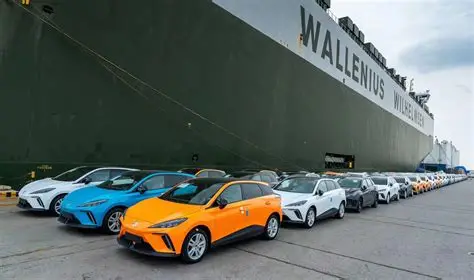
Chinese automakers SAIC Motor and BYD both outsold Tesla in Europe in January 2026, marking a significant milestone in the ongoing realignment of the continent's electric vehicle market — even as overall new car registrations declined and hybrid vehicles emerged as the dominant powertrain technology.
The data underscores a structural shift in European auto demand: consumers are gravitating toward hybrids over pure battery-electric vehicles, while Chinese brands are steadily capturing market share that legacy Western automakers are struggling to defend. For investors, the divergence between surging Chinese nameplates and a retreating Tesla presents a new competitive calculus in one of the world's most important automotive markets.
Europe's total new vehicle registrations fell 3.5% year-on-year in January 2026 to 961,000 units. Within that, battery-electric vehicles (BEVs) accounted for 189,062 units — roughly 19.7% of the total — while hybrid electric vehicles (HEVs) surged to 369,998 units, or 38.5% of all sales, making them the single largest powertrain category on the continent.
Chinese Brands Gain Ground as Tesla Falters
The competitive dynamics among Chinese automakers and Tesla in Europe have shifted materially. In January 2026, SAIC Motor registered 19,300 vehicles in Europe, capturing a 2.0% market share, while BYD sold 18,242 units for a 1.9% share. Tesla, by contrast, managed only 8,100 units — a 17.0% year-on-year decline — leaving it with just 0.8% of the European market.
The gap is even more pronounced when viewed over the full year 2025. BYD's European sales reached 187,700 units, a staggering 268.6% increase year-on-year, while SAIC delivered 305,700 vehicles, up 24.9%. Tesla's 2025 European volume stood at 239,000 units — down 26.9% from the prior year. The combined European footprint of these two Chinese automakers now exceeds 40,000 units per month, a threshold that signals their transition from niche players to credible volume competitors.
The trajectory suggests that BYD's aggressive European expansion, built on a broadening model lineup and competitive pricing, is converting into durable market share gains, while Tesla's brand and demand challenges show few signs of near-term reversal.
Hybrids Dominate; Pure EVs Concentrated in Core Markets
The powertrain breakdown for January 2026 reveals a European market that is electrifying — but on its own terms. HEVs at 369,998 units dwarfed BEVs at 189,062 units, reflecting consumer preference for lower-commitment electrification in a market still constrained by charging infrastructure gaps and price sensitivity.
BEV demand remains heavily concentrated geographically. Germany led with 42,692 units, followed by France at 30,307 and the UK at 29,654. Nordic markets showed characteristically high penetration rates — Denmark registered 10,618 BEVs and Sweden 6,710 — though Norway's January figure of 2,084 units was notably modest.
Plug-in hybrids (PHEVs) contributed 99,654 units, or 10.4% of total sales, with Germany (21,790 units), the UK (18,557), Italy (11,638) and Spain (8,740) as the primary markets. PHEV uptake remains closely tied to corporate fleet incentives and government subsidy structures, making its regional concentration in mature Western European markets a function of policy as much as consumer preference.
The implication for automakers is significant: a product strategy anchored solely in BEVs risks leaving volume on the table in markets where hybrid technology is serving as the dominant bridge to full electrification.
Legacy Automakers Face Uneven Pressure
Among established automaker groups, the January data reveals a fragmented competitive picture. Volkswagen Group retained its position as Europe's largest seller with 256,728 units and a 26.7% market share, but volumes fell 3.8% year-on-year. At the brand level, Volkswagen itself saw a steeper 11.2% decline, while Skoda bucked the trend with 10.1% growth, emerging as an internal bright spot.
Stellantis was a relative outperformer, posting 6.7% growth to 164,436 units, while Renault Group, Hyundai Motor Group and Toyota Group all recorded double-digit declines. In the premium segment, BMW Groupfell 5.7%, while Mercedes-Benz Group eked out a 2.8% gain. Audi and Mercedes-Benz showed divergent performance within the luxury tier, with Porsche retreating modestly.
The breadth of the declines across major groups points to demand softness that extends beyond any single brand's idiosyncratic challenges — a macro headwind that Chinese entrants, still growing from a lower base, are better positioned to absorb.
Strategic Implications for the Road Ahead
The January 2026 data crystallizes several trends that carry lasting strategic weight. First, the European BEV market is not collapsing — it is consolidating around a handful of high-density national markets, which concentrates competitive intensity and raises the stakes for brand positioning in Germany, France and the UK. Second, HEV dominance signals that European consumers are making pragmatic choices, rewarding automakers with credible multi-powertrain portfolios over those betting exclusively on battery-electric transitions.
Third, and perhaps most consequentially for the competitive order, Chinese automakers have crossed a threshold of European market relevance. With combined monthly volumes above 40,000 units and BYD's year-on-year growth rate still triple-digits, the question for investors is no longer whether Chinese brands can compete in Europe — it is how quickly they will scale, and which incumbent brands will absorb the displacement.