
Chinese Automakers Overtake Japan in Europe for First Time as Five Brands Post 64.5% Sales Surge
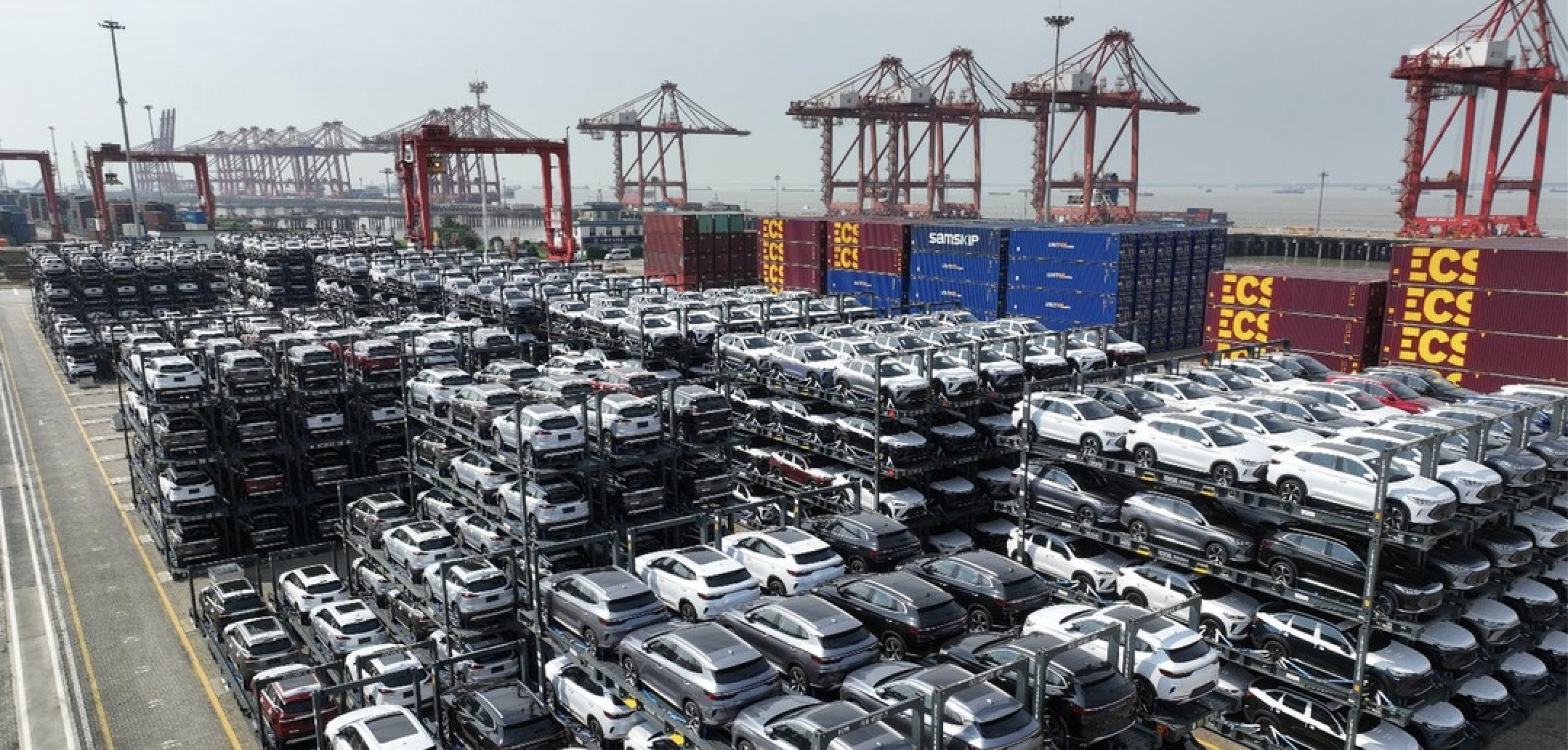
Five Chinese automakers collectively outsold their six Japanese rivals in the European market for the first time on record in May 2026, according to data released by the European Automobile Manufacturers' Association (ACEA), marking a structural inflection point in the continent's automotive competitive order.
The five Chinese brands — BYD, SAIC Motor, Geely, Chery and Leapmotor — registered combined sales of 138,400 units across a 30-plus country European footprint encompassing the EU, the European Free Trade Association and the United Kingdom. That represents a 64.5% year-on-year increase and a market share gain from 7.5% to 12.0% in a single year. Against them, Toyota, Nissan, Suzuki, Mazda, Honda and Mitsubishi collectively sold 130,400 units, a 3% decline that compressed their aggregate share from 12.2% to 11.3%. The net gap of roughly 8,000 units may appear narrow in absolute terms, but the velocity of share transfer — 4.5 percentage points gained by Chinese brands in twelve months — signals a durable trend rather than a one-month anomaly.
Markets reacted cautiously to the ACEA data, with analysts noting that the milestone arrives as Chinese automakers simultaneously accelerate local manufacturing commitments across Spain, France and the United Kingdom, reducing their vulnerability to EU tariff escalation and strengthening their eligibility for "Made in Europe" designations.
Leapmotor and Chery Driving Explosive Volume Gains
Brand-level data reveal a bifurcated growth profile within the Chinese cohort. Leapmotor posted the sharpest acceleration, with May sales surging 465.1% year-on-year — a figure directly attributable to its capacity-sharing arrangement with Stellantis at plants in Madrid and Zaragoza, Spain, announced in May 2026. Chery followed with 244.1% growth, while BYD — the largest Chinese brand by absolute European volume — expanded 136.6%.
SAIC and Geely, the two incumbents with longer European histories, delivered more measured but still positive growth in excess of 10%, reflecting a maturing distribution base rather than early-stage launch effects.
The Japanese camp, by contrast, exhibited pronounced internal fragmentation. Toyota Group, the largest Japanese player with 78,200 units and a 6.8% share, saw sales slip 0.6%. Honda and Mazda posted modest gains of 8.3% and 6.2% respectively, but Nissan and Suzuki contracted, and Mitsubishi suffered a 44.7% collapse — underscoring that the Japanese brand portfolio's European exposure is increasingly concentrated in a shrinking set of competitive nameplates.
European Legacy OEMs Holding Ground but Losing Momentum
Europe's five domestic conglomerates — Volkswagen Group, Stellantis, Renault Group, BMW Group and Mercedes-Benz Group — retained their dominant position with combined May sales exceeding 710,000 units and a collective share above 60%. However, the growth picture is uneven. BMW Group advanced 4.1% and Mercedes-Benz edged up 0.6%, while Volkswagen, Stellantis and Renault all recorded volume declines, with multiple sub-brands facing sustained contraction pressure.
The divergence between premium German brands and volume-oriented European OEMs mirrors a broader electrification-driven bifurcation: brands that have successfully repositioned around battery electric vehicles are outperforming those still managing combustion-heavy portfolios through a prolonged transition.
Chinese OEMs Embedding Into European Manufacturing Infrastructure
The sales data alone understates the strategic depth of China's European push. Over the 60 days preceding the ACEA release, at least five discrete manufacturing or distribution agreements were executed or activated.
On June 23, Leapmotor International — the joint venture between Leapmotor and Stellantis — inaugurated a battery module assembly facility in Malén, Spain, with an initial annual capacity of 65,000 battery module sets, expandable to 100,000 units. On June 22, Chery activated a new production line at the Ebro factory in Barcelona's Free Trade Zone, operated jointly with Spanish partner Ebro-EV Motors, further lifting localized output.
The most strategically significant development came on June 3, when multiple international media outlets reported that Chery had signed a non-binding memorandum of understanding with Nissan Motor under which Nissan's Sunderland plant in the United Kingdom would manufacture Chery-branded vehicles on its Line 1 from April 2027 onward. Nissan's own Qashqai, Juke and Leaf models would be consolidated onto Line 2, freeing capacity for Chery's localized production needs. The arrangement is a direct illustration of how Chinese brands are converting Japanese OEMs' underutilized European footprint into their own supply chain assets.
On June 2, the regional government of Galicia, Spain, confirmed that SAIC Motor plans to construct its first EU-based electric vehicle manufacturing facility at the Port of Ferrol. Initial investment is approximately €200 million (roughly RMB 1.568 billion / US$217.8 million), with construction scheduled to begin in 2027 and operations commencing in 2028 at a target annual capacity of 120,000 vehicles.
Earlier, on May 20, Dongfeng Motor Group and Stellantis announced a proposed European joint venture — Stellantis holding 51%, Dongfeng 49% — tasked with sales and distribution of Dongfeng's Voyah premium EV brand across designated European markets. The two parties also indicated intent to explore localized production of Dongfeng NEV models at Stellantis's Rennes plant in France.
Electrification Emerges as the Decisive Competitive Variable
The aggregate picture that emerges from May's data and the surrounding deal flow is one in which electrification pace has become the primary determinant of European market trajectory. Chinese brands built their competitive position domestically on a high-volume, rapidly iterating EV product cycle; that same cycle is now being exported into a European market where regulatory pressure — including the EU's 2035 internal combustion engine phase-out — is pulling consumer demand and fleet procurement toward battery electric vehicles.
Japanese automakers, whose European portfolios remain more heavily weighted toward hybrid and combustion platforms, are structurally disadvantaged in this transition relative to both Chinese entrants and the premium German brands that have invested heavily in BEV lineups.
The 138,400-unit monthly sales figure should be read not as a ceiling but as a base. With SAIC's Ferrol factory not operational until 2028, Chery's Sunderland arrangement not commencing until April 2027, and Leapmotor's Spanish battery capacity still ramping, the localized production infrastructure that will underpin the next phase of Chinese volume growth in Europe is not yet fully online. The competitive displacement of Japanese brands from Europe's second-tier position may prove to be a durable feature of the post-2026 automotive landscape rather than a single month's data point.
Related Coverage:
China’s Auto Market Enters Brutal Consolidation as H1 Sales Fall 4%, Margins Hit Decade Low