
Chinese EV Brands Capture 23% of UK Monthly Sales, But After-Sales Networks Lag Behind the Surge
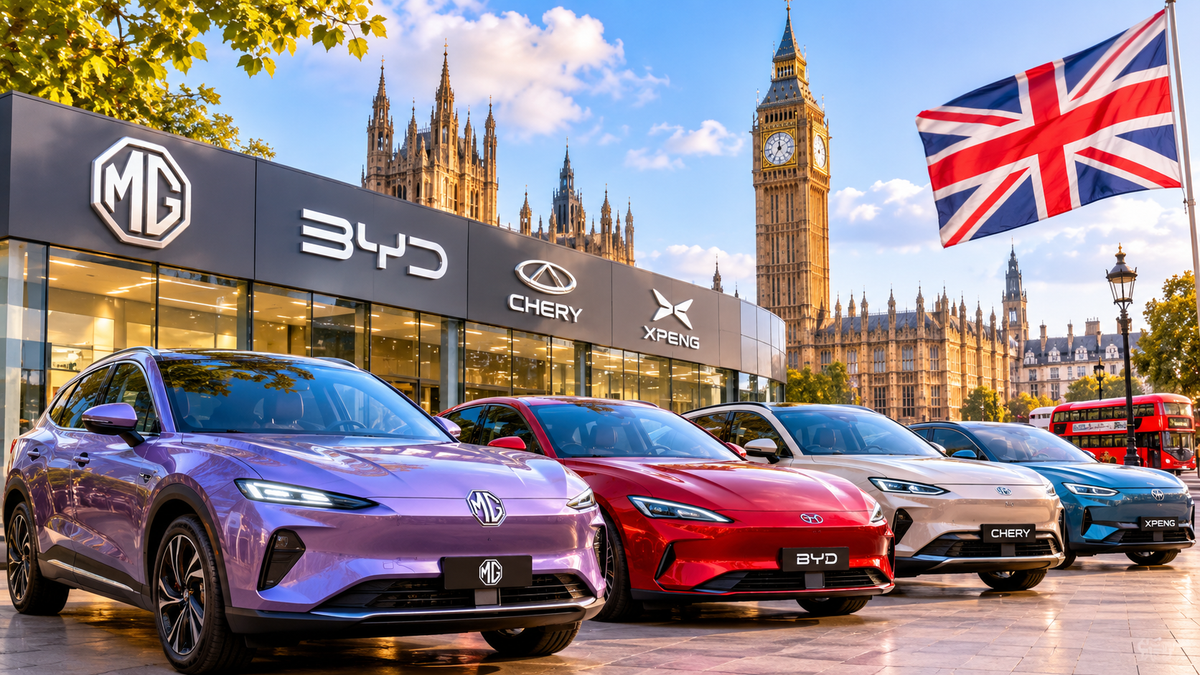
Five divergent service strategies now determine long-term market viability as Chinese automakers collectively register 304,800 vehicles in Britain through September 2026
Chinese automotive brands have seized nearly a quarter of the UK's monthly new-car market, yet the infrastructure required to repair those vehicles is being built on five fundamentally different blueprints — a structural gap that insurers, fleet operators and retail consumers are beginning to price into their decisions.
Data from the Society of Motor Manufacturers and Traders (SMMT) show eight Chinese brands combined for approximately 304,800 new registrations in the UK between January and September 2026, capturing 17.5% of total market volume. In September alone — a seasonally elevated month driven by the biannual plate change — that cohort registered roughly 81,800 units, lifting the monthly share to above 23%. The figures represent a step-change acceleration with no comparable precedent in a major European market that has not imposed supplementary tariffs on Chinese-manufactured electric vehicles.
The absence of the EU-style countervailing duties that Brussels imposed in late 2024 has made the UK a de facto proving ground for Chinese brands' ability to scale distribution, service infrastructure and insurance compatibility simultaneously. What the registration surge does not capture is the uneven maturity of the after-sales ecosystems now responsible for keeping those vehicles roadworthy.
Ranking Reveals Three Tiers That Are Pulling Apart
The brand hierarchy through September 2026 is unambiguous. Chery Automobile and its four UK-active nameplates — JAECOO, OMODA, Chery and LEPAS — lead all Chinese brands with a combined 124,372 registrations. MG, operated under SAIC Motor, recorded 78,930 units to rank second. BYD posted 68,405 as the highest-volume single-brand entrant.
A distinct second tier comprises Zhejiang Geely Holding Group at 14,400 units and Leapmotor International at 13,283, both scaling rapidly from low bases. A third tier — Changan Automobile, Xpeng Motors, Aion, Great Wall Motor, Skywell and DENZA — accounts for a combined 4,185 units.
September's single-month data sharpens the competitive picture. BYD registered 20,140 vehicles, MG 18,026 and JAECOO 15,057, with the JAECOO 7 crossover logging 10,814 units to top the UK's monthly best-seller chart across all marques. The velocity of delivery compression in a single calendar month creates acute pressure on parts-forecasting models that most brands built for steadier throughput.
MG Deploys Integrated Logistics to Defend Market-Share Lead
MG's after-sales architecture is the most consolidated among Chinese brands in the UK. In November 2025, the brand activated a roughly 15,000-square-metre parts distribution centre in Daventry operated through a partnership with XPO Logistics, processing approximately 2,500 orders daily. The facility's headline metric — a first-time parts fill rate exceeding 96% — provides a quantifiable benchmark against which competitors' commitments can be assessed.
Technician development is handled through the Cecil Kimber Academy at Longbridge, where a GBP 500,000 investment expanded workshop floor space to 1,000 square metres and increased practical bays from four to nine. Throughput exceeded 2,000 training sessions in 2025. A three-tier technical escalation protocol — with on-site specialist deployment as the final escalation — addresses the high-voltage disassembly and ADAS calibration competencies that dealership staff rarely possess at point of hire.
Customer mobility during repairs is managed via MG Assistance, a programme co-developed with the AA and Switch Car Rental that had provided replacement vehicles to more than 3,000 customers by autumn 2026 under qualifying policy conditions.
Chery's Rapid Expansion Tests a Shared-Infrastructure Model
Chery's UK retail footprint expanded from 81 to 146 dealer points across JAECOO and OMODA in the past twelve months, with a further 90-plus retailers for the core Chery brand and more than 30 for LEPAS. The pace of retail expansion is the fastest among Chinese brands but the after-sales build has followed a partnership model rather than proprietary investment.
In September 2026, Chery deepened its cooperation with RAC, establishing a dedicated Vehicle Off Road (VOR) case management team tasked with coordinating recovery, repair sequencing, parts logistics and owner communication. Approximately 400 RAC mobile technicians have been granted authorisation to execute designated warranty and recall procedures at customers' homes or business premises — a mobile-first model that reduces dependency on fixed workshop capacity.
October brought the activation of eight regional Super Parts Hubs designed to position high-velocity components proximate to repair demand rather than consolidating inventory at a single national facility. For fleet customers, Chery has articulated a 48-hour parts availability commitment routed through DHL — a service-level target measured differently from MG's fill-rate metric and therefore not directly comparable.
The structural test for Chery's distributed model arrives when bodywork repairs, airbag replacements or radar damage require coordinated access to specialist facilities. VOR days in those scenarios will determine whether RAC's coordination function can replicate the throughput consistency of a captive network.
BYD Separates Retail and Accident Repair Into Parallel Structures
BYD's approach to after-sales reflects the structural distinction between routine maintenance and accident repair that most automotive incumbents took decades to institutionalise. After crossing 100,000 cumulative UK deliveries in late July 2026 and expanding its retail and service network to 143 authorised points, BYD moved in September to establish a parallel network of 138 Approved Repairers in partnership with Vizion, a specialist accident repair network manager.
The separation acknowledges commercial reality: franchised dealerships optimised for new-car sales and scheduled servicing rarely have the bodyshop capacity, insurer relationships or ADAS calibration equipment to handle at-fault accident claims efficiently. By contracting with existing bodyshop operators through Vizion, BYD is accessing established insurer approved repairer agreements without the capital cost of building proprietary collision centres.
BYD's concurrent engagement with Thatcham Research on repair-method documentation, parts-pricing transparency and insurance group classification signals awareness that the cost and time-efficiency of accident repair directly influences how insurers price premiums on its vehicles. A model that is cheap to buy but expensive or slow to repair will face underwriting friction that erodes its total-cost-of-ownership advantage.
Geely and Leapmotor Chart Opposite Courses to the Same Destination
Geely's UK operating entity, formally established in October 2025, had signed 100 retail partners by October 2026, with 80 open for business. Founding dealer groups include Sytner, Stoneacre and Hendy — mid-to-large networks with existing workshop infrastructure. Critically, Geely has consolidated financial services, fleet, after-sales and customer experience functions inside its UK headquarters rather than outsourcing those disciplines to a distributor.
Leapmotor International, in which Stellantis N.V. holds a 51% stake against Leapmotor's 49%, operates on an inverted premise: speed of market access via Stellantis's Distrigo parts distribution network and established dealer workshop capacity. The UK portal lists approximately 83 service locations. The asset-light entry lowers capital requirements but introduces dependency on whether existing Stellantis-franchised technicians have been trained to sufficient depth on Leapmotor-specific diagnostics, battery high-voltage protocols and software architectures.
Xpeng and Changan Prioritise Infrastructure Over Volume — For Now
Xpeng's September 2026 transition from a distributor-led import model under International Motors to a directly operated National Sales Company marks a governance shift rather than an operational one. International Motors retains its import preparation facility at Sheerness and a parts logistics hub of approximately 24,000 square metres (roughly 258,000 square feet) at West Bromwich. Brand strategy is now controlled centrally; physical operations remain contracted.
Changan, with 2,750 registrations year-to-date, disclosed in May that more than 60 sales and service points had been signed — a commitment figure rather than an operational one. Technician training runs through a Technical Excellence Centre in Birmingham; parts logistics are handled by Kuehne+Nagel from a facility near East Midlands Airport. A Thatcham Research collaboration covering repair methodologies, parts pricing and insurance group placement mirrors BYD's approach.
For both brands, the strategic risk is that low parc volume limits the statistical base from which insurers can derive loss ratios, potentially resulting in conservative — meaning expensive — premium quotes that suppress demand independently of the underlying product quality.
Insurance Economics Will Ultimately Arbitrate Network Quality
The five service models operating in the UK market in 2026 — MG's integrated proprietary build, Chery's distributed partnership stack, BYD's bifurcated retail-and-repair structure, Leapmotor's Stellantis-leveraged entry and Xpeng's direct-but-contracted model — each carry distinct unit economics and risk profiles.
Self-built infrastructure commands higher capital but yields tighter control over repair cycle times and quality consistency. Partnership models compress deployment timelines but require precise contractual delineation of responsibilities among manufacturer, logistics provider, accident repairer and roadside assistance operator. When those boundaries blur — as they typically do in complex collision claims involving high-voltage components — VOR days extend and insurer dissatisfaction compounds.
Thatcham Research's vehicle risk assessment methodology incorporates repairability data, component pricing and structural damage severity into the insurance group classification that underpins retail premium quotes. The analytical framework does not apply a brand-of-origin discount or penalty; it evaluates whether a specific model, with its specific parts ecosystem, can be repaired efficiently to a defined safety standard.
Five metrics will distinguish credible network maturity from marketing claims as the UK Chinese-EV parc continues to scale: first-time fill rates for accident-frequency parts disaggregated by component category; average and 90th-percentile VOR days; authorised accident repairer count with disclosed high-voltage, bodyshop and calibration qualifications; average courtesy-vehicle provision days with transparent cost attribution; and insurance carrier coverage breadth correlated with model-specific repair cost data shared with Thatcham and underwriters.
Brands that publish those metrics in verifiable form will have a material competitive advantage in fleet procurement and consumer retention cycles that are now entering their first renewal phase.
Related Coverage: