
Chinese EV Startups Set Aggressive 2026 Sales Targets as Legacy Rivals Opt for Steady Growth
Chinese automakers have outlined diverging strategies for 2026, with emerging electric vehicle manufacturers pursuing rapid expansion through aggressive sales targets, while established legacy players are adopting more conservative growth projections to consolidate their market positions.
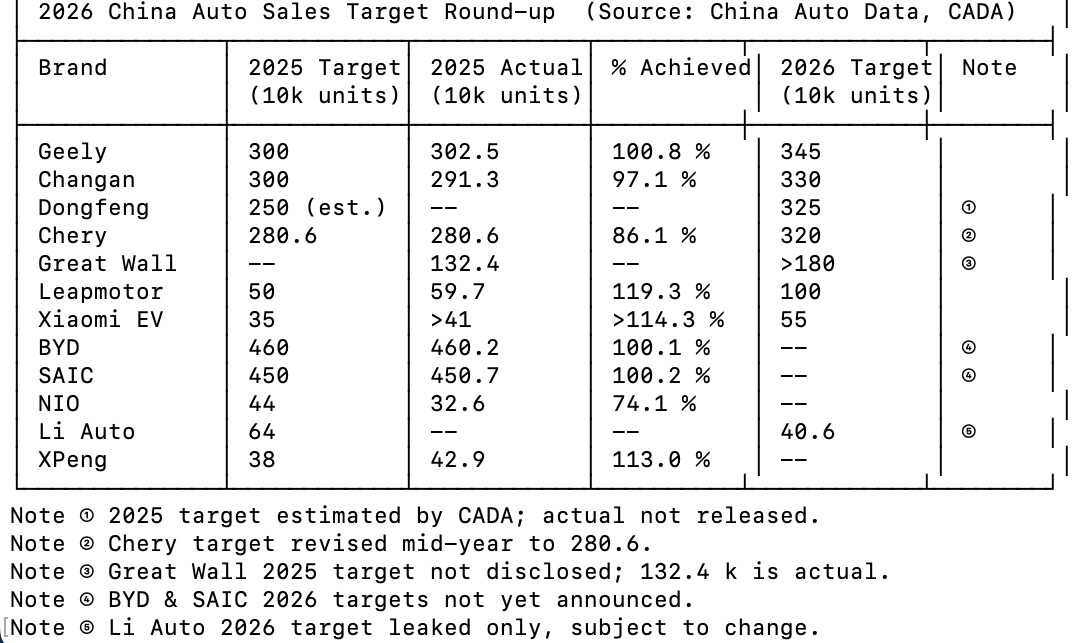
Leading the aggressive push, Leapmotor has set a milestone target of 1 million units for 2026, representing a significant 67.5% increase from its actual sales volume in 2025. Similarly, Xiaomi EV, the automotive arm of the technology giant, has raised its delivery goal to 550,000 units, aiming for a growth rate of approximately 34.1% compared to the more than 410,000 vehicles it delivered last year.
In contrast, traditional heavyweights including Geely Automobile and Changan Automobile have set targets implying growth rates in the low double digits. This disparity highlights a strategic split within the world's largest auto market: new entrants are prioritizing rapid market share acquisition, while incumbents are focusing on steady operational scale amidst intense competition.
Data compiled by China Automotive Digital Research reveals that while most traditional manufacturers are aiming for stability, state-backed Dongfeng Motor Corporation remains an outlier among legacy peers, projecting a robust volume increase of approximately 30% for the year.
EV Newcomers Drive Aggressive Growth
The sales targets released on Jan. 7 indicate that "new force" automakers are betting on continued high demand to scale their operations. Leapmotor’s objective to reach 1 million units marks a substantial leap from its 2025 target of 500,000 units and its actual performance of 597,000 units.
Xiaomi EV continues to ramp up expectations following a year where it exceeded its initial goals. After surpassing its 2025 target of 350,000 units by delivering over 410,000 vehicles, the company is now positioning itself to sell 550,000 cars in 2026. These targets suggest that the technology sector’s entrants into the automotive space remain confident in their ability to disrupt the market and attract consumers despite a crowded field.
Incumbents Favor Measured Expansion
Established automakers have largely eschewed radical volume spikes in favor of sustainable growth. Geely Automobile has set a 2026 sales target of 3.45 million vehicles. This represents a 14.1% increase over its 2025 actual sales of 3.025 million units, a year in which it successfully met its 3 million unit goal.
Similarly, Changan Automobile is targeting 3.3 million units for 2026, a 13.3% rise from the 2.913 million vehicles sold in 2025. Changan slightly missed its 2025 target of 3 million units, which may have influenced a more prudent outlook for the current year.
Chery Automobile has set its 2026 target at 3.2 million units. Notably, this figure is slightly lower than its previous 2025 target of 3.26 million, though it remains higher than the 2.806 million vehicles actually delivered last year.
Mixed Outlooks for State-Backed and Established Players
While many traditional firms are projecting conservative growth, Dongfeng Motor Corporation has outlined a more ambitious trajectory. The company aims to sell 3.25 million vehicles in 2026, an estimated 30% increase from its 2025 volume of approximately 2.5 million units.
Great Wall Motor has also set its sights on expansion, targeting sales of over 1.8 million vehicles. This goal stands well above its 2025 performance, where the company recorded sales of 1.324 million units.