
Chinese Flying Car Maker Huitian Secures Record Middle East Order After Dubai Demo
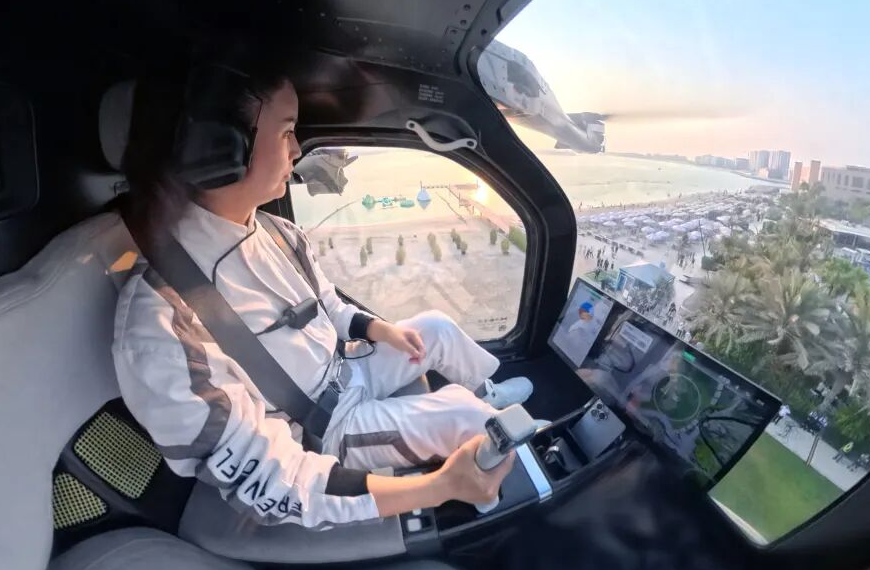
Chinese flying car developer Huitian has secured a landmark order for 600 of its vehicles from Middle Eastern buyers following a successful public demonstration in Dubai, signaling a significant step toward the commercialization of personal aerial mobility.
The record-breaking orders followed the first overseas public manned flight of the company’s “Land Carrier” modular aircraft on October 12. The demonstration, conducted under the observation of the UAE General Civil Aviation Authority and the Dubai Civil Aviation Authority, involved a test pilot taking off, maneuvering over the sea, and landing smoothly.
Crucially, Huitian obtained a flight permit for the demonstration after a review by local regulators, marking a key step in gaining technical and regulatory validation for overseas market entry. The agreements were signed with prominent regional firms including the UAE's Ali&Sons Group, Qatar's Almana Group, and Kuwait's AlSayer Group.
The move, coupled with the launch of a new international brand, underscores an aggressive global expansion strategy starting in a region viewed as highly receptive to future mobility technologies. It provides a major boost to the burgeoning low-altitude economy, suggesting that personal aerial vehicles are moving from science fiction to commercial reality.
A Dual-Product Strategy
Huitian’s market approach is built on a two-pronged product strategy designed to capture different segments of the emerging electric vertical take-off and landing (eVTOL) market. The “Land Carrier” demonstrated in Dubai is aimed at the personal flight market, targeting short-range applications such as tourism and recreation. This aligns with a forecast by Boston Consulting Group (BCG) in a September 2025 white paper, which identified personal flight as a key early-stage segment.
To address the urban and inter-city mobility market, the company revealed it is developing a second model, the A868. This high-speed, long-range flying car is designed with a range of over 500 kilometers and a top speed exceeding 360 km/h, positioning it as a potential "air taxi" for commuter routes. Together, the two products form a strategy to build a diversified presence in both personal recreation and public transport.
Targeting a Receptive Market
The decision to launch its global strategy in the Middle East is a calculated one. According to the BCG report, the Middle East's manned eVTOL market is projected to reach US$11.7 billion by 2040, with personal flying eVTOLs expected to account for nearly 85% of that total, creating a direct fit for the "Land Carrier" model. Huitian Vice President Du Chao noted the region’s forward-thinking policies, strong industrial support, and high user acceptance of future transportation.
To cement its international push, Huitian also launched a new global brand, “ARIDGE,” a portmanteau of “Air” and “Bridge.” The company stated the name symbolizes its goal of connecting ground and air travel. This rebranding effort, combined with a substantial commercial breakthrough, marks an acceleration of its globalization plans.
Manufacturing Power to Back Ambitions Huitian's ability to accept a 600-unit order is underpinned by significant manufacturing investment. The company showcased its flying car smart manufacturing base in Guangzhou, China, which was completed at the end of September 2025. Described as the world's first facility for mass-producing flying cars on a modern assembly line, it is designed for an annual capacity of 10,000 units and is slated to begin deliveries in 2026. At full capacity, the factory is expected to produce one aircraft every 30 minutes.
This industrial capability represents a critical leap from prototype to mass-produced commercial product. It provides the necessary foundation for the company to scale up and fulfill large international orders, transforming it from a technology developer into an industrial manufacturer.
Hurdles on the Path to Mass Adoption
Despite the successful demonstration and record orders, significant challenges remain for Huitian and the broader industry. The complexity of the supply chain, which merges aviation-grade precision with automotive-grade efficiency and cost, presents a formidable hurdle. Establishing a stable, reliable, and cost-effective supply chain will be critical for achieving scalable and profitable mass production.
Furthermore, broad public and regulatory acceptance remains a long-term challenge. Convincing the public of the safety of flying vehicles and navigating complex global airspace regulations are necessary steps for mass adoption. Finally, bringing the cost down to a level accessible to a wider market, beyond wealthy early adopters, will be essential for realizing the vision of a widespread low-altitude economy. While the Dubai flight is a pivotal opening act, the long-term success will be determined by winning a more arduous battle over supply chains, cost control, and market education.