
Chinese GPU Sector Surges as Domestic Chipmakers Enter New Era
China's homegrown GPU industry is experiencing a dramatic transformation, with a wave of initial public offerings delivering extraordinary returns to investors and signaling a breakthrough moment for domestic semiconductor players long constrained by technological gaps and U.S. export restrictions.
The momentum reflects both technical progress and market opportunity created by the artificial intelligence boom, particularly large language models that have fundamentally altered the competitive landscape. At least four major Chinese GPU companies have gone public or are pursuing listings since late 2025, with debut-day gains reaching as high as 693%, creating what market watchers are calling the hottest investment theme on China's A-share market.
The surge comes as U.S. chipmaker Nvidia Corp. recently announced plans to ease restrictions on GPU exports to China, a move analysts interpret as concern over the rapid advancement of Chinese competitors. The Chinese GPU sector, which nearly collapsed during a funding crisis in 2022, has regained investor confidence amid growing demand for AI computing power and Beijing's push for semiconductor self-sufficiency.
Industry executives and analysts say the sector still lags far behind Nvidia's cutting-edge technology, but the rise of generative AI has created an opportunity for Chinese players to compete on more equal footing as the underlying software ecosystem undergoes fundamental change.
Market Frenzy Around Chinese GPU Stocks
The public debut of Moore Threads on the Shanghai Stock Exchange's STAR Market on December 5, 2025, kicked off the rally. The stock soared 469% on its first trading day, pushing the company's market capitalization above RMB 305.5 billion ($42.1 billion). The listing set a record for the fastest IPO approval of the year at just 122 days, and delivered the highest subscription gains since China adopted comprehensive registration-based reforms for stock listings.
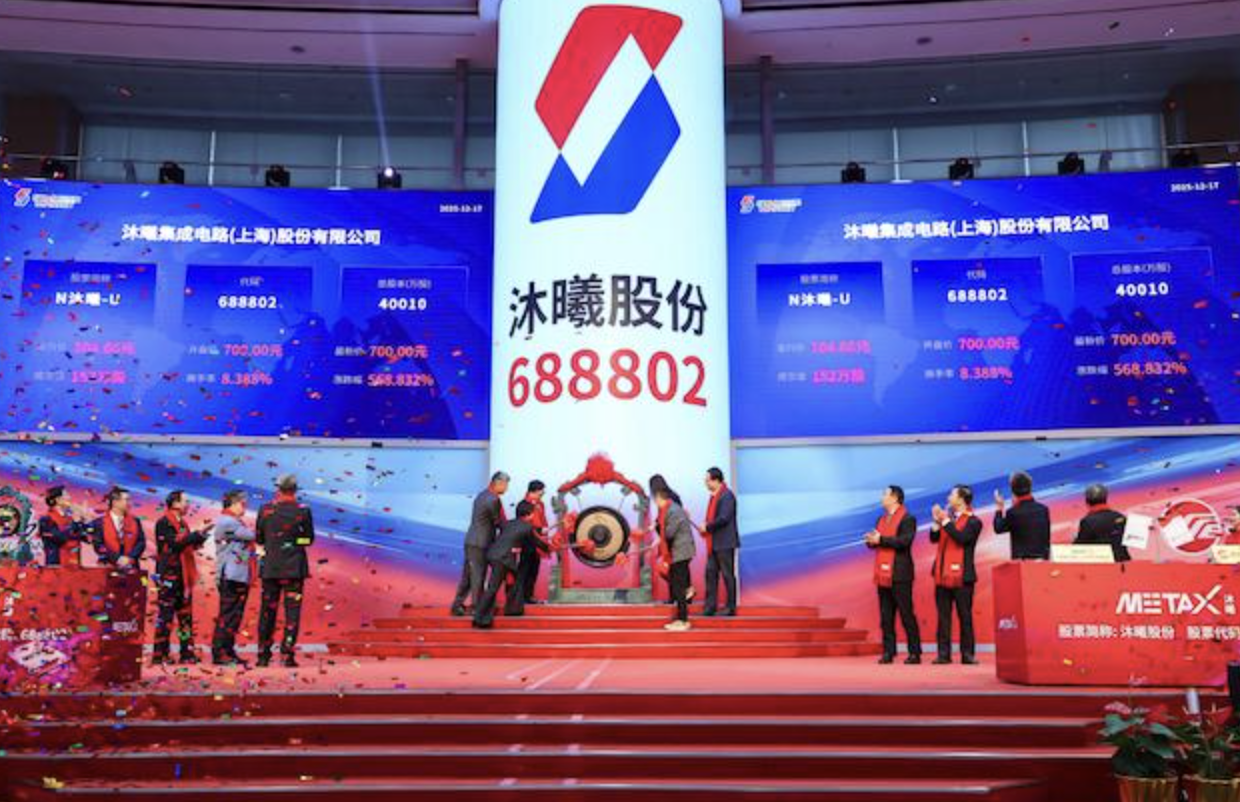
Twelve days later, Metax eclipsed that performance with a 693% first-day surge on December 17, bringing its market value to over RMB 330 billion ($45.4 billion). Retail investors who secured allocations at the RMB 104.66 offering price earned nearly RMB 300,000 ($41,300) per lot, making it one of the most profitable new listings in recent memory.
The other two members of China's "GPU Four Dragons"—Enflame and Biren Technology—are also moving toward public markets. Biren officially listed on the Hong Kong Stock Exchange on January 2, 2025, with shares jumping as much as 120% on the debut day, making it the first Hong Kong-listed GPU concept stock.
From Near-Collapse to Revival
The celebration marks a stunning reversal from just three years ago, when many of these companies faced potential collapse. In 2022, China's AI chip sector entered what industry insiders describe as a "darkest hour" as venture capital funding dried up and Covid-19 lockdowns paralyzed operations, particularly in Shanghai where many GPU startups are headquartered.
Cambricon Technologies, often considered a bellwether for China's AI chip sector, saw its market value plunge nearly 80% from its peak to RMB 27 billion as major shareholders dumped their stakes ahead of the Mid-Autumn Festival in 2022. Metax reported losses of RMB 770 million ($106 million) that year against revenue of just RMB 427,000. Biren failed to announce any funding rounds throughout 2022, forcing the company to operate on limited resources.
The sector's fortunes began turning in late 2022 with the launch of ChatGPT, which triggered a global race to develop large language models and created insatiable demand for computing power. GPU makers worldwide saw their valuations soar as the chips became strategic resources rather than mere hardware components.
Chinese GPU companies seized the moment despite resource constraints. While Nvidia and Intel Corp. can invest tens of billions of dollars in a single chip generation, Chinese startups worked with far smaller budgets. Still, they accelerated development between 2023 and 2025, rushing to upgrade products and capture market share.
Technical Progress and Market Positioning
Moore Threads has completed multiple full-function GPU iterations in just four years. At its recent MUSA Developer Conference, the company unveiled the "Huagang" GPU architecture with 10 times the computing efficiency of previous generations, along with a 10,000-card computing cluster called "Kua'e" capable of supporting trillion-parameter model training.
Biren's BR100 chip achieved half-precision floating-point performance exceeding 1,000 teraflops, with shipments to supercomputing centers growing more than 300% year-on-year. Metax's next-generation C700 GPU targets performance comparable to Nvidia's H100 chip, with tape-out scheduled for the second half of 2025.
U.S. export restrictions, while creating short-term financing pressure, have also accelerated domestic adoption. Chinese technology companies increasingly prioritize supply chain security by deploying locally developed GPU computing power, creating a growing customer base for homegrown alternatives.
Window of Opportunity in AI Transition
The shift to transformer-based large language models represents a potential inflection point for Chinese GPU makers. Unlike previous deep learning neural networks, transformer architectures require different optimization approaches. This technological transition has partially reset competitive dynamics in GPU software ecosystems, where Nvidia has long maintained an insurmountable advantage built over decades by millions of developers.
The software layer—consisting of code that instructs hardware to respond to user commands—has traditionally created higher barriers than hardware itself. Nvidia's CUDA platform, refined over 30 years, represents an ecosystem that Chinese competitors struggled to challenge. But the emergence of large language models demands new software approaches, theoretically placing newer entrants on more comparable footing with established players.
Industry observers note this represents a rare "lane-changing" opportunity in semiconductor competition. Chinese GPU companies, some founded less than five years ago, find themselves at a similar starting line to Nvidia for this new technological paradigm—a situation that hasn't existed in the sector for decades.
Persistent Challenges and U.S. Response
Despite recent progress, Chinese GPU technology remains significantly behind U.S. leaders. Domestic products generally benchmark against Nvidia's H100, already a previous-generation product, while the newer H200 nearly doubles performance. In late 2023, the U.S. added Moore Threads and Metax to the Entity List, blocking access to any production tools containing American technology.
The sector also experienced continued casualties. According to Qichacha data, 10,900 Chinese chip-related companies underwent cancellation or revocation in 2023—an average of 30 per day. Media reports described one Chongqing GPU unicorn nearing dissolution with over 400 employees terminated, a Xi'an semiconductor firm conducting layoffs, and a Shanghai GPU startup facing broken funding chains and operational difficulties.
The U.S. recently announced relaxed GPU export controls, with Reuters reporting Nvidia plans to deliver H200 GPUs to Chinese customers before the 2026 Lunar New Year. Industry analysts interpret this as a strategic move to recapture market share before Chinese alternatives become more deeply entrenched, rather than a genuine policy liberalization.
The Chinese GPU sector's journey from near-extinction to stock market sensation illustrates the interplay of external pressure, technological opportunity, and industrial policy in China's semiconductor development strategy.