
China's Zhipu AI Breaks Issue Price in Hong Kong Trading Debut
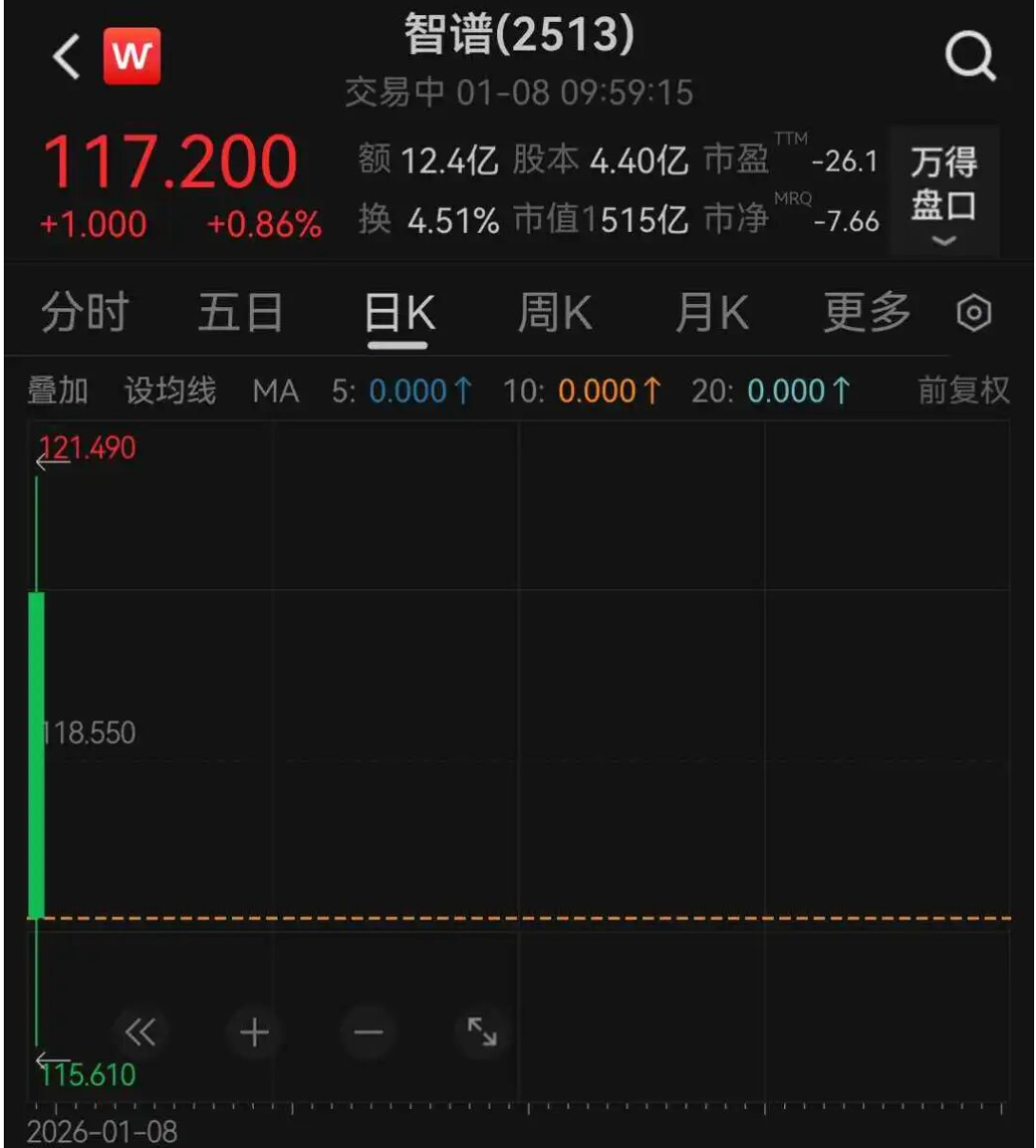
Zhipu AI, billing itself as the "world's first listed large language model company," experienced a rocky market debut on the Hong Kong Stock Exchange's main board, briefly falling below its IPO price of HK$116.20 within the first hour of trading.
The stock opened at HK$120 per share and climbed to an intraday high of HK$121, but momentum quickly reversed. By 9:50 a.m. local time, shares had dropped to HK$116.10, marking a break below the issue price before staging a partial recovery.
The listing carries significant weight for AI capital markets. Zhipu raised approximately HK$4.35 billion (US$558 million) through the sale of 37.42 million H-shares, giving the company a post-listing market capitalization exceeding HK$51.1 billion. The public offering portion was reportedly oversubscribed by approximately 1,164 times, signaling strong retail demand despite the subsequent price volatility.
Zhipu's shareholder registry reads as a who's who of Chinese technology and venture capital, including Meituan, Ant Group, Alibaba, Tencent, and Xiaomi, alongside top-tier investment firms such as Sequoia China, Hillhouse Capital, Qiming Venture Partners, and Shunwei Capital, as well as local state-backed investors.
Early Mover in Foundation Models
Zhipu's path to public markets differs markedly from other Chinese AI unicorns that emerged after ChatGPT's 2022 debut. Founded in 2019, the company began investing in large language model training years before the technology became an industry consensus. According to Mi Lei, founding partner of early investor Zhongke Chuangxing, the firm committed 40 million yuan in angel funding at Zhipu's inception, providing crucial capital for initial GPU purchases and model training.
This early positioning has given Zhipu a six-year development runway, culminating in today's listing as what the company describes as the world's first publicly traded foundation model specialist.
Testing Market Appetite
The listing arrives at a pivotal moment for AI valuations in Hong Kong. The market has already experienced mixed results with AI-related offerings. Mobvoi Inc. listed in April 2024 as the "first AIGC stock" but broke its issue price immediately, casting a shadow over subsequent AI flotations.
More recently, GPU manufacturers including Moore Threads, MetaX Integrated Circuits, and Biren Technology completed listings on A-share and Hong Kong exchanges between late 2025 and early 2026. Their collective market debuts effectively priced AI infrastructure, creating a foundation layer that the market has begun to accept. Zhipu's listing now poses a more fundamental question: whether capital markets are prepared to assign standalone value to large language models themselves, rather than just the computational hardware beneath them.
The timing is no coincidence. MiniMax, another Chinese foundation model developer, is scheduled to list on January 9, just one day after Zhipu. This clustering suggests the AI model sector is collectively testing public market receptivity rather than allowing individual company performance to define sector sentiment.
Revenue Structure Under Scrutiny
Zhipu's commercial model sits uncomfortably between two precedents that have already faced market judgment. SenseTime Group, which listed in Hong Kong in 2021, pursued a project-heavy approach serving enterprise and government clients with customized AI solutions. While this generated revenue, investors questioned scalability and dependence on a limited customer base. Mobvoi attempted the opposite path, emphasizing software and hardware products rather than bespoke engineering, but broke its issue price as markets struggled to assign value to its consumer-facing AI applications.
According to Zhipu's prospectus, the company is attempting to navigate between these models. While cloud deployment revenue has been growing as a percentage of total income, the company maintains significant customized project work for enterprise and government clients. Multiple sources familiar with Zhipu's operations indicated that MaaS revenue remains highly concentrated, with several large internet companies accounting for over 90% of its platform income. This concentration creates vulnerability should any major client opt to develop in-house capabilities or switch providers.
Divergence from Global Peers
Zhipu's market valuation reflects structural differences between Chinese and Western AI investment frameworks. OpenAI and Anthropic have secured private funding at valuations substantially exceeding those of Chinese foundation model companies preparing for public listings. This gap stems less from technical capabilities than from divergent capital market expectations.
Western investors have shown willingness to sustain prolonged periods of high investment and negative profitability in exchange for long-term platform dominance. OpenAI's involvement in Stargate LLC, targeting approximately US$500 billion in AI infrastructure investment through 2029, and Anthropic's commitment to at least US$30 billion in compute purchases from Microsoft Azure exemplify this patient capital approach.
Chinese foundation model companies operate under tighter constraints. After Series B funding, Zhipu's capital structure has tilted increasingly toward state-backed investors, reflecting limited appetite among private capital for extended unprofitability. This funding reality reinforces dependence on near-term revenue generation through customized deployments rather than long-term platform plays.
The company's challenge extends beyond investor patience. China's enterprise software market has historically resisted standardized SaaS pricing models, creating structural headwinds for cloud-based model monetization strategies that have gained traction in Western markets.
Zhipu's market performance in coming months will signal whether Hong Kong's capital markets can support foundation model companies as a distinct asset class, or whether the technology remains too embryonic for standalone public market valuations. For now, the opening-day price volatility suggests investors remain divided on that fundamental question.