
Chinese Humanoid Robot Maker LimX Dynamics Raises $200 Million as Global Funds, Automakers Double Down
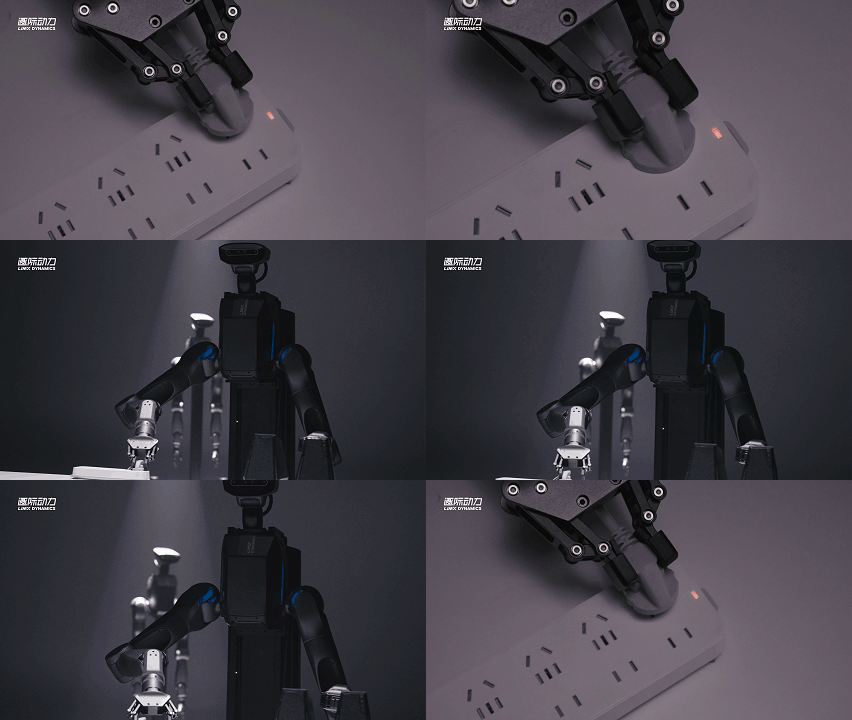
LimX Dynamics, a Chinese humanoid robot developer, has secured $200 million in Series B funding, with participation from a Middle Eastern venture capital firm and strategic backing from major automakers including SAIC Motor and NIO Capital, marking a significant vote of confidence in the company's full-stack approach to embodied intelligence.
The financing round attracted Stone Venture from the United Arab Emirates alongside Chinese institutional investors including Oriental Fortune Capital, Cornerstone Venture, Tianchuang Capital, GF Xinde, and Hefei Innovation Investment. Strategic industrial partners JD.com, Zhongding Group, Guangyang Group, and Eastern Communications joined the round, while existing shareholders SAIC's Shangqi Capital, Beyond Times, NIO Capital, and Matrix Partners China increased their stakes.
The funding comes as the embodied intelligence sector reaches a critical juncture, transitioning from laboratory demonstrations to industrial deployment and scalable production. For investors and developers, the question has shifted from whether humanoid robots can perform impressive stunts to whether they can reliably operate in unpredictable real-world environments and achieve stable, volume delivery.
LimX Dynamics' approach centers on decoupling hardware standardization from intelligent control systems, addressing what the industry calls the "perception-action gap" that has hindered commercial viability.
Modular Architecture Tackles Customization Costs
High hardware customization costs and lengthy development cycles have long blocked robot scalability. Traditional models require designing different robots for different tasks—what industry insiders call the "one scenario, one specialized machine" trap.
LimX's TRON 2 platform employs an original "full-body modular architecture" allowing a single base to transform into multiple configurations. Through modular assembly, TRON 2 switches between dual-arm, biped, and wheeled-leg formats to accommodate requirements ranging from precision manipulation to complex terrain navigation.
The system functions as an engineered "robot Lego," enabling enterprise users and developers to rapidly assemble different forms based on task needs. For scenarios requiring fine manipulation—home meal preparation or laboratory sample handling—the dual-arm configuration provides human-like dexterity with seven degrees of freedom per arm, 70-centimeter reach, and 10-kilogram payload capacity.
For logistics warehouses, outdoor inspection routes, and other complex terrain scenarios, TRON 2's biped and wheeled-leg configurations deliver all-terrain capability with four-hour endurance and 30-kilogram payload capacity.
This "universal base" model directly reduces costs and boosts efficiency. Enterprises avoid purchasing specialized robots for each new task; one TRON 2 covers multiple requirements through module swaps, improving hardware utilization and return on investment. As an open, standardized validation platform, it allows enterprise clients to conduct algorithm verification and commercial loop testing at lower cost and faster speed before committing to mass production, front-loading and simplifying the highest-risk, most expensive trial-and-error phase of product development.
Agentic Operating System Bridges Thinking and Action
Beyond a flexible body, general-purpose robots require a "brain and nervous system" capable of handling different environments and tasks.
While vision-language models have advanced rapidly, most capabilities remain limited to linear task chains where single commands trigger single actions, lacking continuous environmental perception and dynamic planning across multiple tasks. LimX COSA, the industry's first embodied Agentic OS, addresses this gap.
Demonstration tests show that when the company's full-size humanoid robot Oli, equipped with COSA, receives the long-range instruction "deliver water to the front desk guest" and is subsequently asked to "pick up a package," Oli doesn't freeze or falter. Instead, the system's cognitive layer judges task priority, autonomously plans a "deliver water first, then retrieve package" action path, and generates a series of operations including movement, obstacle avoidance, and grasping.
The entire process completes end-to-end autonomously, without relying on pre-written fixed scripts. LimX told the publication this represents not just model advancement but system architecture upgrade. COSA acts as a "dispatch hub," unifying management and coordination of high-level task understanding, mid-level skill libraries, and low-level motion control models, enabling robots to achieve autonomous continuity from thinking to action.
Within this framework, the TRON 2 modular base and Oli humanoid robot constitute the embodied robot body, while LimX COSA operating system, together with the self-developed "cerebellum" foundation model, form a reusable embodied intelligence production capability.
Market Focus on Human-Centric Scenarios
TRON 2 and Oli provide standardized, high-performance universal physical bodies ensuring stable movement and precise operation. The cerebellum foundation model handles real-time generation of arbitrary full-body motions. Large-small brain fusion connects navigation, obstacle avoidance, mobile manipulation, stair climbing, and other complex behaviors with full-body motion control foundation models. LimX COSA serves as the dispatch hub responsible for complex task understanding, planning, and coordination.
This division of labor significantly improves development efficiency. Enterprise engineers and developers need not start from scratch solving high-barrier challenges like hardware stability and basic motion control. Instead, they build upon LimX's validated "body" and "large-small brain fusion skills," using open interfaces and development tools to focus on application-layer development in their vertical industries.
This represents not just product-level modularity but a repositioning of industrial roles. Technology path choices clearly map to market boundary definitions.
When complex "bodies" and "brains" become standardized, LimX's core mission naturally shifts to making this system create value in scenarios requiring maximum adaptability and interactivity. Based on the fundamental positioning of "serving people rather than production processes," LimX's target deployment scenarios prioritize fields requiring direct human interaction and high adaptability, expanding from B2B commercial services like reception and guidance toward C-end household services.
For overseas markets, building on rapid iteration and cost control advantages from China's supply chain, the company will accelerate establishment of localized ecosystems including developers, customers, and channels, achieving technology localization and embodied intelligence market development.
When robots ultimately enter daily life, they require not just occasional perfect demonstrations but reliability and naturalness in every interaction. Full-stack investment in standardized "bodies" and intelligent "brains" may chart a realistic path through complexity toward scaled application for the industry.