
Chinese Startup AheadForm Secures Funding to Bridge Robot ‘Uncanny Valley’
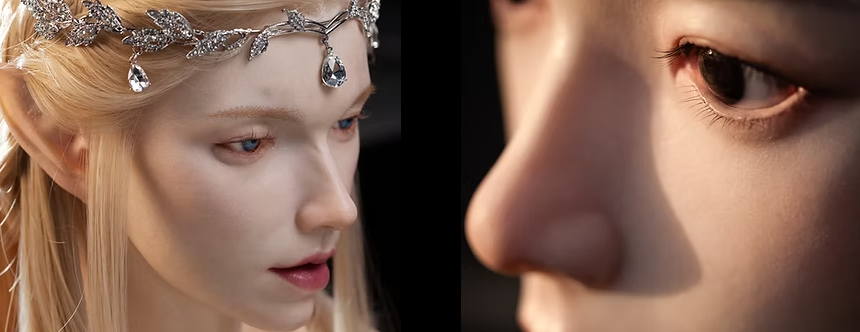
Chinese venture capitalists are placing fresh bets on a highly specialized segment of the robotics industry: hyper-realistic, emotionally interactive machines designed to forge deeper connections with humans. This emerging investment trend signals a strategic pivot from purely functional, industrial robots toward social applications, directly tackling the long-standing design challenge known as the “uncanny valley.”
In a sign of growing investor confidence, AheadForm (首形科技), a startup focused on developing ultra-realistic androids, announced that it has closed a new round of financing. The round was led by Shunwei Capital with significant follow-on investments from existing backers including China Merchants Venture, Shenzhen Capital Group, and AgiBot. Qiji Chuangtan and 5Y Capital also participated in the funding.
The investment marks a significant turnaround for the company. Founder Hu Yuhang acknowledged that his vision for robots centered on facial expressions and emotional interaction was initially met with widespread skepticism, having been rejected by over 100 investors in the past year. Hu argues that for at least the next five years, the primary value of humanoid robots will be in service and emotional support, not industrial productivity.
This funding round highlights a new frontier in China’s competitive humanoid robot sector, where the focus is expanding beyond mobility and dexterity to include sophisticated emotional resonance. For investors, it represents a calculated wager that the key to mass adoption lies in creating robots that are not just useful, but also relatable and capable of empathetic interaction.
Navigating the Uncanny Valley
A core challenge for companies like AheadForm is the “uncanny valley,” a concept first proposed by Japanese roboticist Masahiro Mori. It describes the feeling of unease or revulsion people experience when a robot appears almost, but not perfectly, human. To overcome this, AheadForm is developing what it calls a hyper-bionic emotional interaction robot.
The company trains its robots through self-supervised learning, where a machine uses a camera as an "eye" and a neural network as its control center to practice expressions like frowning and smiling in a mirror. This process allows the robot to autonomously associate motor commands with human-like facial movements, aiming to create expressions that are fluid and natural enough to cross the uncanny valley and foster a sense of affinity rather than discomfort.
The Bet on Emotional Connection
AheadForm’s strategy is built on the premise that “Humanoid Empathy Value” will become a critical commercial differentiator. Hu believes that a physical robot capable of reading and responding to human emotion offers a level of engagement that voice assistants or digital avatars cannot match. This approach is supported by academic research, such as a study by scholars at Beihang University, which found that anthropomorphic features can enhance a robot’s perceived trustworthiness and its ability to foster an emotional connection with users.
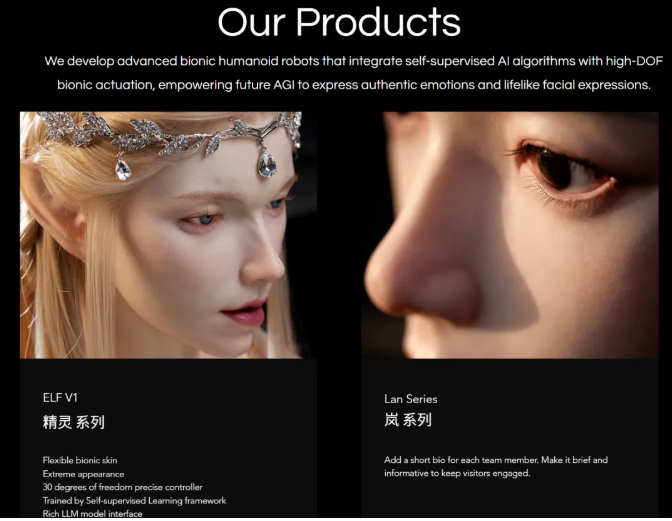
To deliver on this vision, the company has developed three main product lines:
- Elf Series: A hyper-realistic robot with 30 degrees of freedom (DOF) for environmental perception and intelligent dialogue.
- Lan Series: A model with 10 DOF and bionic skin for fluid motion.
- Micro-Motors: High-performance brushless motors designed specifically for fine-tuned facial movements in robots.
A Crowded and Diverse Field
AheadForm is not alone in pursuing the human-like robot market in China, with a growing number of startups developing their own approaches and targeting various applications.
- Qingbao Engine Robot (清宝机器人) has developed robots with up to 52 facial DOFs and realistic silicone skin. Its machines are already being deployed by a major new energy vehicle manufacturer to conduct 24/7 automated safety tests inside intelligent cockpits by simulating driver fatigue.
- DroidUp (卓益得机器人) saw its bipedal robot, “Xueba 01,” receive a doctoral program admission letter from the Shanghai Theatre Academy, showcasing its ability to generate over 100 detailed expressions and interact fluently with an audience.
- NOETIX Robotics (松延动力) reported receiving over 1,000 orders on the first day of launching its female android “Xiaonuo” in May 2025. The robot features 32 facial DOFs capable of producing over 200 micro-expressions.
- Digital China (数字华夏) unveiled its “Xia Lan S02” robot, which has integrated solutions for eye-tracking and lip-syncing. It can mimic 22 distinct human expressions and is equipped with “electronic skin” to sense pressure and touch.
- Yunmu Intelligent Manufacturing Technology (云幕智造) is developing “skin-covered bipedal robots” for the cultural sector, with plans to use them for live-streaming and traditional Chinese opera performances by capturing and mapping human actors' expressions onto the robot in real time.