
CXMT Rejects Apple's Discount Demand, Signaling a Chip Supply Shift
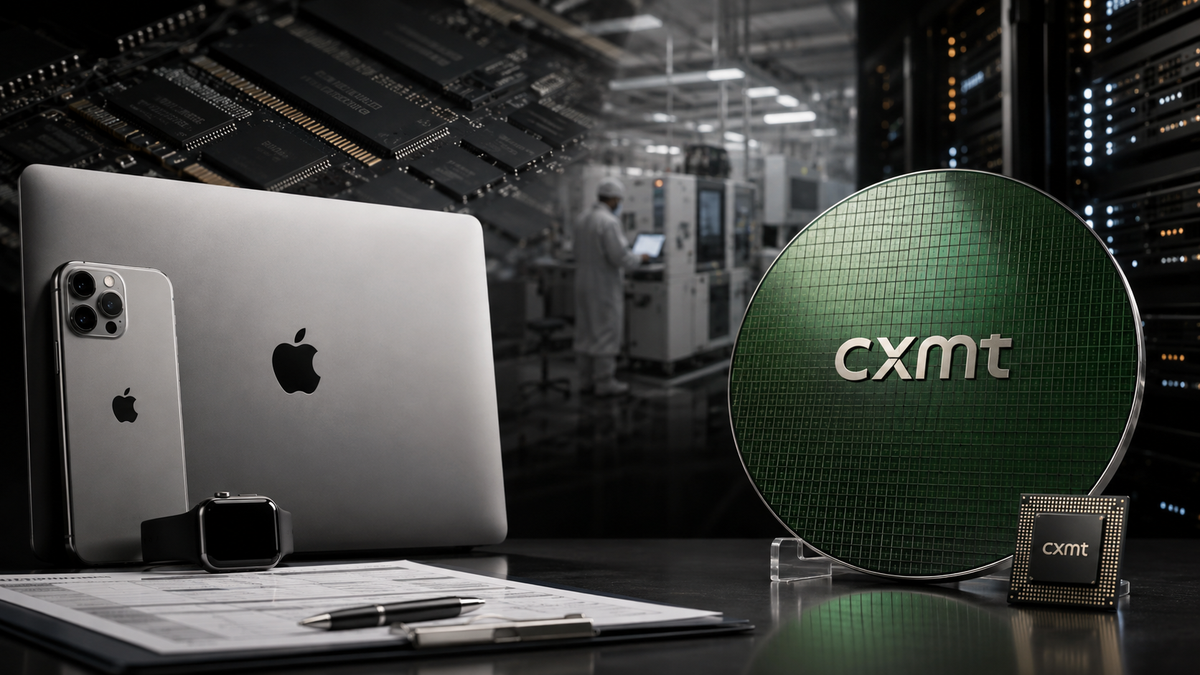
Apple's attempt to use ChangXin Memory Technology as a price-leverage tool against Samsung and SK Hynix has backfired — the Chinese DRAM maker refused to undercut Korean rivals, exposing how the AI-driven memory supercycle has stripped the iPhone maker of its legendary supply-chain dominance.
The rejection, first reported by South Korean trade publication Digital Daily and confirmed by 36Kr on August 6, 2026, marks a structural inflection point: for the first time, a Chinese semiconductor supplier has turned down Apple's procurement overtures on pricing grounds, rather than geopolitical ones. Apple had approached ChangXin Memory Technology (CXMT) seeking DRAM supply at a discount to prevailing Korean vendor prices. CXMT's response was unambiguous — its quotes would match or exceed those of Samsung Electronics and SK Hynix, with no preferential terms for volume.
Market observers note the timing is no accident. DRAM spot prices have surged violently over the past four quarters, reshaping buyer-seller dynamics across the entire semiconductor value chain and leaving Apple with fewer credible alternatives than at any point in the past decade.
Surging DRAM Prices Force Apple to Seek a New Supplier
The proximate cause of Apple's outreach to CXMT is a DRAM price spiral of historic proportions. According to Counterpoint Research data cited by 36Kr, 64GB server DRAM modules rose 3.5x between Q3 2025 and Q1 2026, representing a cumulative year-on-year increase of approximately 490%. Mobile LPDDR5X — the specification used in flagship iPhones — posted a peak single-quarter price increase of 83%, with a 12GB module now costing roughly 90% more than twelve months prior.
The consequence for Apple's bill of materials is severe. Memory chips, which historically represented 10%–15% of total smartphone component costs, now account for 30%–40% of BOM on mid-to-high-end devices, with some large-storage configurations approaching 50%. The cost pressure has already passed through to retail: the top-configuration iPhone has risen by more than RMB 3,000 (approximately US$417) in the current product cycle, with memory cost inflation as the primary driver.
The root cause is a capacity reallocation by the Korean duopoly toward high-bandwidth memory (HBM) for AI infrastructure. SK Hynix now directs 29.2% of its wafer capacity to HBM; Samsung has allocated 23.4%; Micron stands at 18.8%. As AI server customers — led by Nvidia — sign three-to-five-year long-term agreements at premium prices, conventional DRAM supply has tightened structurally. Apple's multi-hundred-million-unit annual pull — spanning iPhone, Mac, and iPad — no longer commands the priority it once did when AI infrastructure clients offer higher margins and more predictable revenue streams.
CXMT's Capacity Is Already Locked by Domestic Hyperscalers
Apple's assumption that a Chinese supplier would trade pricing concessions for the prestige of entering the Apple supply chain proved fundamentally miscalculated. CXMT's mainstream production capacity is already committed under multi-year agreements with domestic clients. Huawei, Xiaomi, OPPO, and Vivo have secured mobile DRAM allocation through long-term contracts. More significantly, major Chinese internet platforms — including Tencent, Alibaba, and ByteDance — have signed server DRAM long-term agreements reportedly worth hundreds of billions of renminbi across three-to-five-year terms. There is simply no uncommitted capacity available to offer Apple on preferential terms.
Equally important is where CXMT's technology now stands. The company has completed a full product transition from DDR4 to DDR5 and from LPDDR4 to LPDDR5X. As of H2 2025, CXMT's DDR5 production yield had exceeded 90%, and its 17-nanometer process node — already validated at scale in Huawei and Xiaomi flagship devices — is sustaining yields above 90%, against an industry qualification threshold of approximately 85%. Samsung's equivalent process generation operates at an estimated 92%–93% yield, meaning the technology gap between CXMT and the global leader has compressed to a statistically narrow range.
The commercial logic follows directly: when performance parity is achieved, the historical justification for a 20% price discount — compensating for technology lag — no longer applies.
Apple's Supply-Chain Leverage Model Faces Structural Erosion
For two decades, Apple operated the most efficient procurement machine in consumer electronics. Its standard playbook — maintaining three competing suppliers, using volume commitments to extract below-market pricing, and deploying the implicit threat of Chinese alternatives to discipline Korean and Japanese vendors — generated gross margins consistently above 40% while keeping component suppliers at single-digit operating margins. Contract manufacturers in the Apple supply chain typically operated at gross margins of 10% or below, with Apple capturing more than 80% of total industry profit.
That model is now under simultaneous pressure from two directions. First, the AI infrastructure buildout has created a class of semiconductor customers — cloud hyperscalers and AI accelerator manufacturers — whose demand for HBM and advanced logic far outstrips Apple's purchasing power in those segments. Second, Chinese suppliers have developed sufficient domestic demand depth that Apple's order volume no longer constitutes a make-or-break revenue opportunity.
The strategic risk calculus for CXMT is also unfavorable. CXMT is already a named entity in U.S. semiconductor export control discussions. Entering the Apple supply chain — which would require dedicated process lines, custom qualification cycles, and deep operational integration — would increase CXMT's exposure to potential entity-list designation with limited offsetting benefit. The precedent set by Ofilm is instructive: at its peak, Apple accounted for roughly 20% of Ofilm's revenue and supported a market capitalization approaching RMB 70 billion (approximately US$9.7 billion). Following its removal from the Apple supply chain in 2021, Ofilm accumulated losses of RMB 9.75 billion (approximately US$1.35 billion) over three years, with unrecovered losses still exceeding one-third of paid-in capital as of 2026. Wingtech Technology invested heavily to secure Apple MacBook assembly contracts before being added to a restricted list, ultimately divesting the entire production line to Luxshare Precision Industry at a discount.
AI Demand Rewrites the Buyer-Seller Hierarchy Across the Memory Stack
The broader structural shift is unambiguous. In the pre-AI era, terminal device brands controlled the supply chain's profit distribution because they owned consumer demand. Suppliers competed for access. In the current cycle, the scarcest resource is upstream capacity: a new DRAM fabrication facility requires capital expenditure of tens of billions of renminbi and a construction-to-qualification timeline of two to three years. Capacity cannot be created on demand, which means suppliers — not buyers — now allocate production to the highest-value customers.
Samsung and SK Hynix redirected capacity to HBM without apparent concern about straining the Apple relationship precisely because Nvidia and the hyperscaler community offer superior economics and longer contract visibility. CXMT's refusal to accommodate Apple follows the same logic applied to a domestic context: Chinese demand from Huawei, the major internet platforms, and the domestic AI server buildout is sufficient to sustain CXMT's growth trajectory without the regulatory and concentration risks that Apple supply-chain participation would introduce.
It is worth noting the limits of this shift. CXMT and the broader Chinese memory industry still trail the global frontier by an estimated three to four years in HBM and the most advanced process nodes. China's share of global DRAM output remains approximately 8%. The transition from "price-competitive alternative" to "equal pricing partner" is meaningful, but it does not yet extend to the highest-value segments of the memory market.
Impact Assessment: What This Means for Apple's Cost Structure and Supply Strategy
For Apple, the episode narrows its strategic options in a critical component category. The company reportedly approached the U.S. government to explore whether CXMT procurement could be structured in a manner consistent with export control frameworks — a move that signals Apple views CXMT as a necessary long-term supply partner rather than a tactical bargaining chip. Whether that diplomatic effort yields a workable procurement framework remains uncertain.
In the near term, Apple faces a DRAM cost environment that is unlikely to normalize quickly. HBM capacity allocation by the Korean majors is locked under long-term AI infrastructure contracts. CXMT's available capacity is committed to domestic clients. Micron, the only U.S.-headquartered DRAM producer, is similarly capacity-constrained and prioritizing HBM. Apple's ability to restore its historical pricing leverage depends on either a significant AI demand correction — which would release Korean capacity back toward conventional DRAM — or a multi-year investment in supply-chain diversification that it has so far been unable to execute on favorable terms.
The CXMT episode is, in this sense, less about one rejected price negotiation and more about the permanent repricing of Apple's supply-chain position in a world where semiconductor capacity is the scarce asset and consumer electronics volume is no longer the most attractive demand signal.
Related Coverage: