
Li Auto’s Live Teardown Gamble: Three Months of Sales Declines Expose Cracks in Its EV Strategy
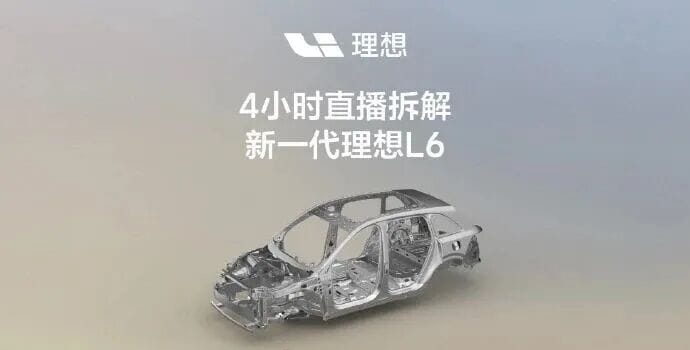
Li Auto is dismantling vehicles on camera to prove its worth — a dramatic signal that China's once-fastest-growing premium EV brand is fighting to reclaim consumer confidence as its sales advantage erodes and its full-year target slips further out of reach.
On August 4, 2026, Li Auto broadcast a four-hour live teardown of its new-generation L6 SUV, stripping the vehicle down to five core modules — seats, body structure, passive safety systems, chassis, and battery pack. The session was hosted by L6 product lead Li Xinyang and framed by the company as revealing "what the spec sheet can't show you." The timing was not incidental: Li Auto has now posted three consecutive months of year-on-year and month-on-month delivery declines, and the brand is the only one among China's top-six new-energy vehicle (NEV) startups to record negative year-to-date growth in the first half of 2026.
The stunt drew immediate competitive echoes. Just one day earlier, on August 3, Zeekr conducted its own live teardown of the Zeekr 7X, complete with a 105 km/h rear-impact crash test and on-site inspection by independent industry experts — underscoring that product transparency has rapidly become a new battleground in China's premium EV segment.
Sales Collapse Accelerates, Squeezing a Once-Comfortable Lead
The numbers tell a stark story. After peaking at 41,053 deliveries in March 2026 — its highest monthly figure of the year — Li Auto's volumes have declined every month since: 34,085 in April, 33,350 in May, 30,895 in June, and 30,468 in July. The cumulative four-month drop exceeds 10,000 units.
Year-on-year, the deterioration was sharpest in May, when deliveries fell approximately 18%, before narrowing to a 14.84% decline in June and a marginal 0.86% drop in July. While the rate of decline is slowing, no inflection point has materialized.
Through the first half of 2026, Li Auto delivered approximately 193,500 vehicles, a 5.1% year-on-year decline — the sole negative performer among its peer group, which includes NIO, XPeng, Leapmotor, AITO and Zeekr. Against the company's stated full-year target of more than 487,600 units — implying 20%-plus growth announced on the Q4 2025 earnings call — the first-half completion rate stands at just 39.7%, leaving the second half carrying an almost impossible burden.
Margin Erosion Signals a Structural Shift, Not a Cyclical Blip
The delivery miss is compounding a financial deterioration that investors cannot ignore. In Q1 2026, Li Auto reported a net loss of RMB 2.3 billion (approximately US$319 million), compared with a net profit of RMB 647 million in Q1 2025 — a swing of nearly RMB 3 billion within twelve months. Vehicle gross margin collapsed from 19.8% in Q1 2025 to 6.1% in Q1 2026, a level that signals pricing pressure has moved well beyond promotional tactics and into the cost structure itself.
The gross margin compression reflects two converging forces: aggressive model refresh cycles that carry higher launch costs, and intensifying price competition as the extended-range electric vehicle (EREV) segment — once Li Auto's proprietary moat — becomes commoditized. Li Auto has refreshed its three core EREV models in rapid succession: the new-generation L9, L8, and L6 all launched within a three-month window, with the L6 hitting showrooms on July 16 at RMB 249,800 (approximately US$34,700), matching its predecessor's price point while upgrading seat comfort, chassis dynamics, smart cabin features, and driver assistance systems.
Despite the refresh cadence, deliveries have not recovered. An analyst tracking the sector told Wall Street CN that Li Auto is navigating a "painful transition period" in which legacy EREV models have lost competitive edge while next-generation vehicles have yet to reach full-volume production.
EREV Moat Shrinks as Rivals Flood the Segment
When Li Auto pioneered the premium family EREV SUV format with the L7, L8, and L9 from 2023 onwards, the powertrain architecture itself was a differentiator. That advantage is now structural history. Traditional automakers, state-owned enterprises, and fellow NEV startups have all introduced EREV products, transforming what was once a niche into one of the most crowded segments in China's automotive market.
Consumer decision criteria have shifted in parallel. The question of "range anxiety" — the primary concern that originally drove EREV adoption — has largely been resolved across the industry. Buyers evaluating premium NEV SUVs in 2026 are instead weighing intelligent driving capability, in-cabin experience, exterior design, brand equity, and total cost of ownership. Li Auto's "family flagship SUV" positioning, which built strong recognition in 2023 and 2024, now faces direct replication from multiple competitors offering comparable space, configurations, and smart features at competitive price points.
Pure-EV Pivot Carries Execution Risk
Li Auto's response to EREV saturation is a push into pure battery-electric vehicles, but the transition is uneven. The company currently sells three BEV models. Of these, the i6 has been the standout, consistently exceeding 20,000 monthly units and becoming the brand's top-selling nameplate. However, reliance on a single model to anchor the pure-EV portfolio creates concentration risk and limits the brand's ability to project a coherent electric identity.
Li Auto founder and CEO Li Xiang has identified embodied intelligence — the integration of AI and robotics into vehicle platforms — as the defining competitive dimension for premium smart cars over the next three to five years. In parallel, the company's "3+2" growth strategy targets sales system optimization, L-series generational upgrades, BEV volume ramp, intelligent driving commercialization, and international market entry.
Overseas Expansion Offers Long-Term Optionality, Near-Term Relief Unlikely
Li Xiang has designated 2026 as Li Auto's "first year of formal overseas expansion." The company has entered Macau, Cambodia, and Laos, and plans to launch the L9 EREV in the Middle East and Central Asia in Q3 2026. A European rollout of the i6 BEV is scheduled for H2 2026, while right-hand-drive versions of the MEGA will target Hong Kong and Singapore by year-end.
International revenue, however, will not meaningfully offset domestic volume pressure within the current fiscal year. The markets being entered — Southeast Asia, the Middle East, and select European cities — are early-stage for Chinese premium NEV brands and will require sustained investment in dealer networks, charging infrastructure partnerships, and regulatory compliance before generating material sales.
Teardown as Strategy: Conviction or Desperation?
Li Xiang framed the August 4 teardown in value terms, writing on social media: "Competing on price is inferior to competing on materials." His post argued that cost structure elements — material grade, structural design, thermal management architecture, and wiring harness specifications — do not appear on a configuration sheet and cannot be assessed in a showroom, but manifest in real-world ownership over five to eight years.
The argument is coherent, but its commercial effectiveness is unproven. A product executive at a rival NEV startup, speaking to Wall Street CN, expressed skepticism: "Competing models are offering better value-for-money on paper. Whether consumers can translate a teardown into a purchase decision remains an open question."
The live teardown format — pioneered in China's consumer electronics sector as a trust-building mechanism — is now being adopted across the auto industry precisely because the price war has made specification differentiation difficult to communicate through conventional marketing. That both Li Auto and Zeekr deployed the tactic within 24 hours of each other suggests it has become a defensive standard rather than a distinctive edge.
For Li Auto, the more pressing arithmetic is straightforward: with 193,500 deliveries banked through June and a full-year target of 487,600 units, the company needs to average approximately 49,000 monthly deliveries across the final six months of 2026 — a figure it has never achieved and that stands 60% above its July run rate. The new-generation L6, the i6's continued momentum, and whatever model launches remain in the pipeline must collectively close that gap. The teardown was a message to consumers. The delivery data will be the verdict.
Related Coverage:
Li Auto Spins Off Chip Unit, Signaling Shift From Carmaker to Full-Stack AI Hardware Contender