
Li Auto Spins Off Chip Unit, Signaling Shift From Carmaker to Full-Stack AI Hardware Contender
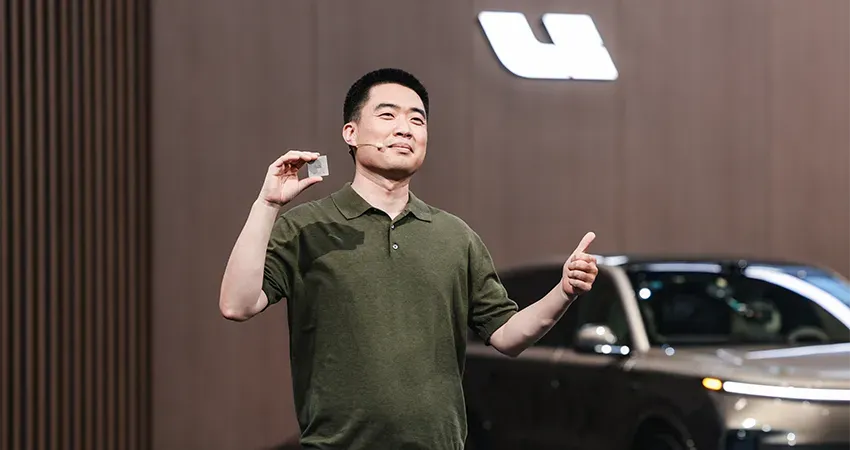
Li Auto has incorporated a dedicated chip subsidiary in Shanghai, formalizing a strategic pivot that positions the electric-vehicle maker as a vertically integrated AI hardware company rather than simply an automotive group with an in-house silicon team.
The new entity, Xinchuang Zhihe Technology, was registered on July 13, 2026, in the China (Shanghai) Pilot Free Trade Zone, according to corporate registry data from Qichacha. The move comes roughly six weeks after Li Auto's self-developed Mach M100 chip entered mass production in May 2026—a timing that analysts and industry observers say is deliberate: the carmaker is converting a development milestone into a permanent organizational structure.
The company is 100% owned by Shanghai Li Auto Technology, whose ultimate controller is Li Auto Chief Executive Officer Li Xiang. Wang Yang, currently serving as Joint Company Secretary at Li Auto (NASDAQ/HKEX: 2015.HK), is named legal representative of the new subsidiary—a role that underscores the entity's current function as a governance vehicle rather than an operationally independent business unit.
Mach M100 Reaches Mass Production, Triggering Organizational Restructuring
The Mach M100 chip was greenlit in November 2022, taped out in 2024, and began shipping in production vehicles—the Li Auto L9, L8, and L6—in May 2026. Manufactured on Taiwan Semiconductor Manufacturing's N5A automotive-grade 5-nanometer process node, a single M100 delivers 1,280 TOPS of compute; dual-chip configurations hit 2,560 TOPS.
That development arc—roughly 3.5 years from concept to volume production—was executed by a team that started with just two engineers in mid-2022 under Chief Technology Officer Xie Yan, who joined Li Auto in July 2022. The team has since grown to approximately 200 people.
The structural logic of spinning out a separate legal entity at precisely this inflection point is straightforward: the chip development cycle runs on a roughly 2-to-3-year semiconductor cadence, while vehicle program cycles run 3-to-4 years. Keeping the chip team embedded inside the parent organization forces semiconductor engineers to operate on automotive program timelines—a mismatch that slows iteration. Xinchuang Zhihe's incorporation gives the silicon team its own operational clock.
Shanghai's Zhangjiang Hub Cuts Supply-Chain Friction and Unlocks Tax Incentives
The choice of the Zhangjiang Science City address in Pudong is not incidental. Within walking distance sit integrated-circuit design firms including Unisoc, HiSilicon, Verisilicon, and GigaDevice — a dense talent pool for senior chip architects commanding annual compensation of RMB 1.5 million to RMB 3 million (US$208,000–US$417,000).
More concretely, the M100's supply chain is anchored in the Yangtze River Delta: TSMC's Nanjing fab and SMIC's southern operations handle wafer fabrication, while advanced packaging is handled by JCET Group and Tongfu Microelectronics, both within a three-hour logistics radius. Previously, the chip team operated under Li Auto's Beijing-centric corporate structure, requiring coordination loops between Beijing, Shanghai, and Hsinchu for every tape-out milestone. Relocating the legal entity to Shanghai compresses that friction materially.
On the fiscal side, IC design companies registered in Zhangjiang qualify for a preferential corporate income-tax rate of 15%—versus the standard 25%—plus a two-year full exemption and three-year half-rate reduction. With Li Auto's total 2026 R&D budget running at approximately RMB 12 billion (US$1.67 billion), of which roughly half is directed at AI-related investment, the tax differential on chip-specific expenditure alone could yield several hundred million renminbi in annual savings once the subsidiary reaches operating scale.
The subsidiary structure also allows Xinchuang Zhihe to issue equity options to senior IC talent without triggering the disclosure requirements and allocation constraints that apply to Li Auto's Hong Kong-listed shares—a meaningful recruiting advantage in a market where chip architects can command competing offers from Huawei, Qualcomm, and a growing roster of Chinese EV-chip startups.
External Sales Ambitions Emerge, But Remain Contingent on Robotics Scale
The most consequential signal from Li Auto's chip strategy may be a subtle but documented shift in CTO Xie Yan's public positioning. In May 2026, Xie stated categorically that the M100 was "serving our own products, not for external sale." By June 2026—one month later—his language had softened to "not ruling out external supply… a number of robotics companies have expressed interest in our chip."
Li Xiang has publicly committed to launching humanoid robots, telling an all-hands meeting in January 2026 that Li Auto "will definitely build humanoid robots and aims to unveil them as soon as possible." An internal robotics R&D team has been established. Xie Yan has separately confirmed the M100 will be deployed in Li Auto's forthcoming robotics platform, drawing an explicit parallel to Tesla's use of its FSD chip across both vehicles and the Optimus robot program.
This creates a dual external-sales pathway for Xinchuang Zhihe: first, supplying the M100 to third-party robotics companies; second, positioning the chip as the compute substrate for Li Auto's own embodied-AI hardware. The independent legal entity makes both pathways operationally cleaner—Xinchuang Zhihe can sign chip supply and licensing agreements directly, without routing commercial terms through the listed parent.
Contrast With NIO's Chip Spin-Off Reveals Different Capital Logic
The contrast with NIO's comparable move is instructive for investors assessing Li Auto's strategic posture. NIO established its chip subsidiary NIO Chip in June 2025 and completed a first funding round of RMB 2.257 billion (US$313 million) in February 2026, implying a post-money valuation approaching RMB 10 billion (US$1.39 billion). Investors included Hefei State Investment, IDG Capital, and SMIC Capital, with external shareholders holding a combined 27.3% stake. NIO CEO Li Bin has actively solicited external chip customers with the public pitch "buy chips from NIO."
Xinchuang Zhihe presents a structurally different picture: registered capital of just RMB 100,000 (US$13,900), 100% parent ownership, no external investors, and a CTO who frames external supply as a future possibility contingent on toolchain maturity. Li Auto reported a Q1 2026 net loss of RMB 2.28 billion (US$317 million), but carries a cash and cash-equivalent position of RMB 94.3 billion (US$13.1 billion)—sufficient to self-fund chip development without dilutive external capital. The primary motivation for Xinchuang Zhihe's incorporation is governance architecture, not balance-sheet relief.
IPO Optionality Exists, But Two Conditions Must First Be Met
The question of whether Xinchuang Zhihe could eventually list independently—on China's STAR Market or in Hong Kong—hinges on two preconditions that do not yet exist.
The first is external revenue materiality. The cautionary precedent is BYD Semiconductor, which cleared a STAR Market IPO review in 2021 but withdrew its application in November 2022 after regulators pressed hard on independence: related-party sales to parent BYD accounted for 54.86% to 63.37% of revenue, and external sales fell well below the threshold regulators consider indicative of genuine market standing. Xinchuang Zhihe currently sells the M100 exclusively to Li Auto. Reaching an external-revenue ratio above 30% of total chip sales—a conservative floor for listing credibility—likely requires two to three years of robotics-market development at minimum.
The second condition is a robotics business of sufficient scale to reframe the asset narrative. If Li Auto achieves humanoid-robot volume production in the 2028–2029 window and Xinchuang Zhihe simultaneously supplies M100 derivatives to third-party robotics platforms, the investment story transforms from "captive chip unit of a car company" to "embodied-intelligence compute platform"—a valuation multiple that would be substantially higher on either A-shares or Hong Kong.
Until those conditions are met, Xinchuang Zhihe functions as what the corporate structure already signals: a talent and tax optimization vehicle, with optionality on a future capital event preserved but not yet pursued.
Next-Generation M200 Sets the Pace for Xinchuang Zhihe's Operational Independence
With the M100 in mass production, Li Auto's chip roadmap now advances to the M200. Under the new subsidiary structure, M200 development is no longer gated by vehicle-program SOP schedules—Xinchuang Zhihe's engineering team can run its own tape-out and certification timeline. Xie Yan has indicated the toolchain needs further maturation before external supply becomes a formal commercial offering, suggesting the M200 development cycle will be the proving ground for Xinchuang Zhihe's operational autonomy.
Li Xiang's strategic framing—explicitly benchmarking against Apple's integration of chip, operating system, hardware, and cloud services—implies that Xinchuang Zhihe is not conceived as a standalone chip vendor but as the silicon foundation of a broader AI system stack. The question for investors in Li Auto's listed entity is whether that stack, once assembled, remains fully consolidated or whether selective monetization of individual layers—starting with silicon—becomes the preferred path to unlocking embedded value.
Related Coverage:
Li Xiang Positions Li Auto's In-House Chip Push as AI Infrastructure Play, Not a Vanity Project