
China AI Shifts From Parameters to ROI at WAIC 2026, as Tencent Dominates and ByteDance Stays Away
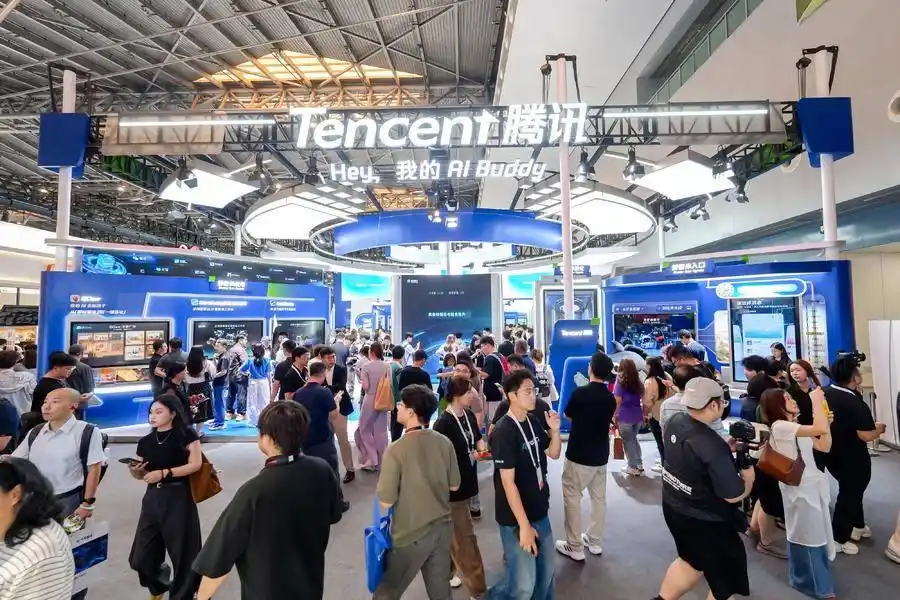
Tencent emerges as the defining force at the 2026 World Artificial Intelligence Conference in Shanghai, deploying a full-stack agent ecosystem while the industry collectively abandons benchmark theater in favor of deployable, revenue-generating applications—a structural shift that redraws competitive lines across China's technology sector.
The contrast with WAIC 2025 is unambiguous. Last year's show floor rewarded the biggest parameter counts and the most photogenic generative demos. This year's edition, spanning the World Expo Center main forum hall and the West Bund Exhibition Center consumer experience venue, ran on a different currency: cost-per-inference, deployment timelines, and verifiable return on investment. The shift is not a marketing pivot by any single company—it is an industry-wide acknowledgment that foundational model capability has crossed the "good enough" threshold, and that the next competitive moat lies entirely in application depth.
Notably absent from the floor: ByteDance, which again declined to set up an official independent exhibition booth, a conspicuous gap given the company's aggressive AI investment posture in prior quarters. The vacuum it leaves is being filled, aggressively, by incumbents that observers might have written off as late movers.
Tencent Converts Full-Stack Architecture Into Market Leadership
Tencent's booth at WAIC 2026 functions less as a product showcase and more as a proof-of-concept for vertical integration as competitive strategy. The architecture runs from the Hunyuan Hy3 foundation model through the Agent Development Platform (ADP) middleware layer, up to end-user applications including WorkBuddy and CodeBuddy, and out to deployment verticals spanning mobility, marketing, and embodied intelligence.
The Hunyuan Hy3 positioning is analytically significant. Rather than competing on raw capability—a race with rapidly diminishing marginal returns—Tencent has explicitly optimized for cost-performance ratio. The strategic logic is sound: enterprise procurement decisions at scale are driven by total cost of ownership, not peak benchmark scores. A 1% accuracy improvement does not justify a 3x inference cost premium. Hy3's market validation arrived fast: within one week of launch, the model topped OpenRouter's global large model API call volume rankings, a developer-driven signal that carries more weight than any internally produced benchmark.
WorkBuddy, the workplace productivity agent Tencent released in early March 2026, has scaled with unusual speed. According to the 2026 Q2 China Office AI Agent Platform Market Insight Report published July 20, WorkBuddy recorded over 20 million PC-side visits in June alone, holding the domestic market's top position and surpassing the combined traffic of the second- and third-ranked competitors. Four months from launch to category leader is a deployment velocity that warrants attention from enterprise software investors tracking China's productivity stack.
During the conference, Tencent executed three simultaneous product moves that collectively address the core friction points limiting agent adoption. First, WorkBuddy launched as a standalone application across iOS, Android, and Huawei's HarmonyOS—the first general-purpose agent to land on HarmonyOS, a distribution channel that adds strategic optionality independent of any single mobile ecosystem. Second, a partnership with AR hardware maker Li Weike produced the X-AI memory glasses, extending the agent's context-capture capability into wearable form factors and directly addressing the persistent "context gap" that limits single-session AI tools. Third, the "AI Navigator+" international expansion toolkit—bundling regulatory, legal, and tax corpus data across seven countries—represents the "general capability plus vertical corpus" deployment template that enterprise AI vendors have been theorizing about for two years.
The embodied intelligence component deserves separate scrutiny. Tencent's robotics stack—combining a VLM visual model, RxBrain decision model, and VLA action model under an agent orchestration layer—has moved beyond laboratory demonstration. The HyVLA-0.5 system has been deployed in daily chemical manufacturing, recording a task success rate exceeding 95% and an SKU adaptation cycle of under three days. Those are industrial-grade metrics, not conference-floor theater.
The commercial architecture binding the entire ecosystem is SkillHub: 78,000 AI skills connected to the SkillPay payment infrastructure. The structure replicates App Store economics—developers publish monetized skills, users pay within the agent interface, Tencent captures platform margin. Whether this achieves the network density required for flywheel effects remains to be seen, but the payment rail is the missing piece that most competing agent platforms have not yet built.
NetEase Bets on Vertical Depth Over Platform Breadth
NetEase made a deliberate choice to appear at WAIC 2026 with focused, commercially validated products rather than aspirational platform narratives. Two business lines anchored its presence: SmartEase, targeting industrial robotics, and NetEase GrowthEase, targeting enterprise AI applications.
SmartEase's core products—the "Lingzai" loader robot and "Lingju" excavator robot—are operating across more than 100 projects in over ten provinces, qualifying as scaled commercial deployment rather than pilot programs. The addressable use cases share a common characteristic: environments where human labor is either unavailable, dangerous, or prohibitively expensive. Sealed coal yards at power plants, enclosed ship holds at ports, extreme-cold mining sites, and high-altitude construction projects all face acute recruitment shortfalls. NetEase's "lights-out worksite" configuration—fully autonomous operation in zero-light conditions—has demonstrated efficiency 20% above experienced human operators, with a 15% reduction in energy consumption, running 7×24 operations across multiple road and rail projects.
The deployment model's competitive differentiation is operational rather than technical: no large-scale site retrofitting required. The "plug-and-play" adaptation characteristic directly attacks the cost barrier that has historically prevented industrial AI from scaling beyond flagship installations.
NetEase GrowthEase addresses the enterprise software stack through three product layers: Agent Guard for AI safety governance, ClawHive for converting tacit employee knowledge into standardized organizational capability, and a trio of customer-facing tools—AI private domain assistant, AI customer service, and SalesPro—targeting measurable improvements in operational efficiency, issue resolution rates, and new-hire sales ramp time. NetEase GrowthEase CEO Ruan Liang framed the company's positioning precisely: the gap between "capability emergence" and "productivity realization" is an engineering problem, not a research problem.
Content Platforms Catalyze User-Led AI Creation
Bilibili, Xiaohongshu, and Zhihu represent a third strategic archetype: platforms that are not building AI products so much as building AI-enabled creation ecosystems, redistributing innovation capacity to their user bases.
Bilibili's Q2 2026 data shows over 190 million monthly users consuming AI-related content on the platform. The June AI Creation Open Competition generated nearly 5,000 submissions in just over a month, with entries ranging from emotional art installations to functional hardware robots—produced predominantly by non-professional creators. Bilibili is positioning itself as both a distribution channel and a talent discovery layer for China's AI industry.
Xiaohongshu's pivot is the most structurally ambitious of the three. The RED Skill framework, Vibe Coding tools, and Builder Hub system create an end-to-end loop—development, discovery, usage, and feedback—entirely within the platform. Internal beta testing produced over 7,300 original skills within one month. More than 160,000 AI developers have been active on the platform over the past year, and the technology creator segment has grown over 200%. The platform's structural advantage is distribution: a user encountering an AI skill in a content post can activate it immediately, without platform migration. That frictionless experience is a meaningful moat against pure-play developer platforms.
Zhihu leverages a different asset: 21 million AI-related users and 57.17 million pieces of AI-related content accumulated over more than a decade. Its WAIC strategy centers on opening that proprietary corpus as a high-trust data service for model developers—simultaneously monetizing a legacy content asset and creating developer ecosystem lock-in.
MiniMax Demonstrates the Startup Survival Formula
MiniMax operates without the distribution infrastructure of an internet incumbent or the community flywheel of a content platform. Its WAIC 2026 presentation was effectively a public answer to the question every independent AI company faces: what is the viable business model when hyperscalers are open-sourcing competitive models and commoditizing inference pricing?
The technical foundation is the M3 model, built on a proprietary MSA sparse attention architecture. Total parameters reach 428 billion, but active parameters are held to 23 billion—an engineering choice that preserves large-model reasoning capacity while keeping inference costs competitive with mid-sized models. Maximum context length of 1 million tokens directly addresses the long-document and multi-step agent use cases where enterprise clients generate the highest willingness to pay. Day-0 compatibility with domestic Chinese chip platforms positions M3 competitively in government and financial sector procurement, where supply chain localization requirements are non-negotiable.
The commercial model is asset-light by design. MiniMax does not operate consumer traffic products or manufacture hardware. Instead, it licenses AI capability to partners who own the end-user relationship: a consumer-grade robot dog powered by M3 generated pre-sale revenue approaching RMB 100 million (approximately US$13.9 million); hardware integrations span AI glasses, earphones, children's toys, and NAS home storage devices. The aggregate reach—over one million enterprise clients and developers, 300 million individual end users—has been achieved without the capital intensity of a direct-to-consumer model.
Three Consensus Shifts Redefine China's AI Competitive Landscape
Across all six companies, three structural realignments are now visible with sufficient clarity to treat as industry consensus rather than individual strategy.
Competition has permanently migrated from model layer to application layer. Benchmark scores are no longer the primary purchasing criterion. Enterprise buyers are calculating ROI: input cost, headcount reduction, efficiency gain, payback period. Models that cannot be translated into a legible cost-benefit equation are not being procured, regardless of their leaderboard position.
Agents have become the primary commercialization vehicle, but industry understanding remains stratified. The simplest agent implementations are enhanced chatbots with tool-calling. Mid-tier implementations handle multi-step task planning and execution. The most sophisticated—long-term memory, autonomous decision-making, environmental interaction—represent a qualitatively different product category. The gap between these tiers is not primarily technical; it reflects the depth of a company's understanding of the specific workflow it is trying to automate.
Ecosystem value compounds faster than point-product value. No single company can cover all deployment scenarios. The platforms that build open developer ecosystems—with functional payment rails, revenue-sharing mechanisms, and quality governance—will accumulate compounding advantages. Tencent's SkillHub with SkillPay integration is the most complete implementation of this model currently visible in the Chinese market. The critical metric is not application count; it is whether developers can generate sustainable revenue, which is the only condition under which organic ecosystem growth becomes self-sustaining.
Two additional structural trends emerged from the conference floor. Embodied intelligence has transitioned from demonstration to industrial deployment, with clear upstream-downstream supply chain specialization now visible across data collection, model training, hardware manufacturing, and scenario application. And edge-side AI is accelerating: latency constraints, privacy requirements, and bandwidth costs are pushing model inference from cloud infrastructure to on-device execution, expanding the addressable hardware market for AI capability licensing.
The youngest participant in Xiaohongshu's hackathon was 12 years old. The generation entering the workforce with AI as a native tool—not an acquired skill—will eventually redefine product design assumptions across the entire industry.
Related Coverage: