
Li Xiang Positions Li Auto's In-House Chip Push as AI Infrastructure Play, Not a Vanity Project
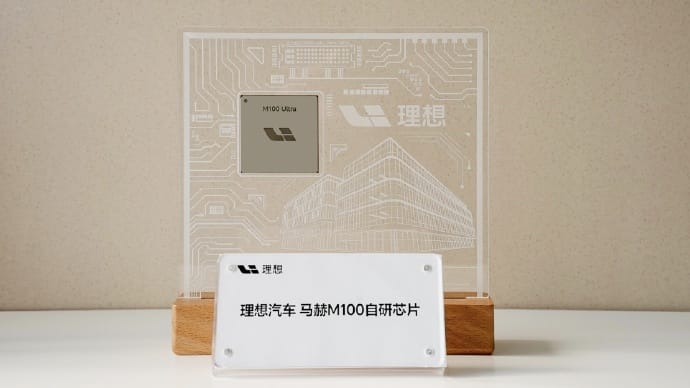
The debut of Li Auto's Mach M100 chip — delivering claimed single-chip performance roughly three times that of Nvidia's Thor-U — signals the company's pivot from smart-car maker to vertically integrated AI hardware platform, a strategic bet that carries both competitive upside and significant execution risk.
Li Auto CEO Li Xiang on May 12, 2026 publicly reframed his company's semiconductor ambitions, pushing back against market narratives that characterize the effort as trend-chasing capital burn. In a statement that drew immediate attention across China's automotive and chip sectors, Li argued that existing supplier solutions have hit "performance bottlenecks" in deploying AI at the physical layer — a gap he says justifies building proprietary silicon from scratch.
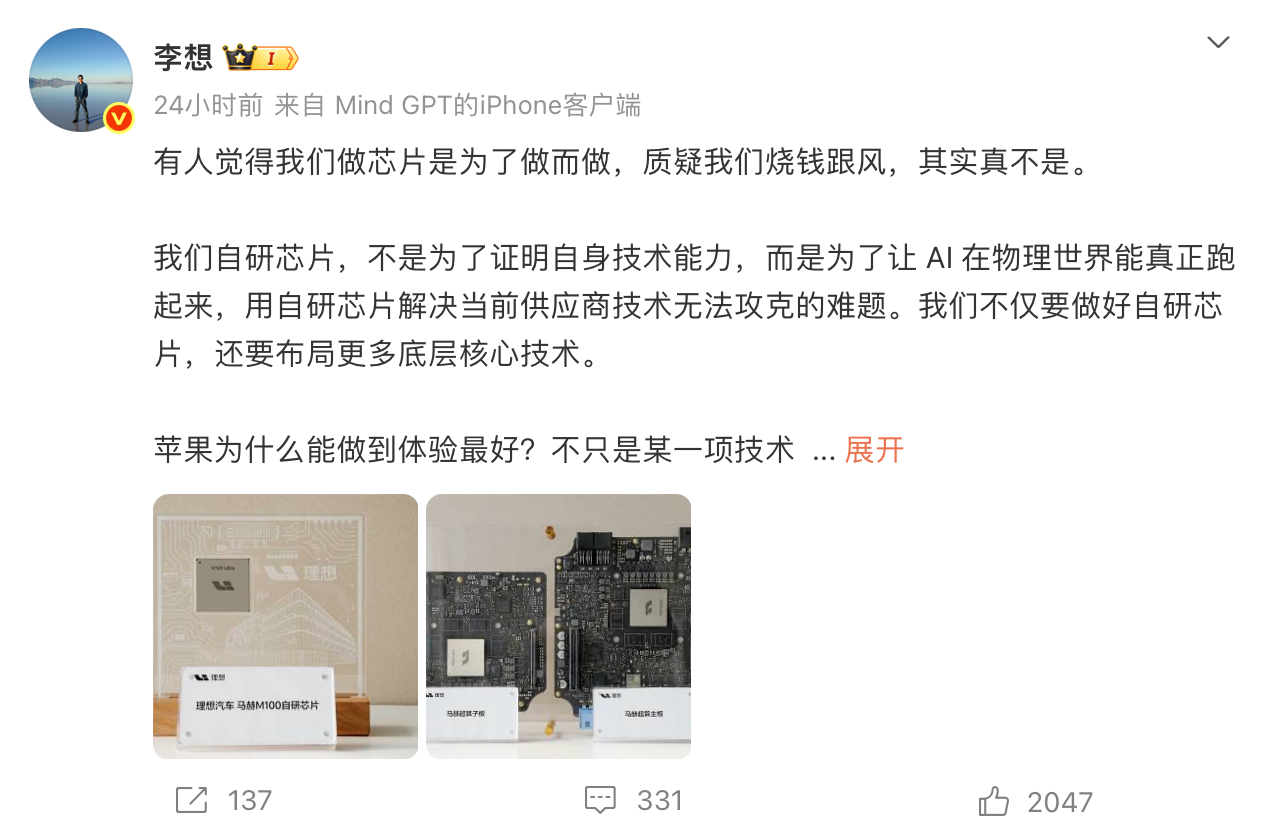
The timing is pointed. Nvidia CEO Jensen Huang recently acknowledged that the company's AI GPU shipments into China have effectively fallen to zero amid tightening U.S. export controls, creating a structural vacuum that Chinese automakers and their chip partners are racing to fill. Li Auto's move into in-house silicon is therefore less a standalone corporate decision than a direct response to a supply chain that has become geopolitically unreliable.
M100 Enters Mass Production, Targeting the New L9 as Its Launch Platform
Li Auto's first proprietary cockpit chip, the M100, has reached mass production and will debut in a dual-chip configuration on the upcoming new Li L9. The combined compute performance of the dual-chip setup is cited at 2,560 TOPS — a figure that, if validated independently, would represent a meaningful step-change in in-vehicle AI processing headroom.
Li Auto claims the single-chip effective compute of the M100 is approximately three times that of Nvidia's Thor-U, the current benchmark in automotive-grade AI processors. The company argues this performance gap translates into measurably shorter reaction times in emergency avoidance scenarios, converting raw compute into a tangible, differentiable user experience rather than a spec-sheet number.
The choice of the L9 — Li Auto's flagship six-seat SUV and historically its highest-margin volume model — as the launch vehicle is strategically deliberate. It maximizes early-adopter visibility while concentrating integration risk on a platform where the company has the deepest engineering familiarity.
Li Xiang Invokes Apple's Playbook to Justify Full-Stack Control
Li framed the chip strategy within a broader vertical integration thesis, explicitly citing Apple as the reference model. His argument: superior user experience is inseparable from end-to-end control of silicon, operating system, and hardware — a loop that cannot be optimized when any layer is outsourced to a third party whose roadmap priorities diverge from the vehicle maker's.
Beyond the M100, Li Auto says it is simultaneously developing a proprietary operating system, large language models, and underlying hardware infrastructure — what Li described as a "full-domain co-design system" oriented toward the AI era. This positions Li Auto not merely as a chip customer moving upstream, but as a company attempting to build a closed-loop AI stack comparable in ambition, if not yet in scale, to what Apple has constructed in consumer electronics.
The strategic logic is coherent, but the execution bar is formidable. Apple spent over a decade and tens of billions of dollars building the A-series and M-series chip lineages before achieving the performance-per-watt advantages that now define its competitive moat. Li Auto, founded in 2015 and still generating the bulk of its revenue from three SUV models, is compressing that timeline under considerably more financial and competitive pressure.
Supplier Bottlenecks Drive Vertical Integration Across China's EV Sector
Li Auto's rationale — that incumbent suppliers cannot deliver the performance architecture required for next-generation AI vehicles — echoes a broader structural shift underway across China's electric vehicle industry. BYD, Huawei, and Horizon Robotics have each, in different ways, moved to internalize critical semiconductor and software capabilities over the past two years.
The acceleration has been partly forced. U.S. export restrictions have progressively narrowed Chinese automakers' access to leading-edge Nvidia and Qualcomm automotive chips, while domestic foundry capacity at advanced nodes remains constrained. This creates a bifurcated incentive: companies with sufficient scale and capital can invest in proprietary silicon; those without face a dependency on domestic chip vendors whose roadmaps may lag global peers by one to two generations.
Li Auto's 2025 annual revenue reached approximately RMB 144 billion (US$20 billion), providing a financial base that makes a multi-year chip development program feasible, if not low-risk. The company has not disclosed the cumulative R&D expenditure allocated to the M100 program.
Competitive Benchmarking Raises Questions That Require Independent Verification
The 3x performance claim relative to Nvidia's Thor-U warrants scrutiny. Automotive chip benchmarking is notoriously inconsistent — "effective compute" figures can vary significantly depending on workload type, memory bandwidth assumptions, and thermal envelope. Li Auto has not published third-party validation data, and the comparison metric used ("effective" rather than peak TOPS) introduces interpretive flexibility that the market should treat cautiously until independent testing is available.
What is verifiable is that the M100 has reached mass production — a milestone that many Chinese automotive chip programs have announced but failed to sustain at volume. If Li Auto can demonstrate stable, high-volume yields and software ecosystem maturity on the new L9, the chip program will have cleared its most critical near-term hurdle regardless of how the benchmark numbers are ultimately contextualized.
Impact Assessment: What Investors and Suppliers Should Watch
For investors, the key variable is not whether Li Auto can build a chip — it demonstrably can — but whether vertical integration improves gross margin per vehicle and accelerates the software monetization trajectory that the market has been pricing in for two years. The Apple analogy only holds if proprietary silicon enables recurring software and services revenue that offsets the capital intensity of the chip program.
For Tier-1 suppliers, particularly those providing cockpit compute solutions to Li Auto, the M100's commercial deployment represents a direct revenue displacement risk. The broader signal — that Chinese EV makers with sufficient scale will increasingly internalize compute — should accelerate supplier consolidation and force remaining merchant chip vendors to compete on ecosystem depth rather than raw performance.
Li Xiang's assertion that "the era of single-point technology leadership is over" is the most strategically significant line in his statement. It is a declaration that the next competitive cycle in China's EV market will be won or lost at the systems level — architecture, OS, model, and silicon integrated — not at any individual component. Whether Li Auto has the organizational bandwidth to execute across all four dimensions simultaneously remains the central, unresolved question.
Related Coverage:
Li Auto's Margin Slump Triggers Strategic Pivot Toward AI Chips and Robotics