
Morgan Stanley Cuts China EV Targets as Homogenization Looms, Bets on AI and Exports
Morgan Stanley's Asia autos team, led by analyst Tim Hsiao, published a sweeping sector reassessment on May 11, 2026, slashing price targets across China's major electric vehicle makers while simultaneously lifting its full-year export growth forecast to 33% year-over-year. The report arrives at a critical juncture: April sales data has exposed a widening chasm between year-to-date run rates and OEMs' full-year targets, and the recently concluded Beijing Auto Show offered a sobering display of product homogenization that the bank argues could ultimately undermine the very anti-involution policies designed to fix it.
The timing matters. China auto stocks have experienced sharp dispersion in 2026 — some names rallying more than 25% while others have shed over 35% year-to-date — yet investor conviction remains thin, with most participants either underweight or inclined to sell into strength. Morgan Stanley believes that dynamic is about to shift, but selectively.
The Involution Paradox
The Beijing Auto Show crystallized a structural problem the bank has been flagging for months. Government guidelines aimed at curbing predatory pricing and financing promotions may be backfiring. As Morgan Stanley puts it bluntly: "the anti-involution campaign may risk prolonging the involution they aim to curb," as a flood of look-alike models increasingly saturates the market rather than rationalizing it.
Consumer behavior has responded predictably. The sheer breadth of new launches has entrenched a wait-and-see mentality, with buyers deferring purchases in anticipation of better pricing or model refreshes. Anti-involution price hike announcements from several OEMs, combined with raw material cost inflation, risk further dampening any domestic demand recovery — though Morgan Stanley notes it is worth watching whether rising consumer expectations of future price increases could paradoxically prompt early order lock-ins.
Four Pillars of Differentiation
Against this backdrop, the bank identifies four strategic vectors where leading EV players are accelerating investment:
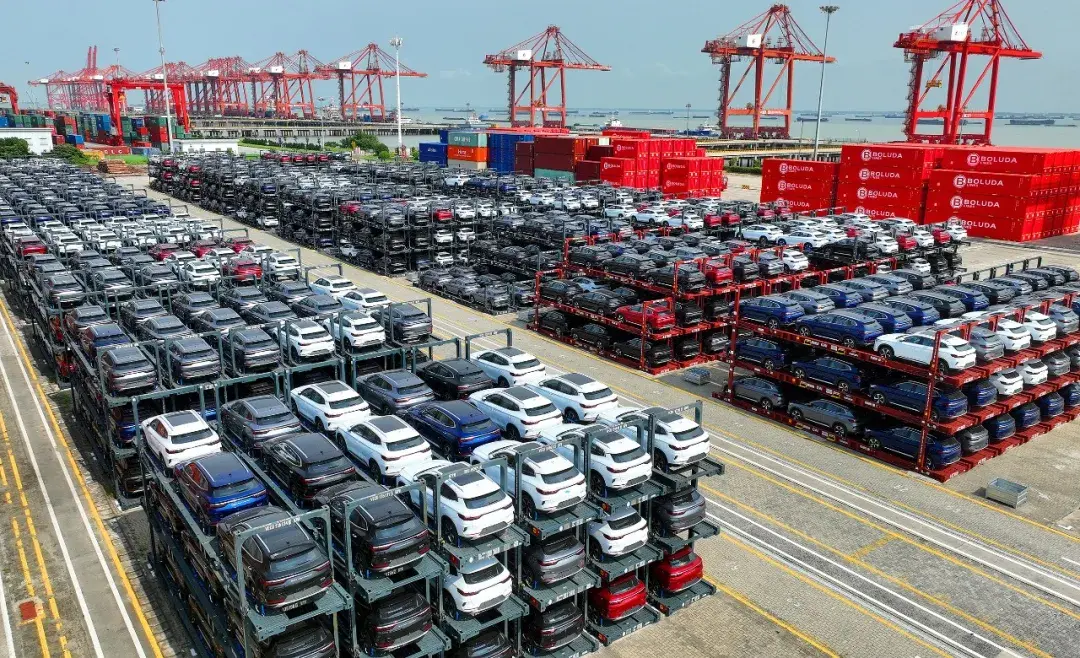
Exports remain the primary growth engine. Morgan Stanley lifts its 2026 passenger vehicle export growth forecast to 33% YoY, with NEV exports expected to surge 88% YoY to 4.5 million units — a dramatic revision from a prior 22% estimate — as BYD, Geely, SAIC, XPeng, and Leapmotor continue gaining share in Latin America, ASEAN, and Europe. Crucially, the bank estimates overseas unit profitability may run 5–10x higher than domestic — a figure that renders export mix not merely a volume story but a margin lifeline.
AI and autonomous driving are reshaping the competitive axis from price to value. L2+ penetration is forecast to reach 32% in 2026, up from 25% in 2025, while L3/L4 moves from concept toward commercialization. Most OEMs under coverage have guided for double-digit R&D spending growth in 2026, driven by AI computing power and autonomous driving investments. The key debate, per Morgan Stanley: whether that spending ultimately converts into non-vehicle revenue streams — physical AI, robotaxis, humanoids — or simply drags on operating margins without a corresponding return.
Mix upgrade continues, with the RMB 200,000–300,000+ (approximately US$27,000–41,000+) segment gaining 2–3 percentage points of share year-over-year in the first quarter of 2026, as demand gravitates toward premium and mid-to-large SUVs.
To-B opportunities — OEM technology partnerships and in-house commercialization — are gaining traction, with XPeng's deepening Volkswagen collaboration and NIO cited as early examples of a model that could provide margin support independent of retail volumes.
Stock Calls: Quality Over Consensus
Morgan Stanley's revised price targets reflect a more conservative demand recovery in the first half of 2026 and higher cost assumptions, but the bank is not uniformly bearish. Its order of preference places XPeng (XPEV.N, new PT: US$25, from US$34) at the top, with the bank projecting a sales inflection from the second half driven by the GX and upcoming Mona L03 models. The Volkswagen partnership is seen as providing both margin support and a credibility anchor for XPeng's physical AI narrative spanning robotaxis and humanoids.
Li Auto (LI.O, PT: US$21.50, from US$22) is characterized as a "measured-risk, potentially high-reward" play. Net profit forecasts for 2026–28 were cut 20–39% to reflect higher SG&A from overseas expansion, but the bank sees the upcoming L9 upgrade and i9 launch in the second half as capable of pushing monthly run rates back toward 40,000 units. An ongoing share buyback and a substantial discount to cash value provide downside cushion.
NIO (NIO.N, PT raised to US$7.40 from US$7.00) is the one name where Morgan Stanley actually upgraded its financial estimates, narrowing its 2026 net loss forecast by 62% to RMB 3.3 billion (approximately US$453 million) and pulling forward its breakeven timeline to 2027 — one year earlier than prior estimates. The ES9 launch in May is flagged as a critical volume and margin catalyst.
BYD (1211.HK, PT: HK$121, from HK$126) remains Overweight, but the bank tempers enthusiasm: 2026–28 net profit forecasts were trimmed 6–8% to RMB 38–59 billion on higher BoM costs from smart driving upgrades and R&D step-ups. The second-generation blade battery capacity bottleneck is expected to ease by summer 2026, after which new model launches — including Great Tang, Sealion 08, and Han EV — should support domestic recovery. BYD's upcoming Tech Day in May is the near-term catalyst to watch.
Great Wall Motor (2333.HK: Equal-weight, PT cut 20% to HK$12; 601633.SS: Underweight, PT cut 18% to RMB 14) faces the most challenging setup. Net profit forecasts were cut 30–32% for 2026–27, reflecting raw material cost inflation, Russian scrappage tax headwinds, and a conservative NEV strategy relative to peers. The A-share's stretched valuation — trading at roughly 18x 2026 earnings against a PT implying 13x — underpins the Underweight call.
The Broader Setup
Morgan Stanley expects downside risk to second-quarter volumes but sees easier base effects from the third quarter as a potential trading catalyst, with AD-focused names offering the most compelling valuation re-rating potential. The message to investors is clear: in a market where everyone is launching everything, the companies that can demonstrate disciplined execution — on exports, on AI monetization, and on cost control — will be the ones that ultimately separate from the pack.
Related Coverage: