
DeepSeek's $2.56B Huawei Chip Order Exposes China's AI Infrastructure Inflection Point
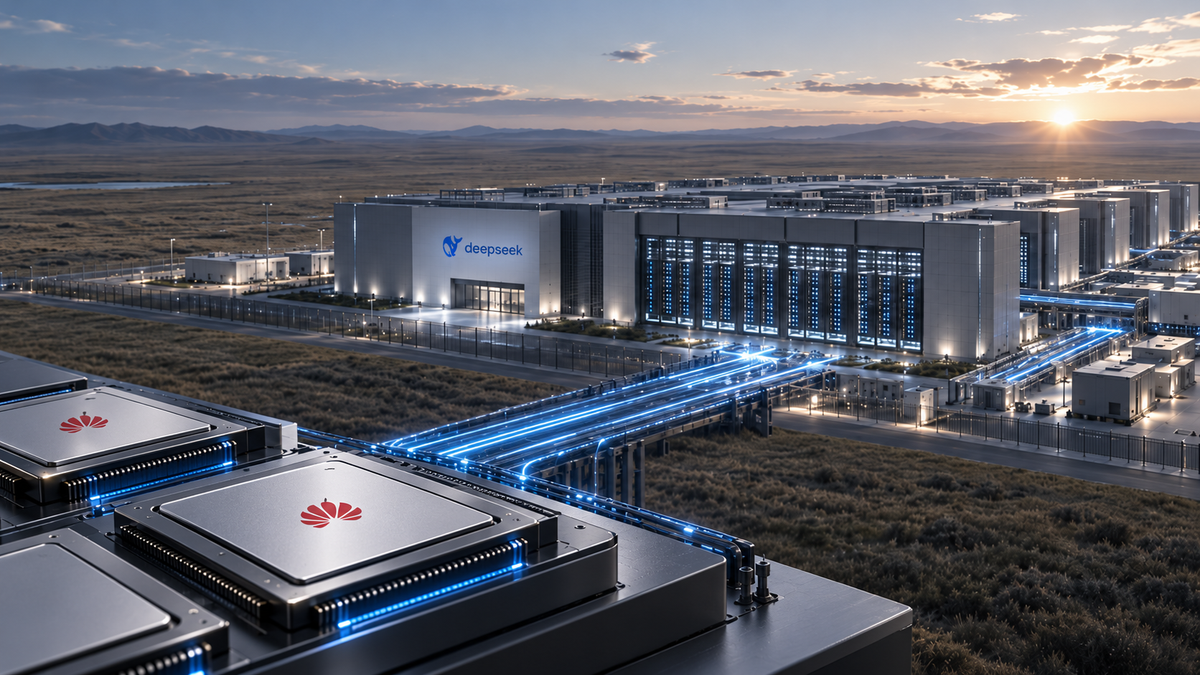
A single purchase order for 160,000 Ascend 950DT chips signals that China's AI compute stack has permanently bifurcated from the West—and that Huawei Technologies is now the sole credible supplier at scale.
Bloomberg reported on September 4, 2026, citing people familiar with the matter, that DeepSeek plans to deploy a minimum of 160,000 next-generation Huawei Ascend 950DT chips at a new hyperscale data center in Ulanqab, Inner Mongolia, primarily for model inference workloads. The order's estimated value stands at approximately RMB 18 billion (US$2.56 billion), making it one of the largest single AI chip procurement contracts ever disclosed in China. Huawei confirmed the Ascend 950DT is scheduled for general availability in Q4 2026, meaning full delivery could extend 12 to 18 months beyond the order date.
The market's immediate read is straightforward: Nvidia Corporation's CEO Jensen Huang has publicly confirmed the company holds a 0% share of China's AI accelerator market—a position that was effectively dominant just 18 months prior. TrendForce data for 2026 shows domestic solutions now command close to 90% of China's high-end AI chip market, with Huawei Ascend projected to hold a 62% share of the domestic AI accelerator segment for the full year.
Benchmarking the Cluster Redraws Global Scale Comparisons
The 160,000-chip deployment warrants direct comparison against the largest publicly disclosed AI clusters globally. xAI's Colossus facility in Memphis, Tennessee—widely described as the world's largest single-body liquid-cooled data center at launch in late 2024—initially deployed 100,000 Nvidia H100 units, later expanded to 150,000 H100s plus 50,000 H200s. Google's eighth-generation TPU architecture via its Virgo network supports interconnects of up to approximately 134,000 chips. Amazon Web Services and Nvidia's "Project Ceiba" supercomputer runs on 16,000 H200 chips.
DeepSeek's 160,000-unit cluster, if fully deployed as planned, would exceed or match every publicly confirmed Western AI cluster in raw chip count. The project's planned power draw is gigawatt-scale, placing it in a category occupied by only a handful of facilities worldwide.
The Ascend 950DT's architecture underpins the cluster's technical ambition. The chip integrates Huawei's proprietary HiZQ 2.0 high-bandwidth memory at 144GB capacity, with memory access bandwidth of 4TB/s and chip interconnect bandwidth of 2TB/s. The Atlas 950 SuperPoD configuration—the deployment architecture chosen for this cluster—supports up to 8,192 Ascend cards operating in concert via Huawei's proprietary "Lingqu" interconnect fabric.
Export Controls Force a Dual-Track Compute Strategy Across China's AI Sector
The procurement logic is not purely technical preference. Successive rounds of U.S. export controls have restricted Nvidia's China-addressable product to the H20, an export-compliant variant whose compute performance sits at roughly 15% of the H100's peak capability. DeepSeek founder Liang Wenfeng stated in July 2026 that four Huawei chips are needed to match the output of one top-tier Nvidia GPU, and that Huawei trails Nvidia by approximately two years in absolute performance terms—a candid acknowledgment that the choice is constrained as much as it is strategic.
The resulting architecture emerging across China's leading AI developers is a deliberate dual-track system: Nvidia's installed base of legacy H100 and H800 inventory handles training workloads, while domestic Ascend chips absorb inference demand—the faster-growing and more volume-intensive segment. DeepSeek has previously disclosed that API throughput limitations stemmed directly from compute constraints; the Ulanqab deployment is explicitly designed to resolve that bottleneck.
The pattern extends well beyond DeepSeek. Zhipu AI has commissioned a gigawatt-scale data center in Inner Mongolia running exclusively on domestic chips. Meituan completed full-cycle training of its large language model on a 50,000-card domestic chip cluster. ByteDance is in active discussions for a new compute project in Inner Mongolia. When four of China's most capital-intensive AI developers are executing the same infrastructure pivot simultaneously, the direction of the market is no longer a forecast—it is an observable outcome.
Four Supply Chain Segments Absorb Disproportionate Demand Shock
The 160,000-chip order does not land in isolation; it propagates through a specific set of upstream and downstream supply chain nodes that are structurally undersupplied relative to accelerating demand.
ABF Substrate Demand Surges Past Domestic Supply Capacity
The Ascend 950DT's multi-Chiplet stacking architecture requires ABF (Ajinomoto Build-up Film) substrates of 12 or more layers, with line width/spacing requirements at the 20-micron level—several multiples more demanding than consumer-grade chip substrates. The 160,000-chip order translates directly to demand for more than 160,000 high-end ABF substrate units, adding an estimated incremental market value exceeding RMB 1 billion (US$139 million) from this single order alone. The 2026 domestic high-end ABF substrate market is forecast to grow 192% year-on-year, yet domestic self-sufficiency remains below 15%. Domestic substrate manufacturers that have cleared Ascend supply chain qualification are positioned as the primary beneficiaries of this structural gap.
High-Speed Connectors See Volume and Price Expansion Simultaneously
The Atlas 950 SuperPoD architecture integrates three times the chip density of a standard server rack, driving step-change requirements for connector transmission speed, channel density, and signal integrity. The 224Gbps high-speed backplane connector—standard equipment for SuperPoD cabinets—is consumed at four times the rate of conventional server deployments. Companion 800G high-speed cable connectors carry unit prices approximately 80% above legacy products, generating simultaneous volume and average selling price expansion. The 2026 domestic AI high-speed connector market is forecast to grow 218% year-on-year, with compute-related applications contributing more than 60% of incremental demand. Domestic manufacturers that have cleared the 224G technical threshold and entered the Ascend SuperNode supply chain represent the highest earnings-leverage sub-segment in this procurement cycle.
AI Switches Absorb a Direct RMB 2 Billion-Plus Demand Injection
A 160,000-chip cluster operating under a Spine-Leaf three-tier networking architecture requires more than 1,000 AI switches, with 800G switches constituting over 70% of the deployment and 1.6T switches serving core nodes at more than double the per-unit value of standard equipment. This single project generates direct incremental AI switch demand exceeding RMB 2 billion (US$278 million). The 2026 domestic 800G AI switch market is forecast to grow 245% year-on-year. Domestic network equipment vendors that have released full product lines compatible with the Ascend ecosystem are direct beneficiaries of ten-thousand-plus chip cluster networking requirements.
Advanced Packaging Capacity Runs at Full Utilization
The Ascend 950DT's 2.5D advanced packaging process—incorporating Chiplet heterogeneous integration, TSV through-silicon vias, and multi-chip stacking—demands packaging precision, yield management, and throughput capacity that exceeds conventional OSAT capabilities. The 160,000-chip order maps directly to 160,000 units of advanced packaging capacity, sustaining full utilization at qualified packaging facilities. The 2026 domestic AI chip advanced packaging market is forecast to grow 176% year-on-year. Packaging and testing houses that have commissioned dedicated production lines compatible with the Ascend series are positioned to capture this demand as chip volume scales.
Huawei's Capacity Constraint Is the Order's Central Risk
The single most material execution risk in this transaction is Huawei's production capacity for the Ascend 950DT. The chip enters mass production in Q4 2026, with annual output currently estimated at several hundred thousand units across all customers. Fulfilling a 160,000-unit order for a single buyer—while simultaneously servicing other enterprise and cloud customers—implies a delivery timeline of 12 to 18 months under optimistic production ramp assumptions. Delays in TSMC-independent advanced node production, packaging yield improvements, or HBM supply from domestic memory producers could extend that timeline further.
The software ecosystem gap presents a longer-duration structural challenge. Nvidia's CUDA platform, built over two decades and supported by millions of active developers globally, constitutes a switching cost that no single procurement decision can neutralize. Huawei's CANN (Compute Architecture for Neural Networks) software stack is maturing, but the ecosystem inertia differential remains wide.
China's AI Chip Market Trajectory Frames the Investment Context
The aggregate market context amplifies the significance of this single order. China's AI chip market is forecast by institutional estimates to reach RMB 218.9 billion (US$30.4 billion) in 2026, expanding to RMB 256.7 billion (US$35.7 billion) in 2027. Domestic AI chip demand volume is estimated at 4 million units in 2026, rising to 6 to 8 million units in 2027. DeepSeek's 160,000-unit order represents 4% of 2026's total projected domestic demand volume—concentrated in a single facility, a single vendor, and a single application type.
The structural conclusion is that DeepSeek's Ulanqab commitment is not an isolated procurement event. It is the most visible data point in a market reorientation that has already claimed Nvidia's entire China accelerator revenue and is now generating a capital expenditure cycle for domestic suppliers that is both larger and faster than most 2025-vintage forecasts anticipated.
Related Coverage:
DeepSeek Posts 10x Revenue Surge, 82.9% API Margin as Valuation Nears $70B