
Chinese Automakers Seize 7.6% Global Share as Overseas EV Sales Surge 62% in Seven Months
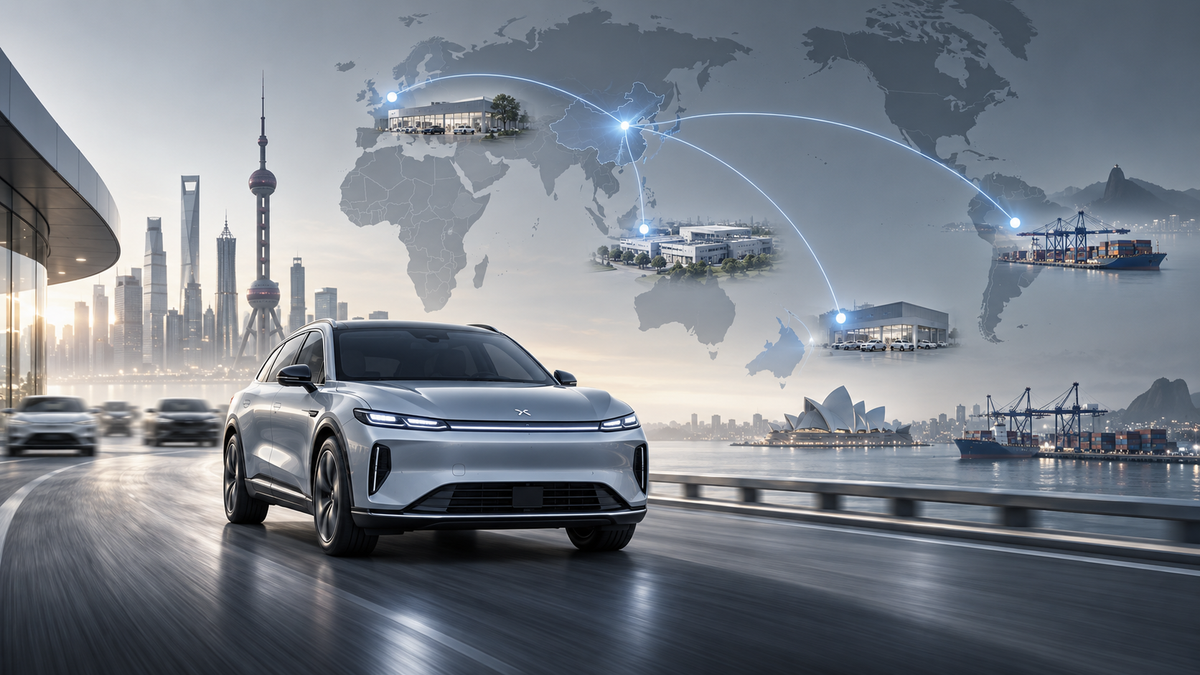
Chinese domestic brands sold 2.94 million vehicles in trackable overseas markets in the first seven months of 2026, a 62% year-on-year jump that signals the industry's pivot from opportunistic exports to systematic global market construction — and is compressing margins for Japanese rivals from Oceania to Southeast Asia.
The acceleration marks a structural inflection rather than a cyclical spike. July alone posted 475,200 units, up 59% year-on-year and a fresh monthly record, extending a rally that began gaining momentum in early 2025. The data, compiled by independent analyst Cui Dongshu of the China Passenger Car Association, covers trackable retail registrations in key markets and excludes hard-to-verify volumes in less-developed economies — meaning the headline figures likely understate actual penetration.
Investors tracking BYD, Geely Automobile Holdings, Chery Automobile and SAIC Motor Corporation should note that the growth is no longer driven by low-cost commodity vehicles filling vacuum markets. The incremental share gains are concentrated in higher-income geographies — the European Union, Oceania and urban Southeast Asia — where brand equity and after-sales infrastructure matter, and where Chinese OEMs are now competing directly against Toyota Motor Corp., Honda Motor Co. and Stellantis NV.
EV Share Jumps 9 Points, Rewriting the Competitive Map
The most strategically significant data point in the July dataset is not total volume but mix: Chinese domestic-brand new-energy passenger vehicles captured a 24% share of the overseas NEV segment in January–July 2026, up 9 percentage points from the same period in 2025. In South America, NEV share for Chinese brands has crossed 79%; in Southeast Asia it stands at 45%.
That shift is partly a function of U.S. market contraction. American EV demand has softened materially in 2026 amid policy uncertainty, shrinking the denominator in the global NEV share calculation. But the numerator is also genuinely expanding: plug-in hybrid (PHEV) models are circumventing EU tariff barriers that target battery-electric vehicles, with PHEV registrations from Chinese brands posting outsized growth in Germany, France and the Netherlands in the first half of the year.
The EU has emerged as the single largest incremental engine for Chinese NEV exports. In May 2026, five major Chinese brands collectively registered 138,400 new vehicles in Europe — surpassing the combined 130,400 units from six Japanese marques for the first time. Chinese brands' EU market share reached 12.01% that month, up from effectively negligible levels three years earlier, while Japanese brands' aggregate share slipped 3.13% year-on-year. Analysts at the China Passenger Car Association characterize this as "structural divergence on the electrification track" rather than a temporary dislocation.
Regional Footprint Reveals a "Surround the Cities" Strategy Taking Shape
The geographic distribution of Chinese brand share in January–July 2026 illustrates a deliberate sequencing: the Southern Hemisphere at 21%, Europe at 12%, Southeast Asia and the Middle East at approximately 9%, with the consolidated "mainstream market" share at roughly 10%. Exposure to the U.S., Japan and South Korea remains near zero — a deliberate posture given tariff and regulatory headwinds.
Russia and Central Asia remain the highest-penetration market, where Chinese brands hold the No. 1 position. Chery and Changan Automobile have delivered the standout volume growth in the region, though overall export momentum to Russia has slowed relative to the 2023–2024 peak.
Latin America is the fastest-evolving theater. Cumulative trackable sales reached approximately 950,000 units in January–July 2026. BYD commands roughly 30% segment share in the region, with Geely, SAIC-GM-Wuling and Chery forming a second tier. BYD's localized assembly capacity in Brazil — designed to sidestep the country's Imposto sobre Produtos Industrializados (IPI) industrial tax structure — has been the critical enabler. Brazil's forthcoming IPI policy review represents the single largest near-term regulatory risk to the region's export trajectory.
Oceania presents a different dynamic: BYD has emerged as the dominant force, while Great Wall Motor has overtaken Chery for second place — a competitive reshuffling that illustrates the intensifying intra-Chinese-brand rivalry in markets where access barriers are low.
Africa remains a volume anchor, with Chery and Great Wall sustaining strong performance and BYD accelerating rapidly, leveraging infrastructure and trade relationships built over two decades of Chinese engineering project activity on the continent.
South Asia is the least-developed front, with SAIC's Wuling brand carrying the majority of Chinese exposure. Guangzhou Automobile Group and BAIC Motor Corporation are early-stage entrants posting initial traction.
Localization Displaces Pure Export, Squeezing Japanese OEMs
The strategic model has shifted decisively. Chinese OEMs have moved away from the "buy-out" wholesale export model toward dealer-network ownership, local KD (knock-down) assembly, and in select markets, full-scale manufacturing. BYD, Great Wall and Chery have established local commercial management centers that directly supervise dealer service quality — a capability investment that is beginning to translate into measurable brand equity gains in customer satisfaction surveys across Southeast Asia and the Middle East.
This mirrors — and in several respects improves upon — the playbook used by Chinese white-goods exporters Haier Group and Midea Group in earlier decades, a comparison the analyst report explicitly invokes as a cautionary lesson absorbed and applied.
The pressure on Japanese OEMs is quantifiable. Toyota, Honda and Suzuki Motor are losing share simultaneously in Oceania, Africa and Southeast Asia — markets they have dominated for 30 to 40 years. The combination of Chinese brands' price competitiveness, NEV technology depth and improving after-sales networks is eroding the reliability-and-resale-value moat that Japanese brands have historically leveraged in emerging markets.
Profitability Remains the Unresolved Tension
The export surge is not translating cleanly into earnings. Separate data from the China Passenger Car Association show that China's automotive industry profit margin stood at just 3.6% in January–July 2026, with revenue up 2.7% year-on-year but costs rising 3.8% and profits falling 20%. The divergence between volume growth and margin compression reflects intense domestic price competition bleeding into export pricing discipline, as well as the upfront capital costs of building overseas distribution and assembly infrastructure.
For investors, the implication is that the revenue line at SAIC, BYD and Geely is expanding faster than the profit line — a pattern consistent with a land-grab phase that prioritizes share over returns. The question is whether the localization investments now being made in Brazil, Europe and Southeast Asia will generate the margin recovery that justifies current valuations, or whether Chinese OEMs are replicating the volume-without-profit trap that constrained their domestic market peers through the 2018–2022 cycle.
Full-year 2026 total China auto exports are projected at 12 million units, per the China Passenger Car Association, against 6.41 million units in January–July — implying a second-half run rate broadly consistent with the first half's 54% year-on-year pace.
Related Coverage:
China's Auto Sector Posts Worst H1 Earnings in Years as Nine of 16 Carmakers Bleed Red