
Tencent's WorkBuddy: Can an AI Productivity Tool Become the Operating System for the Agent Era?
What Is WorkBuddy — and Why Does It Matter?
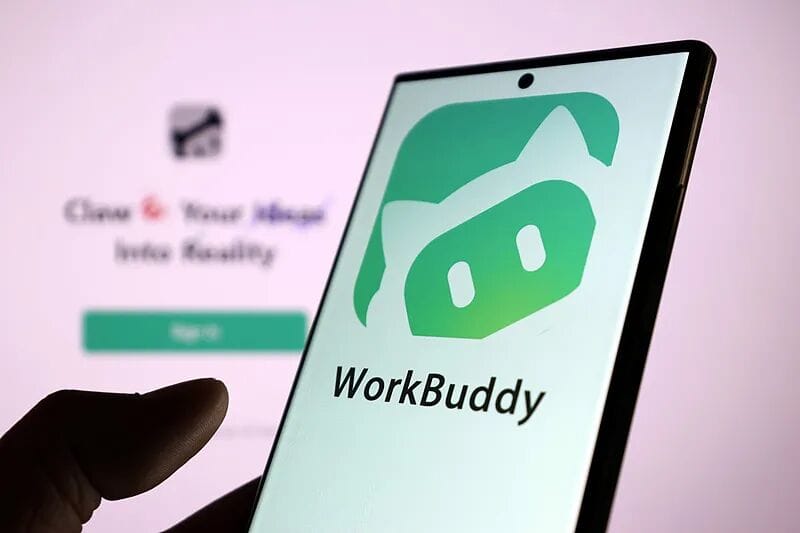
WorkBuddy is Tencent's AI-native productivity platform, built on top of CodeBuddy, an AI coding agent the company developed starting in 2023. Launched in March 2026, WorkBuddy has grown rapidly into China's largest efficiency-focused AI agent service by daily active accounts, according to Tencent's Q1 2026 earnings report.
In June 2026, its monthly PC visits surpassed 20 million, placing it first in China's native AI office agent market, per Analysys data.
But WorkBuddy is no longer positioning itself as a productivity tool. In September 2026, Tencent opened WorkBuddy to external developers, hardware manufacturers, and enterprise partners — signaling an ambition that goes well beyond an office assistant: to become the operating system of the AI Agent era.
Why the Competitive Logic Has Shifted
For most of the first half of 2026, competition in China's AI productivity space followed a familiar playbook: free tiers to acquire users, feature races to retain them, and model benchmarks to claim bragging rights. The decisive variable was raw capability — how well an AI agent could execute tasks.
That logic is now changing.
The emerging consensus among industry players is that individual agent capability has largely converged. The new battleground is ecosystem depth: which platform can connect the most devices, integrate the most enterprise systems, and cover the widest range of workflow scenarios — enabling agents to run uninterrupted from start to finish.
This shift reframes the core question from "how smart is your AI?" to "how far can your AI reach without breaking down?"
Liu Yi, Vice President of Tencent Cloud and the executive credited with building WorkBuddy, summarized the logic: "True productivity is not just about how capable a single tool is — it depends on how many capabilities it can connect and how many scenarios it can enter."
How WorkBuddy's Ecosystem Is Structured
The September 2026 open platform launch introduced three integration layers:
1. Hardware Layer Nine co-branded devices — including smart glasses, earphones, microphones, and recording cards from partners such as Plaud, Rokid, Insta360, iFlytek, and Anker — can now route audio and video inputs directly into WorkBuddy for cloud processing, with outputs synced across devices. The integration lowers the barrier for hardware makers to embed AI without building their own models.
The notable constraint: all nine initial devices are voice-input peripherals. WorkBuddy's hardware integration is, for now, concentrated at the audio capture layer. The devices function more as external input extensions than deeply embedded co-processors.
2. Application ("Buddy") Layer Enterprise partners in finance, legal, healthcare, and education can build branded AI workspaces on top of WorkBuddy's agent infrastructure, without developing their own AI. Partners bring their own domain data and workflows; WorkBuddy provides the agent runtime.
In practice, however, partners are unlikely to expose their core data or proprietary logic to the platform. A financial terminal integrated into WorkBuddy, for example, can support market summaries and information aggregation — but not trade execution or deep data processing. The application layer currently functions more like a mini-program aggregator than a true agent operating system.
3. Developer Layer Developers can build and publish three types of components: Skills (executable workflows), Experts (domain knowledge modules), and Connectors (API bridges to external tools and services). The framework allows developers to extend WorkBuddy's capabilities into specialized verticals.
The gap: monetization infrastructure for developers — payment rails, revenue sharing ratios, settlement timelines — has not been publicly defined. The platform's head of ecosystem acknowledged that operational and marketing tools for developers are still under development and not yet available.
The Four-Stage Model for Enterprise AI Adoption
WorkBuddy's enterprise strategy is built around a progression that distinguishes it from simply packaging a consumer product for corporate use:
- Cultivate "super individuals" — empower key employees to dramatically amplify personal output using AI
- Institutionalize organizational assets — convert individual expertise into reusable AI skills, expert models, and knowledge bases
- Embed AI into core workflows — integrate agent capabilities across finance, HR, legal, and operations
- Build governance infrastructure — establish controls for cost, security, permissions, and compliance
This framework reorients the key performance metric away from token consumption toward demand throughput rate: how quickly an organization can respond to market needs and deliver value to users. For software companies, this directly measures innovation velocity.
A second metric — retention smoothness — tracks how often an AI agent is interrupted by human checkpoints or system permission walls during task execution. Many enterprises that purchase AI tools report low utilization not because the tools are poor, but because internal systems create friction that prevents end-to-end task completion.
What Are the Structural Risks?
The ecosystem was built in three months. WorkBuddy's team began planning the open platform in May 2026 and launched in September — a timeline that raises legitimate questions about platform maturity. CodeBuddy, the coding agent that underpins WorkBuddy's core capabilities, took more than two years to stabilize before it was ready to power a consumer product. The question is whether six months of validation in a more complex, fragmented office environment is sufficient to package those capabilities as stable APIs for third parties.
Office tasks have lower error tolerance than code. A software bug can be patched; an incorrect data analysis can cause direct business damage. The reliability bar for enterprise-facing AI agents is structurally higher than for developer tools.
Monetization remains undefined. The platform has introduced a unified credit system for end users, allowing them to pay for tasks across multiple applications with a single currency. But the revenue-sharing model for partners — how they get paid, at what rate, on what timeline — remains publicly unspecified. Without clear economics, partner engagement is likely to remain exploratory rather than committed.
Internal alignment is incomplete. WorkBuddy was built within Tencent Cloud (CSIG). Enterprise WeChat belongs to a different business group. Tencent Docs only formally joined Tencent Cloud in June 2026. As WorkBuddy expands its positioning toward a "unified entry point for work and life," it inevitably encroaches on the turf of other Tencent products — creating internal coordination challenges that external observers tend to underestimate.
The absence of Enterprise WeChat and Tencent Docs from the initial partner list is a visible signal of these frictions. Both products have their own AI roadmaps and their own ecosystem ambitions. Subordinating them to WorkBuddy is not a straightforward decision.
Why Tencent Moved Early — and What It's Actually Betting On
The competitive logic is clear: Alibaba and ByteDance are both consolidating their AI productivity product lines around unified internal entry points. The window to establish ecosystem position is open now, but it will not stay open indefinitely.
By launching the open platform before its monetization infrastructure is complete, Tencent is making a calculated trade-off: claim territory first, then build the commercial foundation. This is a recognizable pattern in platform competition — analogous to how mobile app stores, cloud marketplaces, and mini-program ecosystems have historically developed.
The risk is equally recognizable. If revenue-sharing mechanisms remain vague for too long, partners who have invested development resources in WorkBuddy integration will reassess. SaaS vendors in particular have limited tolerance for integrations that generate no incremental revenue.
WorkBuddy's current market position was built on product quality — specifically, the stability and task execution reliability inherited from CodeBuddy's two-plus years of development. That foundation is real. The open question is whether the team can sustain product iteration velocity while simultaneously building out a three-layer ecosystem — and whether the 100-plus launch partners represent the beginning of a self-sustaining ecosystem or a well-staged launch event.
What to Watch Next
Several variables will determine whether WorkBuddy's ecosystem ambition translates into durable competitive advantage:
- Developer monetization clarity: When and how WorkBuddy defines revenue sharing for Skills, Experts, and Connectors will be the most important near-term signal of platform seriousness
- Enterprise WeChat and Tencent Docs integration: The depth and timeline of integration with Tencent's own productivity suite will reveal how much internal alignment has actually been achieved
- Hardware expansion beyond voice input: Whether WorkBuddy can extend hardware integration beyond audio peripherals into display, compute, or mobile form factors
- Partner retention rates: Whether initial integrations convert into sustained usage and business value creation — or quietly go dormant
- Competitive response: How Alibaba's DingTalk ecosystem and ByteDance's Lark platform respond to WorkBuddy's open platform move will shape the pace and nature of the next competitive cycle
The structural bet Tencent is making is that when model capabilities converge — as they historically do — ecosystem breadth and switching costs become the primary moat. That logic is sound. Whether WorkBuddy can execute the transition from product leader to platform operator, without losing the product quality that created its lead, is the central question the next 12 to 18 months will answer.
Related Coverage:
China’s AI Office War Moves Beyond Chatbots as Doubao Takes Aim at Tencent WorkBuddy