
DeepWay Secures $162 Million in China's Largest Autonomous Trucking Round as Capital Pivots to Commercial Viability
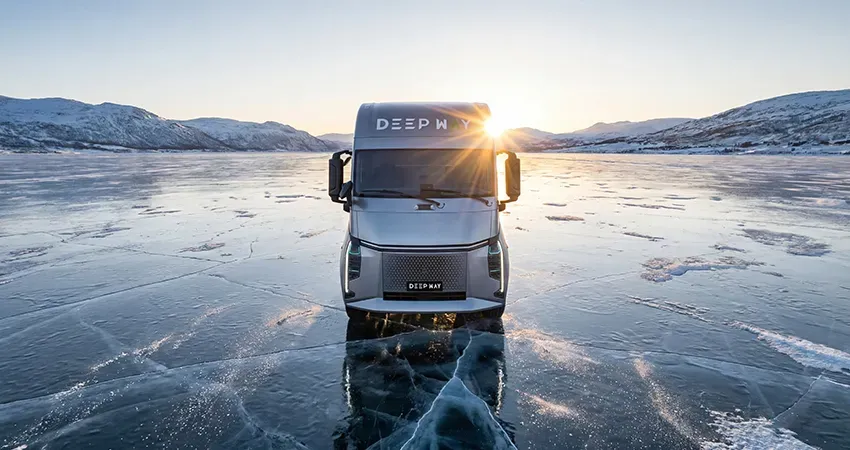
In a market where autonomous driving unicorns have burned through billions chasing moonshot promises, a Chinese heavy-duty truck startup just landed RMB 1.177 billion (US$162 million) by doing something radical: making money.
DeepWay, an autonomous electric truck manufacturer, closed its Pre-IPO round on January 27, 2026, marking the largest single financing in the autonomous trucking sector's history. The round drew a telling mix of investors—state-backed Puhua Capital, Temasek's ABC Impact fund, and battery giant Sunwoda Technology—signaling a fundamental shift in how capital evaluates self-driving ventures.
Pre-IPO rounds are notoriously brutal. Investors at this stage aren't buying science projects; they're underwriting near-term public market stories. That DeepWay attracted sovereign wealth, foreign institutional capital, and strategic industrials simultaneously suggests the market has moved past "technology worship" and toward what one might call commercial certainty.
The Pragmatist's Playbook
DeepWay's approach diverges sharply from the industry's "rocket launch" school—companies betting everything on a direct leap to Level 4 autonomy. Instead, the company adopted an incremental strategy: build commercially viable Level 2 trucks today to fund Level 4 development tomorrow.
The numbers validate the strategy. DeepWay has accumulated over 100 million kilometers of real-world L2 driving data, with a paid subscription penetration rate exceeding 30%. In logistics—an industry where operators scrutinize every basis point of operating cost—that adoption rate speaks volumes. Customers aren't paying for futurism; they're paying for measurable reductions in accident rates, fuel consumption, and driver fatigue.
This mirrors broader 2025 trends. China's autonomous driving sector attracted over RMB 58.2 billion (US$8 billion) in disclosed funding last year, nearly triple 2023's "winter" levels (around RMB 20 billion). But the capital concentrated heavily in companies demonstrating unit economics, not just technical prowess. Leading autonomous delivery firms raised over RMB 4 billion (US$550 million), while several niche players completed Hong Kong IPOs, including Pony.ai and Xidi AutoDrive.
Vertical Integration as Moat
DeepWay's competitive edge lies in a capability rare among autonomous driving companies: it designs and manufactures its own trucks. This vertical integration creates three compounding advantages.
Data sovereignty. By controlling the entire vehicle architecture, DeepWay captures granular telemetry from every component—drivetrain, suspension, thermal management. Traditional autonomous driving suppliers retrofitting third-party trucks see only what CAN bus protocols expose. DeepWay sees everything, enabling adaptive algorithms for perception, load management, and platooning.
Cost structure. Conventional OEMs retrofitting L2 systems face bills of materials exceeding RMB 20,000 per vehicle. DeepWay's forward-integration approach adds just RMB 3,000–5,000 in incremental BOM cost, dramatically expanding addressable market and accelerating technology diffusion.
Safety depth. DeepWay's electronic architecture and chassis were designed from inception for autonomous operation, enabling millisecond-latency cross-domain fusion. The steering system features adaptive calibration to compensate for long-haul drift; the braking system balances regenerative and pneumatic actuation for optimal energy recovery without compromising safety. The company's proprietary vehicle control unit (VCU) orchestrates fail-safe redundancy that sensor-only competitors cannot replicate.
The L4 Catalyst
Heavy trucks present unique autonomy challenges. A loaded tractor-trailer's mass can swing by 30 tons between empty and full; the articulated connection between cab and trailer introduces non-linear dynamics; varying road surfaces and weather multiply edge cases exponentially.
DeepWay's 100 million L2 kilometers weren't accumulated for perception training—they're a massive dataset for control algorithm calibration under real-world conditions. Because L2 and L4 share underlying execution logic, these control models transfer directly. As DeepWay's fleet scales toward hundreds of millions of kilometers, this data moat becomes nearly insurmountable.
Equally important, DeepWay has industrialized engineering processes for testing, validation, and fleet deployment—capabilities that transfer seamlessly to L4 rollout. The company is already conducting constant platooning trials in Xinjiang's Hami region, leveraging modular rule-based algorithms alongside end-to-end neural networks to handle corner cases where pure learning models falter.
Capital's New Calculus
DeepWay's financing underscores a maturation in autonomous driving investment. The sector's frothy years rewarded technical audacity; today's capital demands cash flow visibility and defensible market position. DeepWay's "earn while you learn" model—generating revenue from L2 to fund L4 R&D—represents a sustainable path that doesn't rely on perpetual fundraising.
With this round closed, DeepWay is positioned to accelerate development of end-to-end foundation models while expanding commercial fleet operations. For an industry long on promises and short on profits, that combination of present-tense revenue and future-tense technology may finally be the formula that works.
The autonomous trucking endgame remains Level 4 driverless operation. But DeepWay's $162 million round suggests investors now believe the winners won't be those who sprint toward the finish line—they'll be those who build profitable businesses along the way.