
DJI Spin-off Zhuoyu Valued at Over 10 Billion Yuan After Strategic Backing from FAW Group
Zhuoyu Technology, the autonomous driving unit originally incubated by drone giant DJI, has secured a strategic investment totaling over RMB 3.6 billion yuan (US 497 million) from China FAW Group. The financing round pushes Zhuoyu’s post−investment valuation past the RMB 10 billion yuan mark, establishing the Shenzhen-based firm as a new unicorn in the intelligent driving sector.
This transaction represents the largest capital injection for a Level 2+ autonomous driving provider in 2025, with China's state-owned automotive giant FAW becoming Zhuoyu's largest external single shareholder. Despite the significant stake, the deal is structured as a strategic investment rather than a takeover; Zhuoyu will maintain its status as an independent legal entity, preserving its current management team, technical roadmap, and brand strategy.
The investment comes amidst a sharp rebound in capital activity within the autonomous driving sector this year, following a period of market contraction. The broader industry—encompassing robotaxis, sensors, and driving assistance software—has recorded approximately 19 financing rounds in 2025 with a combined value exceeding RMB 40 billion yuan (US$5.5 billion). Zhuoyu’s latest fundraising accounts for nearly 10% of this total, signaling a decisive shift where industrial capital from automakers is replacing venture capital as the primary driver of commercialization.
For the market, the deal underscores the accelerating trend of "gas-electric same intelligence", where advanced driving capabilities are extended beyond electric vehicles to internal combustion engine models. By backing Zhuoyu, FAW aims to secure a competitive edge in the "unrestricted warfare" of high-end intelligent driving, leveraging Zhuoyu's expertise in cost-efficient, mass-deployable autonomous systems to accelerate its own technological transformation.
Industrial Capital Takes the Lead
The shareholder structure of Zhuoyu reflects a broader industry trend where major automakers are becoming direct stakeholders in technology providers to secure supply chains and technical integration. In addition to lead investor FAW, Zhuoyu's roster of shareholders includes entities affiliated with BYD, SAIC Motor, and BAIC Group, alongside original backer New Territory Technology Company Limited—an entity of DJI.
Unlike traditional venture capital bets, these investments follow a pattern of "cooperation first, investment later." Automakers typically validate Zhuoyu’s technology through mass production partnerships before committing capital. This marks a maturation of the sector in 2025, where funding is directly tied to proven scalability and immediate commercial application rather than speculative long-term growth.
Cost-Efficiency and Technical Roots
Zhuoyu’s competitive advantage stems from its heritage in drone technology, specifically the binocular vision systems first introduced in DJI’s Phantom 4 drone in 2016. The company focuses on maximizing performance from limited computing power, a strategy that contrasts with competitors who rely on expensive, high-specification hardware.
The company has reportedly achieved full Level 2+ driving assistance capabilities using computing power as low as 32 TOPS (tera operations per second)—significantly below the industry standard. This efficiency is achieved through a fundamental optimization of chip architecture. Rather than relying solely on CPUs, Zhuoyu’s proprietary tools allocate specific algorithmic operators to dedicated AI accelerators within the System on Chip (SoC), reducing latency for tasks like image scaling from 2 seconds to 20 milliseconds.
This "code-level" optimization allows Zhuoyu to deliver high-end features at approximately half the hardware cost of mainstream competitors, addressing a critical need for automakers seeking to deploy advanced features across lower-priced, high-volume vehicle segments.
Mass Production and Integration
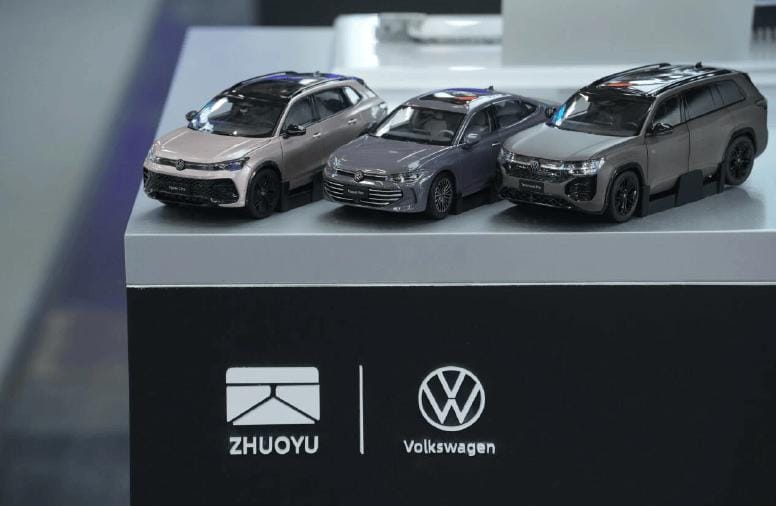
The application of Zhuoyu's technology has rapidly expanded across multiple brands and powertrain types. The company has successfully implemented high-speed navigation and driving assistance in fuel-powered vehicles, a segment often overlooked in the intelligence transition. Notable implementations include the FAW-Volkswagen Talagon and the new generation Sagitar, as well as the SAIC-Volkswagen Pro family, marking a significant step in the "gas-electric same intelligence" strategy.
Furthermore, Zhuoyu is advancing toward "Cockpit-Driving Integration", a centralized architecture that unifies smart cockpit functions with autonomous driving controls on a single chip. This approach, seen in models like the Arcfox Alpha T5 from BAIC, represents a transition toward central computing architectures essential for future "robotic car" concepts. By providing a full stack solution—including end-to-end algorithms, operating systems, and protocols—Zhuoyu is evolving from a component supplier into a provider of underlying customized intelligence platforms.
Sector Consolidation
As of late 2025, the autonomous driving landscape in China is entering a "knockout stage." The market is consolidating around players who can demonstrate both technological leadership in large multi-modal models and the ability to execute cost-effective mass production.
With the supply chain maturing and hardware costs decreasing, traditional automakers are aggressively pursuing intelligence transformations to survive what is described as a "life or death" phase for the industry. Zhuoyu’s combination of high-end technological capabilities (such as VLA large models) and a proven track record in low-cost deployment positions it as a critical partner for OEMs looking to remain competitive in a saturated market.