
From ‘Despair’ to a $600 Million Funding Round: How Neolix Is Betting on the Mass Commercialization of Autonomous Delivery
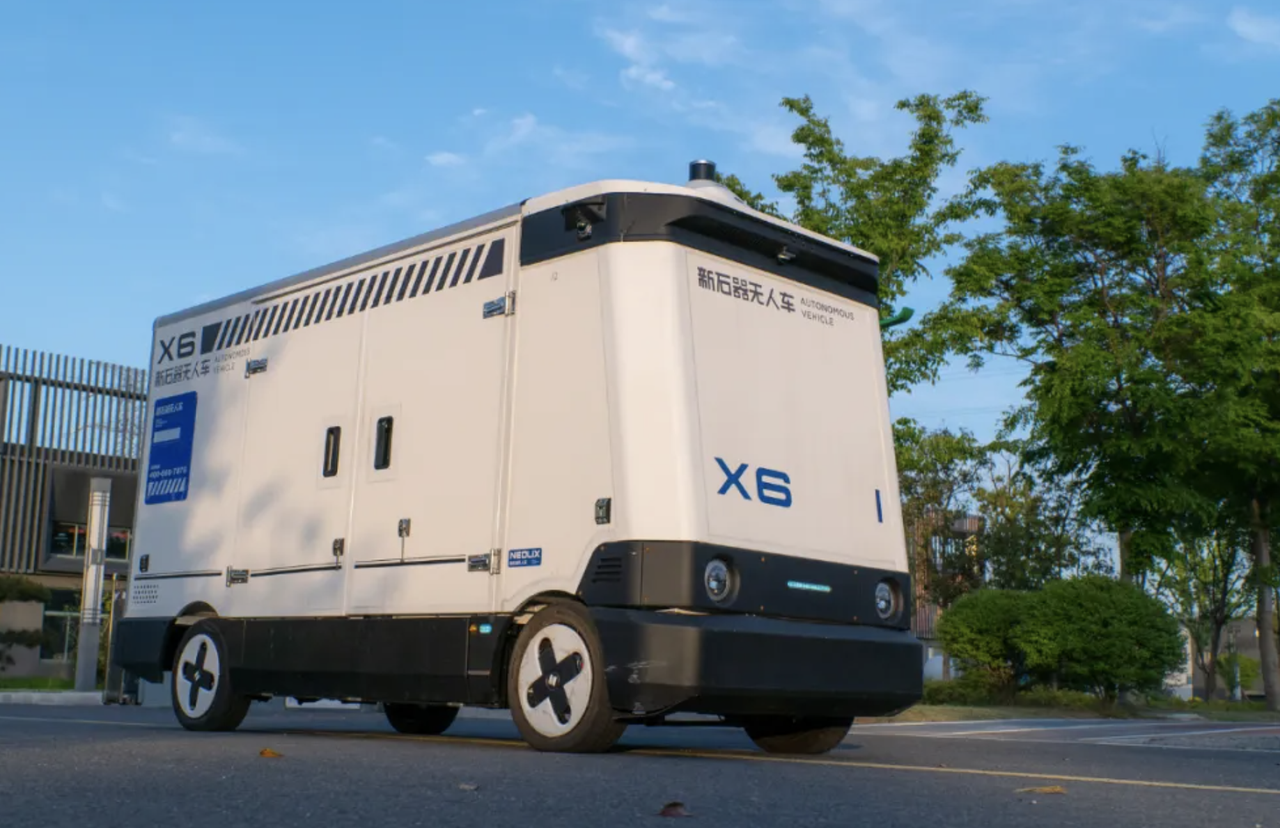
Chinese autonomous logistics firm Neolix has secured over $600 million in a Series D funding round, a landmark deal that signals the country’s driverless delivery sector is shifting decisively from research and development into large-scale commercialization.
The financing, one of China’s largest private equity transactions in 2025, provides Neolix with significant capital to expand production and accelerate its global push. The company has already delivered over 10,000 of its L4 autonomous Robovans and is undergoing a strategic pivot from relying on a few large logistics giants to serving a broader base of smaller businesses.
"We believe the industry is moving from the '0 to 1' phase into a '1 to 100' period of super-fast growth," Yu Enyuan, founder and CEO of Neolix, said in an interview. "It's crucial to have enough ammunition to seize this window of opportunity."
With the new capital, Neolix plans to deepen its investment in algorithms, expand its product line and production capacity to meet potential demand of 100,000 units next year, and build out its global sales and service network. The company reported achieving monthly profitability in the first half of 2025 and projects it will be fully profitable next year, with expected revenue hitting the RMB 10 billion yuan (about $1.4 billion) level in 2025.
A Strategic Shift Beyond Big Logistics
A cornerstone of Neolix’s strategy is to reduce its dependence on a handful of large enterprise clients, known as Key Accounts (KAs). While major delivery firms like SF Express, JD.com, and China Post remain core customers, the company is aggressively expanding into the more fragmented market of small and medium-sized businesses.
"What determines our survival is not the KA market, but the speed of our expansion into the small B market," stated Yu. He cited the cautionary tale of a promising U.S. peer that collapsed after a contract delay from a single major client disrupted its cash flow. Orders from smaller businesses now account for half of Neolix’s monthly deliveries of over 2,000 units, a figure the company aims to increase to 70-80% next year.
Commercialization at Scale
The funding and strategic pivot are underpinned by tangible commercial traction. The milestone of 10,000 cumulative vehicle deliveries, reached two months ahead of schedule, marks a significant moment for the L4 autonomous driving sector, demonstrating the potential for mass deployment in logistics. The company is now targeting a monthly delivery rate of 3,000 units by the end of the year.
Neolix's business model is centered on selling its vehicles as "AI products" rather than operating a large-scale leasing fleet. The company has calculated the all-in cost per kilometer for its vehicles—including hardware depreciation, operations, maintenance, and power—at approximately RMB 0.4 to 0.5 yuan. The Robovans are designed for a lifespan of eight years, or 300,000 to 500,000 kilometers of travel.
Mapless Technology and Global Ambitions
A key technological advantage for Neolix is its early adoption of a "mapless" or pure-vision autonomous driving system. This approach provides the operational flexibility needed for on-demand logistics, where routes are not always fixed. Crucially, it also resolves a major hurdle for international expansion: data compliance. By avoiding the large-scale collection of high-precision mapping data, Neolix can more easily navigate strict data security regulations in overseas markets.
The company is using its recent investment from an Abu Dhabi-based fund to establish a bridgehead in the Middle East. It has already secured the world's first public road license for driverless vehicles in the UAE and signed a deal with state-owned entity K2. The goal is to deploy 5,000 vehicles in the UAE by the end of next year. Neolix is also establishing pilot projects in South Korea, Southeast Asia, Europe, and Hong Kong.
Navigating a Competitive Field
As capital flows into the sector, competition and price wars are intensifying. Responding to a competitor's recent ultra-low bid in a tender, Yu remained firm on Neolix's strategy, emphasizing that the company will not engage in a race to the bottom. "The logistics business is about results," he said. "If you can't genuinely help clients lower their operating costs, they won't buy your product."
Instead, Neolix aims to build a healthy ecosystem with a reasonable pricing structure that allows partners in its value chain to thrive. The company's vision is built on what Yu describes as "long-termism," a philosophy of patient, focused execution. "In this industry, we might be the only ones who truly treat this as a long-term cause," he said. "I have been waiting for a second long-termist rival to emerge."