
Geely Bets €221 Million on Ford's Idled Spanish Plant, Rewriting China's European EV Playbook
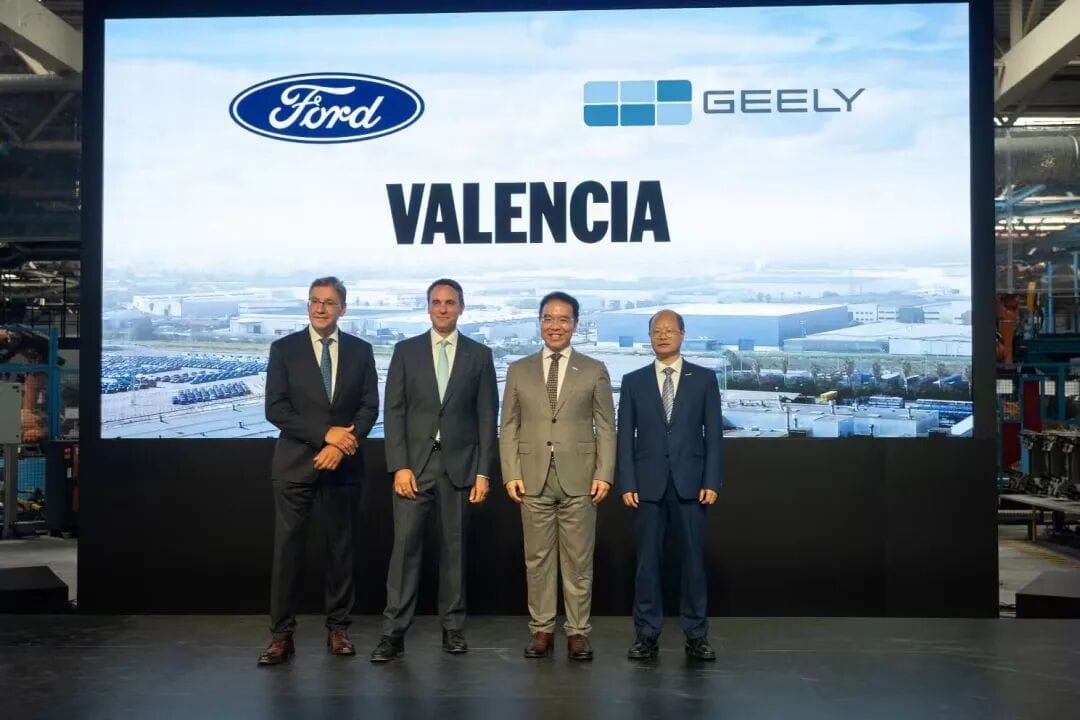
Geely is acquiring a 34% stake in Ford's Valencia factory for €221 million (approximately RMB 1.765 billion, or US$245 million), a transaction that marks the most structurally significant pivot yet in Chinese automakers' European manufacturing strategy — and the most consequential shift in the Geely-Ford relationship since Geely bought Volvo from Ford for US$1.8 billion in 2010.
The deal, announced July 23, 2026, transforms a chronically underutilized asset — Ford's Almussafes plant in Valencia, Spain, running at roughly 26% of its roughly 500,000-unit annual capacity as of 2025 — into a shared advanced manufacturing center for both brands' new-energy vehicles. The joint venture, pending regulatory approval, is slated to begin operations in the first half of 2027, with the first new models rolling off the line in 2028. For investors tracking Chinese OEM internationalization, the transaction crystallizes a "capital-light localization" model that bypasses greenfield factory risk entirely.
Market reception has been measured but constructive. Geely (00175.HK) had already signaled the strategic direction in February 2026, and the company's first-half export data — 474,000 units, up 158% year-on-year, exceeding the full-year 2025 export volume — provides the commercial logic underpinning the move. Geely has since raised its full-year 2026 export target twice, from 640,000 units to 750,000, and now to 900,000 units.
Diverging Trajectories Converge Around One Underperforming Factory
The strategic arithmetic of this deal is best understood by examining what each party brings to — and desperately needs from — the table.
Ford's European position has deteriorated markedly over the past decade. From annual passenger car sales exceeding 1 million units and a No. 4 market ranking roughly ten years ago, Ford Europe's 2025 passenger car volume fell to approximately 426,000 units, placing it eighth. The Fiesta, Mondeo, S-MAX, Galaxy, and Focus have all been discontinued or wound down. The Valencia plant, which opened in 1976 and once produced the Fiesta at scale, now relies almost entirely on the Ford Kuga to justify its fixed-cost base — stamping lines, body welding, paint shop, final assembly, and a workforce whose costs accrue regardless of throughput.
Geely's trajectory runs in the opposite direction. The company's first-half 2026 total sales reached 1.423 million units; overseas sales of 474,228 units now represent 33.3% of total volume, meaning one in every three Geely vehicles sold goes to an international market. The overseas segment has been formally elevated to one of three core growth pillars alongside the domestic market and new-energy vehicles. By mid-2026, Geely had established more than 1,900 sales and service points across more than 100 countries.
The Valencia transaction is where these two curves intersect.
Five Models, Two Brands — and the Product Plan That Must Justify the Investment
Under the disclosed production roadmap, the Valencia joint venture will operate a "five-model, two-brand" structure. Ford will continue producing the Kuga; a new compact SUV from the Bronco Mustang family is scheduled for 2028 launch; and a co-developed Ford-branded crossover — designed by Ford but jointly engineered with Geely, covering pure-electric, plug-in hybrid, and range-extended EV (REEV) powertrains — is also targeted for 2028 production.
Geely will introduce two battery-electric SUVs. A senior Geely executive confirmed to Reuters that the first model is the EX5, already on sale in European markets. The second remains in development.
The co-developed Ford crossover is the most analytically significant element of the five-model slate. Its multi-powertrain scope — BEV, PHEV, and REEV — implies that the collaboration extends beyond shared stamping and paint capacity into joint platform engineering. The precise delineation of platform ownership, battery and e-drive sourcing, electronic architecture, and software stack has not been publicly disclosed. Until those details emerge, the depth of technology transfer — and the associated intellectual property implications — remains the single largest open variable for both equity investors and supply-chain analysts.
Geely's "Capital-Light" Overseas Model Gains Structural Definition
Geely founder Li Shufu articulated the strategic rationale explicitly in April 2026: the group will no longer build new factories overseas, instead activating existing capacity through partnerships and equity stakes. The Valencia deal is the clearest operational expression of that policy.
The accounting structure reinforces the capital discipline. Geely holds 34% versus Ford's 66%, meaning the target company — Ford España — is classified as an associate under the equity method and will not be consolidated into Geely's balance sheet. The factory itself operates as a contract manufacturer with no independent sales, product design, R&D, or branding function. Geely acquires guaranteed European manufacturing capacity without the balance-sheet exposure of a wholly owned plant.
This is not a standalone innovation. Geely has applied analogous logic across multiple geographies: Volvo's existing European factories for premium models, Proton's Southeast Asian distribution network, and Renault's Latin American channels have all been leveraged through equity cooperation and technology transfer rather than greenfield construction. The Valencia deal extends the template to the highest-tariff, highest-scrutiny market the company faces.
The tariff calculus is direct. The EU currently levies a 10% standard import duty on passenger cars from China, plus an additional anti-subsidy countervailing duty of 18.8% specifically applicable to Geely Group vehicles — a combined 28.8% cost disadvantage on Chinese-manufactured exports. Vehicles assembled within Spain and sold within the EU single market are not subject to those China-specific countervailing duties, materially improving the landed cost economics for the EX5 and the second BEV model.
Ford Seeks a New Cost Benchmark It Cannot Generate Internally
Ford's motivation is equally structural. The company has publicly framed the Valencia deal around achieving "a new global cost benchmark" — language that reflects a frank acknowledgment of where European OEMs stand relative to Chinese competitors on development speed, platform amortization, component standardization, and procurement scale.
Ford has already moved to address this gap through multiple external partnerships: the Volkswagen MEB platform for its Explorer and Capri electric models, and a collaboration with Renault on small EVs and commercial vehicles. The Geely partnership adds a third axis, giving Ford access to Geely's new-energy platform experience, multi-powertrain engineering capability, intelligent cockpit systems, and the supply-chain organization speed that characterizes the Chinese automotive development cycle.
Bringing Geely's two BEV models into Valencia does more than fill idle capacity. It distributes the factory's fixed costs — stamping dies, paint-shop depreciation, energy contracts, workforce — across a larger volume base, reducing per-unit manufacturing cost for the Kuga and the new Ford models simultaneously. If the five-model plan approaches meaningful utilization of the plant's ~500,000-unit capacity, the fixed-cost leverage is substantial.
The risk is symmetric: five models on the schedule is not five models in the market. European consumer acceptance of Geely-branded EVs, the EX5's pricing competitiveness against established players, and Ford's ability to position the new Bronco-family SUV and the co-developed crossover against an increasingly crowded segment all remain unresolved. Valencia's local unions have already signaled expectations that the joint venture deepen local supply-chain content and create durable employment — not merely relocate final assembly.
A Repeatable Template Reshapes China-Europe Auto Industry Dynamics
The Geely-Ford structure is not isolated. Stellantis and Leapmotor have extended their cooperation from European distribution into local production. Chery Automobile is utilizing the former Nissan plant in Barcelona through a partnership with Ebro. Several European OEMs have publicly signaled willingness to open idle capacity to external brands.
The pattern is consistent: European manufacturers hold factories, workforces, regulatory expertise, and brand equity, but face declining volumes and rising fixed-cost pressure. Chinese automakers hold competitive new-energy products and supply-chain efficiency, but need local manufacturing to navigate tariffs and meet tightening EU local-content requirements. The resource complementarity is real; so are the latent tensions over product positioning, platform ownership, and IP governance when both partners produce competing SUVs on the same assembly line.
Four metrics will determine whether the Valencia joint venture delivers on its structural promise: sustained improvement in actual plant utilization; the proportion of Geely platform and core components adopted in the co-developed Ford crossover; the degree to which battery, e-drive, and supplier ecosystems are genuinely localized in Spain; and Geely's ability to convert European sales momentum into a durable brand and service network — not merely an export volume statistic.
In 2010, Geely needed Ford's assets to enter the global automotive system. In 2026, Ford needs Geely's capabilities to remain competitive within it. That role reversal, more than any single transaction detail, defines the significance of what was signed in Valencia on July 23.
Related Coverage:
Geely Aggressively Expands HEV Footprint as Xingrui and Xingyue L i-HEV Debuts