
CAS Space Crosses 110-Satellite Threshold as Kinetica-1 Rocket Shifts Into Monthly Launch Cadence
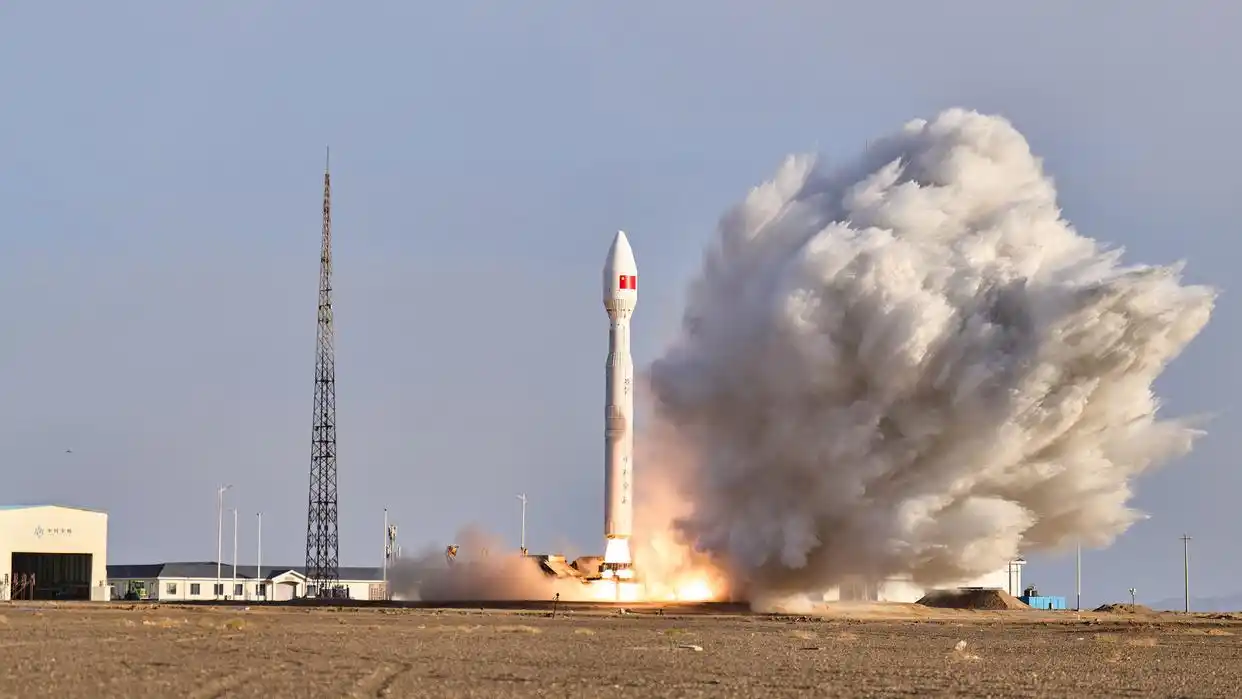
SHANGHAI, July 24, 2026 — CAS Space has crossed a symbolic threshold in China's commercial launch industry, deploying its 110th satellite aboard the Kinetica-1 rocket and signaling a structural shift from technology demonstration to industrialized, on-demand orbital delivery — with space-based artificial intelligence computing emerging as the dominant demand driver.
The Kinetica-1 Yao-15 mission lifted off Thursday morning from the Dongfeng Commercial Aerospace Innovation Test Zone, placing five payloads into their designated orbits in a single rideshare configuration. The mission marked the rocket's 15th flight and the 16th launch in the broader Kinetica series. More consequentially, CAS Space executives framed the milestone as the closing of a proof-of-concept chapter and the opening of a commercialized, high-cadence launch era — one the company is calling "monthly normalized launches" for the second half of 2026.
Market observers will note the timing: three of the five satellites aboard this mission are directly tied to the space computing infrastructure race, a sector that has attracted accelerating capital and policy attention across China in 2026. The convergence of dense launch capability and constellation networking demand is reshaping how investors should evaluate commercial launch providers — not merely as transportation utilities, but as critical infrastructure enablers for the emerging orbital AI economy.
Reaching 110 Satellites Validates CAS Space's Assembly-Line Model
The 110-satellite figure is not merely a vanity metric. CAS Space Deputy Commander Meng Xiangfu told STAR Market Daily that the milestone certifies the company's quality control architecture, standardized operating procedures, and rapid-response logistics under high-frequency mission conditions — the three pillars required to transition from experimental launches to what the company terms "bus-service" delivery.
CAS Space's Guangzhou Nansha production base now operates a pulse-production assembly line, enabling standardized, sequential rocket integration. The company has simultaneously built a supply chain model combining proprietary core components with strategic third-party partnerships, designed to eliminate capacity bottlenecks that have plagued competitors. Launch pad turnaround efficiency has been improved through a mission-agnostic universal rocket design, allowing a single pad to serve multiple customer configurations without extended reconfiguration periods.
The cumulative payload mass delivered now exceeds 16 tonnes across 110 satellites. CAS Space claims Kinetica-1 is the only Chinese private commercial rocket to have surpassed the 100-satellite delivery mark — a distinction that Chief Designer Shi Xiaoning argues is its most credible sales tool in overseas markets, where rocket delays and pad congestion have become chronic pain points.
To date, Kinetica-1 has served more than 30 domestic and international clients, including six overseas customers, across more than 10 satellite payload categories spanning optical remote sensing, X-band SAR, quantum communications, space situational awareness, and space computing.
Three Satellites Define the Architecture of China's Orbital AI Infrastructure
The payload manifest of the Yao-15 mission reads as a blueprint for the three foundational layers of a space-based computing stack.
The compute node: Jitian Star A-04, developed by Zhijiang Laboratory in partnership with Cloudnine Information, MetaX, Orbital Voyager, and Zhejiang University City College, is an intelligent computing satellite carrying a GPU-based onboard AI payload built on Muxin's proprietary chip architecture. The satellite deploys an embodied intelligence model capable of autonomous health management, mission planning, command generation, and in-orbit data processing. It also carries an onboard router and laser communication terminal, positioning it as an active node within the Santi Computing Constellation — a network targeting the convergence of orbital computing power, inter-satellite connectivity, and AI model deployment in space.
The security layer: Gande-1 01 Star, developed by AoTian Technology, is China's first commercial space debris monitoring satellite. Equipped with both a wide-field survey camera and a high-resolution precision tracking camera, it deploys onboard AI algorithms for star extraction and correlation positioning, enabling autonomous catalog updates of small debris objects. The satellite fills a documented gap in China's commercial space domain awareness capabilities. Aotian Technology disclosed that the full Gande constellation is planned at 120 satellites in a mixed low-earth and geostationary orbit configuration, with Phase 1 — 14 satellites — targeted for network completion by October 2027. Upon full deployment, the constellation is projected to generate more than 200,000 effective detection arcs per day.
The data center pathfinder: Chenguang-1, designed by Beijing Rail Transit Chengguang Technology, targets the most capital-intensive bottleneck in large-scale orbital computing: thermal management and space-grade power systems. The satellite carries a commercial computing server and a compact remote sensing camera, conducting in-orbit experiments on the two engineering constraints — energy supply and heat dissipation — that currently limit the scalability of space data centers. Its mission is explicitly framed as pathfinding for the industrialization of orbital data center infrastructure.
Rocket Economics Shift as Constellation Demand Pulls Forward Launch Cadence
The Yao-15 mission illustrates a structural dynamic that carries direct implications for the commercial launch market's competitive landscape: the economics of rocket operations are increasingly being set by downstream constellation customers rather than by launch providers themselves.
Shi Xiaoning identified three competitive advantages that have allowed Kinetica-1 to capture all foreign satellite launch orders placed with Chinese private commercial rocket companies to date. First, schedule certainty — the ability to guarantee on-time orbital insertion as long as customer payloads are delivered on schedule, a differentiator in a global market where SpaceX's Falcon 9 backlog and European launch disruptions have created multi-year queue pressure. Second, service flexibility — the capacity to accommodate last-minute rideshare adjustments, co-design engagements, and joint testing within compressed timelines. Third, international technical standards compliance, reducing friction in cross-border commercial negotiations.
The rideshare model deployed in Yao-15 — five payloads from five separate clients on a single vehicle — is the operational expression of the "bus service" framework. As constellation operators require not just launch access but predictable, repeatable launch windows to maintain orbital network integrity, providers capable of monthly cadence with multi-satellite separation precision gain structural pricing power.
CAS Space's declared trajectory — monthly launches through the remainder of 2026 — will be the real test of whether the assembly-line model holds under sustained operational pressure. If it does, the company will have established a repeatable cost and cadence benchmark that reframes the competitive calculus for every constellation operator currently mapping their China launch strategy.
Related Coverage:
CAS Space Eyes IPO With $21 Billion Valuation After 11 Launches