
China's Qianfan Constellation Hits 238 Satellites After Record 20-in-One Launch
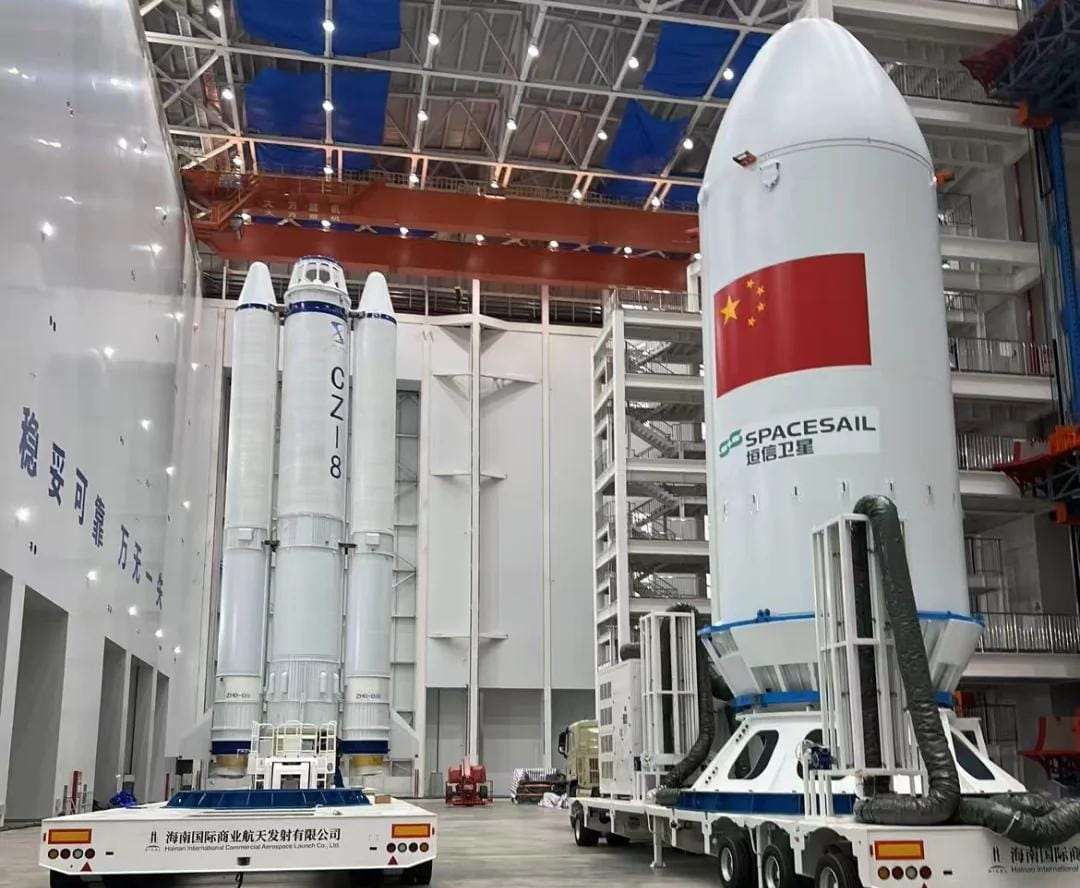
SPACESAIL (Shanghai Spacecom Satellite Technology), successfully launched 20 polar-orbit networking satellites in a single mission on the evening of July 5, marking the first time the company has deployed 20 spacecraft on a single rocket and bringing its Qianfan constellation to a total of 238 satellites in orbit.
The launch took place at 9:43 p.m. local time from the Hainan Commercial Space Launch Site, carried by an upgraded Long March 8A rocket designated Y9. The mission also marked the inaugural flight of the improved Long March 8A variant following a core performance upgrade, successfully validating optimized orbital flight profiles, a new engine configuration, and expanded fairing and satellite multi-layer release structures. The upgraded rocket set new records for both the number of satellites and total payload mass delivered in a single launch.
The two additional satellites compared with Yuan Xin's previous standard of 18 per launch may appear incremental, but the operational significance is material: each extra satellite carried per flight reduces the total number of rocket missions required to complete the constellation, directly lowering launch costs and compressing the network build-out timeline.
July 5 also represented a structural shift in how the Long March 8A is positioned commercially. Previous Long March 8A missions had exclusively served China Satellite Network Group, the state-backed broadband constellation operator. By carrying Qianfan satellites — a commercial constellation — for the first time, the Long March 8A has effectively expanded its customer base beyond the state sector, offering commercial operators access to a higher-capacity, higher-reliability launch vehicle. Analysts tracking China's satellite industry have noted that broader rocket access tends to reduce per-unit launch costs through economies of scale while improving scheduling flexibility at launch facilities.
The 20 satellites were manufactured by the Shanghai Engineering Center for Microsatellites (SECM), which has now launched a cumulative total of 348 spacecraft. The onboard telemetry, tracking and control software for this batch was independently developed by Spaceestar, a private company based in Jiangsu province — marking the first time a private enterprise has provided a complete suite of core tracking and control products for an entire batch of satellites in a large-scale low-Earth orbit constellation deployment in China.
The launch cadence also signals growing industrial maturity. Yuan Xin conducted its previous launch on the afternoon of July 4, less than 32 hours before the July 5 mission lifted off, underscoring the throughput capacity of the manufacturing, launch and mission control infrastructure supporting the program.
On the infrastructure side, the July 5 mission was the first to utilize a second vertical assembly and testing bay at the launch site, enabling two Long March 8 series rockets to undergo simultaneous processing. The dual-bay configuration raises the Long March 8 family's annual launch capacity to 30 missions, a threshold that could prove critical as China accelerates low-Earth orbit constellation deployments across both state and commercial programs.
Related Coverage:
LandSpace's Zhuque-2 Rocket Delivers Satellites, Marking New Commercial Milestone