
Germany’s Military Will Stop Using Chinese Training Drones, Reversing a Whitelist
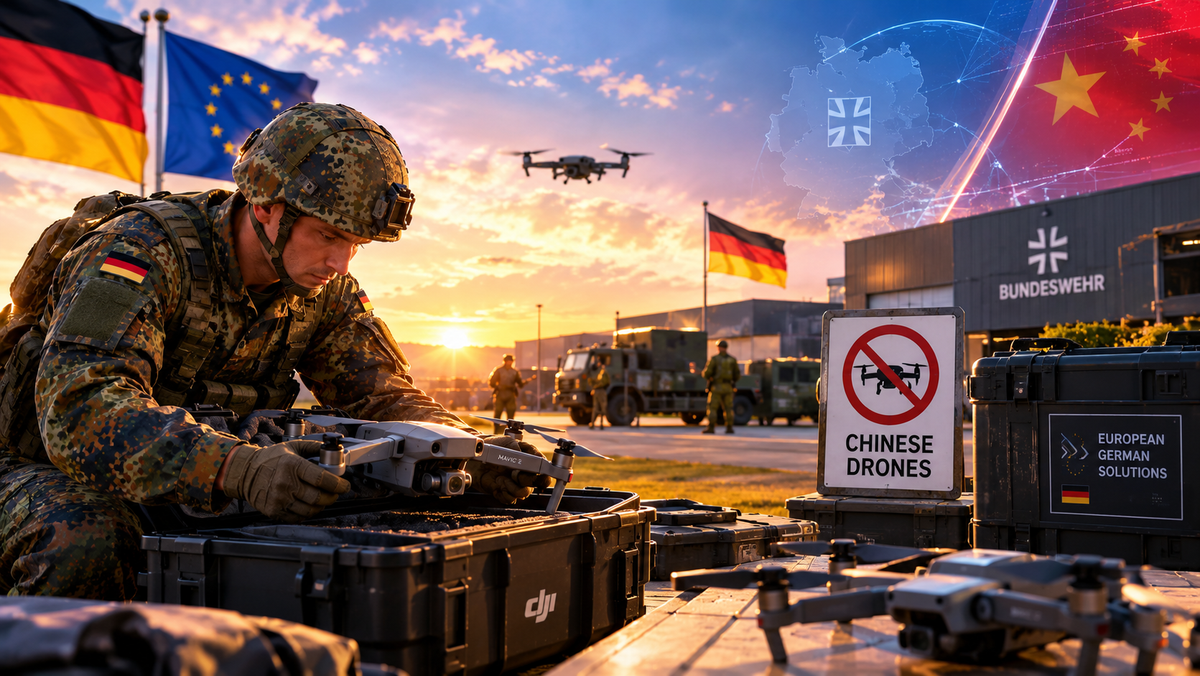
Germany’s defense ministry has confirmed that the Bundeswehr will stop using Chinese-made drones, including for training and target presentation, and will replace the systems it already has with national and, where appropriate, European products.
A ministry spokesperson told the investigative outlet CORRECTIV that the change was meant to strengthen the military’s “self-supply and technological sovereignty,” and that Chinese models would no longer be used. Aero.de and Bayerischer Rundfunk, citing the ministry on Wednesday, said the restriction also covers tasks the military does not treat as operationally sensitive, such as target presentation and training. CORRECTIV quoted the spokesperson as saying the shift takes effect immediately. Der Spiegel reported the decision first.
The ministry has not presented the move as a blanket embargo on equipment from a particular country. BR24 reported that officials described it as the result of an individual risk assessment, intended to protect military, data and IT security. The ministry has also not said it found an active leak from the training fleet. The official case, as stated this week, is risk and supply sovereignty.
That framing matters because this is not the first time the issue has been decided. CORRECTIV reported in August that the Bundeswehr had already banned the use of these drones by order in 2023, then allowed them again about six months later. They were placed on a “white list,” after which individual units could buy them on their own. The Guardian, citing Spiegel, said a 2024 strategy let local commanders purchase approved systems, including several made by DJI, the China-based drone maker. Because there was no central record of those unit-level purchases, Spiegel reported, the military is now imposing a blanket withdrawal.
The ministry’s public statements this week have referred to “Chinese models” and drones of Chinese manufacture, not to a named vendor. DJI is the manufacturer that prior German reporting placed on that whitelist, and a photograph published with CORRECTIV’s report shows a Bundeswehr soldier packing a DJI Mavic 2 during the Wettiner Heide exercise. ChinaBiz Insider could not find a DJI comment on the new decision.
The commercial point is narrower than the security rhetoric around it. Germany is not announcing that it has proved these training drones were sending data to Beijing. It is closing a channel that its own units had been allowed to reopen. For DJI, already under tighter U.S. constraints — including a Pentagon listing the company is appealing, and an FCC block on new foreign-drone approvals that DJI has said it regrets — the practical effect in Germany is the loss of an official foothold in a major European military’s training inventory.
Spiegel also reported that the Bundeswehr has imposed broad entry bans on Chinese cars at barracks and other security-classified sites, and that lists circulating inside the force include models from BYD, Geely and NIO, leaving soldiers who own those cars to park outside and walk in. That part of the story has not been confirmed in the same terms by the ministry. A spokesperson told Deutschlandfunk that a driving or entry ban can be imposed on vehicles that are connected and fitted with sensors. Those are different statements, and they should be kept apart. Germany has not, on the record available this week, issued a named-brand ban on Chinese passenger cars comparable to the U.S. Air Force’s decision to bar BYD vehicles from Kadena Air Base in Okinawa.
The wider European argument over Chinese connected hardware is real, and it is moving on a separate track. Poland has already restricted Chinese-made vehicles at military facilities. Last week, a group of members of the European Parliament asked the Commission to have the EU cybersecurity agency assess whether BYD should face procurement restrictions; BYD Europe said that data processed or stored in the cloud or in a vehicle cannot be remotely accessed from China, and that it does not make such data available to BYD entities or third parties in China. Those disputes do not, by themselves, explain the drone decision. What the German ministry has settled is more limited, and more concrete: Chinese-made drones are coming out of the training fleet, including the ones bought after the last ban was relaxed.
Related Coverage:
As European Manufacturers Crumble, Chinese Motorcycle Giants Are Seizing The Continent
Why NIO's European Retreat Reveals a Fundamental Flaw in Its Global Strategy