
Hesai Sacrifices Pricing Power to Defend Market Share as Lidar ASP Breaches RMB 1,300 Floor
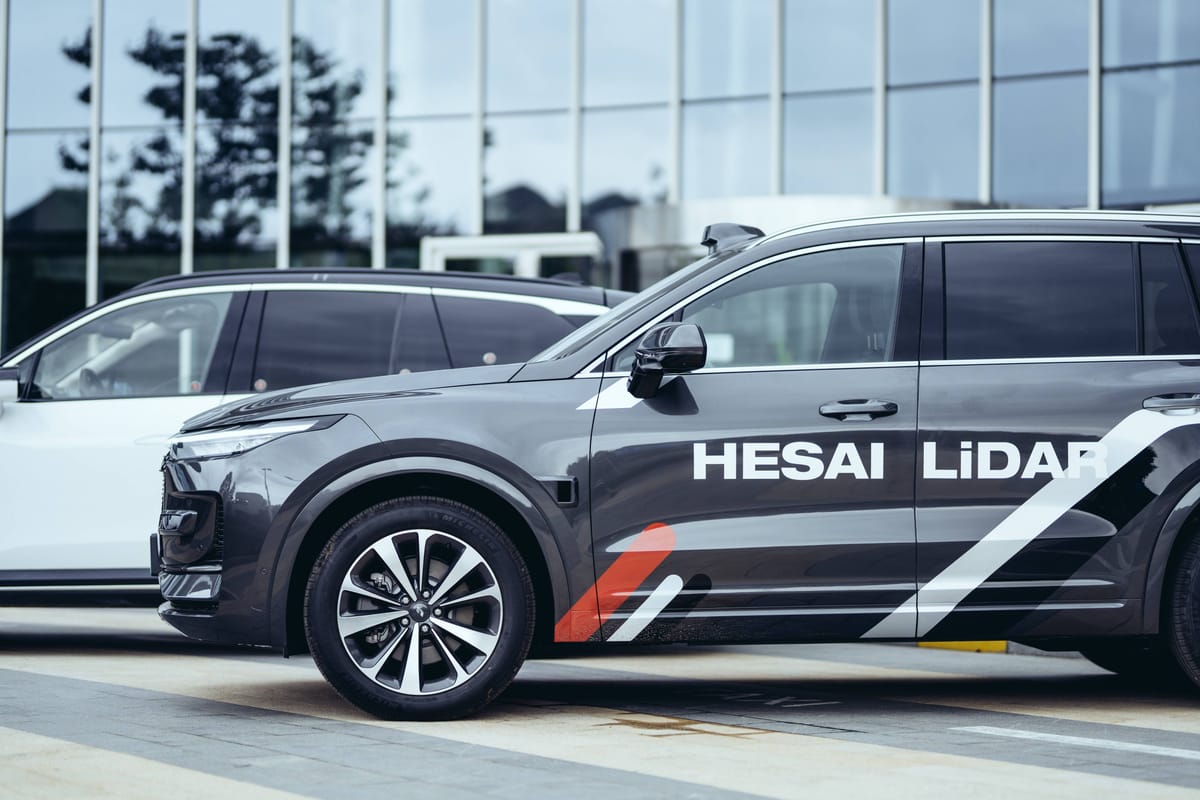
China's dominant lidar maker is winning the volume war but bleeding on price — and the margin of safety is narrowing faster than investors expected.
Hesai Technology reported Q2 2026 revenue of RMB 860 million (US$119.4 million), up 22% year-on-year and landing at the lower bound of its own guidance range of RMB 850–900 million. The headline number masked a sharper deterioration underneath: average selling price for lidar units collapsed 35% year-on-year to RMB 1,297 — below the market consensus of RMB 1,350 and piercing the RMB 1,300 psychological floor for the first time. The print confirms that 2026 is shaping up as a year of strategic pain for the company, with pricing power eroding faster than volume growth can compensate.
The market's initial read is cautious. While gross margin held at 40.1% — marginally above the 39.5% consensus and up one percentage point sequentially — operating profit came in at just RMB 2 million (US$277,800), a fraction of the RMB 50 million analysts had projected. The shortfall traces directly to a 16% year-on-year surge in R&D spending to RMB 230 million (US$31.9 million), as the company front-loads investment into its nascent Spatial General Intelligence (SGI) business unit.
Volume Beats Mask a Structural ASP Erosion Across Product Lines
Shipments of 628,000 units in Q2 2026 fell short of both the company's own target of 650,000 and the market estimate of 637,000. The miss was concentrated in ADAS automotive lidar, where 486,000 units shipped against a consensus of 504,000. Two forces drove the shortfall: slower-than-expected new-energy vehicle sales growth following the phase-out of NEV purchase-tax exemptions, and weaker-than-anticipated delivery volumes from key customers Xiaomi and Li Auto.
Robotics lidar provided a partial offset, with 142,000 units shipped against a forecast of 133,000, driven by the JT128 sensor for humanoid and quadruped robots — deployed across more than 50 embodied-AI companies — and the JT16 lawn-mowing robot lidar.
The more consequential story is the structural composition of the ASP decline. Three dynamics are compressing blended unit pricing simultaneously:
First, RoboSense has closed the technology gap. Its EMX series, which began scaling in Q4 2025 after pivoting from MEMS to rotating-mirror architecture, has effectively eliminated the one-generation lead Hesai previously held. In response, Hesai has voluntarily surrendered the 10–20% pricing premium it historically commanded over peers — a deliberate trade of margin for market share.
Second, the ATX product line is being structurally diluted. While the standard ATX variant holds at approximately US$150 per unit, dedicated versions supplied to high-volume customers including BYD and Geely are priced at roughly RMB 800 (US$111) — a 47% discount to the standard version. As these volume-oriented SKUs scale, they drag the ATX line average lower.
Third, the FTX blind-spot supplementary lidar carries a guided ASP of only approximately US$100. As FTX shipments ramp — Li Auto's L8 and L9 each carry four Hesai units, and the new L6 offers a four-lidar option at a RMB 250,000 (US$34,700) price point — the product mix shifts further toward lower-priced units.
Gross Margin Holds at 40% as Chip Integration Offsets Price Compression
Despite the ASP freefall, Hesai maintained a 40.1% gross margin in Q2 2026 — a result that deserves analytical attention. The company's proprietary FMC500 SoC, built on a RISC-V architecture and integrating MCU, FPGA, and ADC functions into a single chip, has reduced core chip costs that previously represented approximately 40% of bill-of-materials. Hesai's self-developed SPAD integration technology, entering mass production in 2026, provides an additional cost-reduction lever. At 300–350 million units of annual production capacity — doubled from 2 million to over 4 million units versus 2025 — fixed-cost absorption is also improving materially.
Management has maintained full-year gross margin guidance of approximately 40%, implying a 1.8 percentage-point year-on-year decline. The key risk to this target is upstream commodity inflation: aluminum, iron, batteries, and memory components have all seen price increases in 2026, raising input costs for downstream EV customers and increasing their pressure on supplier pricing.
SGI Business Accelerates, Raising a Second Revenue Curve
The SGI segment — encompassing the Kosmo spatial intelligence platform and actuator modules for humanoid robots — contributed RMB 40 million (US$5.6 million) in Q2 2026. Management has raised full-year SGI revenue guidance from RMB 100 million to RMB 200–300 million (US$27.8–41.7 million), with Q3 2026 alone expected to approach RMB 100 million. The 2027 SGI target of RMB 700 million (US$97.2 million) was maintained.
The Kosmo platform shipped prototype units in July 2026 and secured orders from multiple leading humanoid robot companies — including Galbot — within seven days of launch. More than 200 potential partners have engaged since the April preview, spanning tourism, film production, gaming, and advertising verticals.
The actuator module business, entering the market through dexterous-hand components, has shipped over 10,000 cumulative units through Q2 2026 and is ramping toward approximately 10,000 units per month. Hesai supplies Sharpa — an independent company sharing co-founders with Hesai — which has been adopted on NVIDIA's GROOT humanoid robot platform.
Hesai's full dual-track robotics strategy targets a 50/50 revenue split between lidar and robotics within five years.
Full-Year Outlook: Volume Surges, but Profitability Remains Compressed
Hesai has raised its 2026 shipment guidance to 300–350 million units, up from an earlier range of 200–300 million, implying 85–116% year-on-year growth. Annual production capacity has been doubled to over 4 million units. Analyst estimates from Dolphin Research project total 2026 shipments of approximately 3.3 million units: 2.62 million ADAS units (up 90% YoY, at the lower end of guidance due to NEV demand softness and Xiaomi's addition of RoboSense as a second supplier) and 677,000 robotics units (up 183% YoY, materially above the 500,000-unit guidance).
On financials, Dolphin Research projects full-year 2026 revenue of RMB 4.48 billion (US$622 million), up 48% year-on-year, with lidar revenue of RMB 4.18 billion (US$580 million, +40% YoY) and SGI contributing RMB 250 million (US$34.7 million). Net profit is estimated at RMB 520 million (US$72.2 million), representing 19.4% growth and landing at the lower bound of the company's own RMB 500–700 million guidance range.
The blended ASP trajectory remains the central concern. Dolphin Research forecasts a full-year 2026 ASP of approximately RMB 1,268, implying a 31% year-on-year decline — steeper than the company's implied guidance range of RMB 1,300–1,380 derived from its revenue and shipment targets.
Three Catalysts Could Shift the Trajectory Into 2027
L3 autonomous driving regulation represents the most significant volume and value catalyst. When China's L3 regulatory framework formally takes effect — expected in 2027 — per-vehicle lidar content is projected to jump from a single ATX unit (approximately US$200) to a multi-sensor configuration of one primary radar plus multiple FTX blind-spot units, pushing per-vehicle value to US$500–1,000. Hesai's ETX high-end lidar — featuring the Picasso 6D full-color SPAD-SoC with up to 4,320 channels and 600-meter detection range — is targeting SOP in H2 2026, with Great Wall Motor already confirmed as a launch customer.
International market entry provides a structural hedge against domestic ASP compression. Hesai has completed C-sample development for a leading European OEM and targets overseas mass production by end-2026. Critically, Hesai has been designated as a partner on the NVIDIA Drive Hyperion platform, granting preferred integration status when overseas OEMs adopt NVIDIA's full-stack autonomous driving solution. Overseas customers carry lower price sensitivity and a preference for premium specifications — a favorable contrast to the domestic price war.
ASP stabilization is expected to begin in 2027. Dolphin Research projects the annual ASP decline to narrow sharply from approximately 31% in 2026 to approximately 10% in 2027, and then to a normalized 5–10% per year thereafter — consistent with traditional automotive component pricing dynamics. The primary driver of the 50%-plus ASP declines of the past two years — the cost reduction unlocked by proprietary chip integration — has largely run its course. Future declines will be driven by incremental scale and annual OEM price negotiations, not step-change technology transitions.
Investment Takeaway: A Necessary Transition, But Patience Required
Hesai enters the second half of 2026 as the undisputed volume leader in China's independent third-party lidar market — a competitive set that excludes Huawei's bundled hardware-software configurations. Its gross margin defense at 40%, achieved while ASP fell 35%, demonstrates genuine manufacturing and engineering discipline. However, the near-term earnings profile offers limited upside: operating leverage is suppressed by SGI investment, ETX and overseas revenue remain back-half-loaded at best, and the robotics business has not yet been priced into consensus estimates.
The 2026 fiscal year is best understood as the trough of Hesai's price-cycle transition — a deliberate repositioning from premium-priced technology supplier to high-volume platform provider, with the next margin expansion phase contingent on L3 regulation, ETX ramp, and international OEM wins materializing in 2027 and beyond.
Related Coverage:
Hesai Sacrifices Margins for Lidar Market Dominance in Brutal 2026 Price War