
Chinese Automakers Capture 8.9% of Europe — But Can They Make Money?
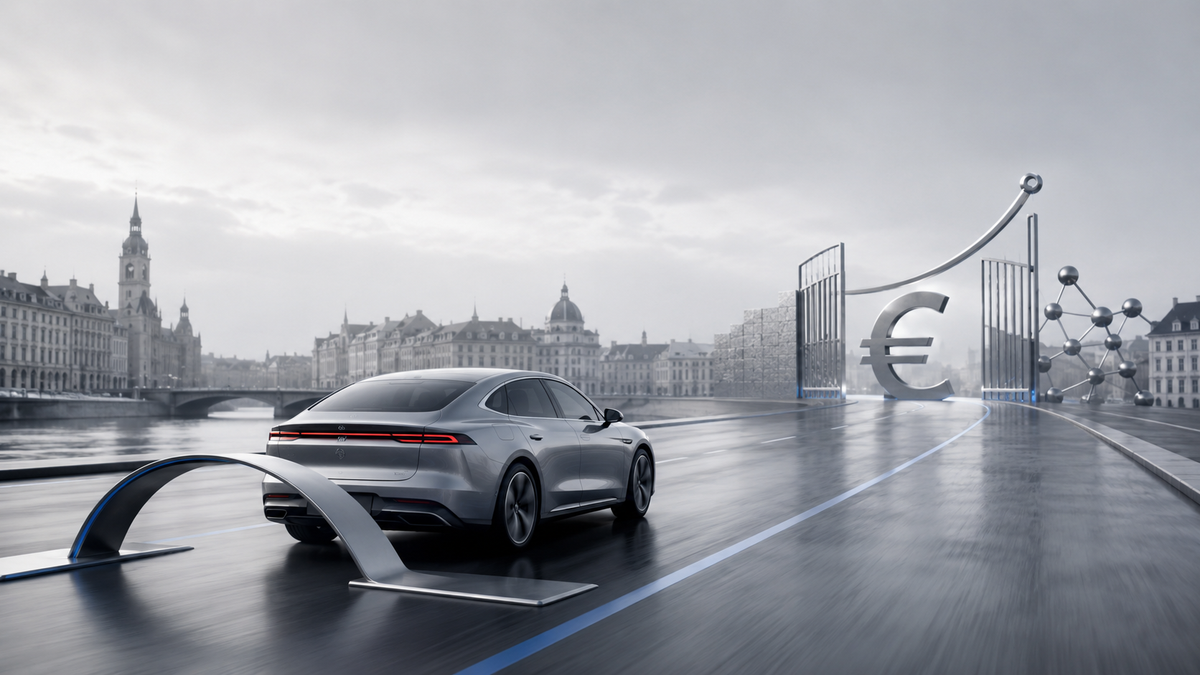
Chinese automakers now hold nearly 9% of the European market. The harder question is whether any of them are profitable.
What Is Happening?
In the first half of 2026, five Chinese automakers — BYD, SAIC, Chery, Geely, and Leapmotor — sold a combined 643,000 vehicles across the EU, EFTA member states, and the United Kingdom. Their collective market share nearly doubled, rising from 4.5% to 8.9%, with year-on-year sales growth of 111.5%, according to data from the European Automobile Manufacturers' Association (ACEA).
In May 2026, Chinese brands outsold Japanese brands in Europe for the first time — a milestone that would have seemed implausible just three years earlier.
The sales curves look spectacular. But behind the numbers lies a question that no one has cleanly answered: which Chinese automaker is actually closest to turning a profit in Europe, and at what cost?
To answer that, you need to examine four separate ledgers: per-unit export margins, localization economics, channel efficiency, and used-vehicle residual values. Each one tells a different part of the story.
Ledger 1: How Much Does a Chinese EV Actually Earn Per Unit in Europe?
Start with the most straightforward calculation: what does a Chinese automaker actually keep after selling one car in Europe?
Take a vehicle with a European retail price of €38,000. That headline figure is not the automaker's revenue. In Germany, VAT runs at 19%, which means the pre-tax revenue available to the manufacturer and its distribution chain is roughly €31,900.
From there, costs stack up quickly:
- Manufacturing and logistics: Factory cost plus ocean freight, insurance, and port handling comes to roughly €18,000–€22,000 per vehicle.
- EU tariffs: The European Union imposes a 10% base import duty on Chinese-made EVs, plus additional countervailing duties. BYD faces a combined rate of 17.4%, Geely 18.8%, and SAIC as high as 35.3%.
- Dealer margins: Europe's multi-tier distribution system — importer, distributor, retailer — absorbs roughly 8–15% of the retail price.
- Compliance, warranty, and marketing: E-mark certification, regional management costs, warranty reserves, and advertising add several thousand euros per unit.
After all deductions, a vehicle retailing at €38,000 typically leaves the automaker a per-unit contribution margin of under €3,000. In an optimistic scenario, that figure can reach €4,000. In a pessimistic one, the business is near breakeven — and that is before allocating any share of R&D expenditure from headquarters.
The export model, in other words, is structurally thin. It generates market presence more reliably than it generates profit.
Ledger 2: Does Local Manufacturing in Europe Solve the Problem?
The logical response to tariff pressure is to build locally. If a Chinese automaker assembles cars inside the EU, the countervailing duties disappear. Several companies are pursuing exactly this strategy.
BYD's factory in Hungary, for example, represents an investment of approximately €4 billion, with a planned annual capacity of 300,000 units and an initial design capacity of 150,000. Spread over a ten-year depreciation schedule, per-unit depreciation costs range from roughly €1,300 at full capacity to €2,600 at the initial ramp-up level. Add European labor costs (approximately three times higher than in China), energy, local supply chain development, and operational overhead, and the fixed-cost burden becomes substantial.
Industry estimates suggest that BYD's Hungarian plant needs to reach annual sales of 120,000–150,000 units before local production becomes cost-competitive with the export-plus-tariff model. That threshold is close to the facility's initial design ceiling — meaning that for most of the ramp-up period, local manufacturing may actually be more expensive per unit than exporting.
The tariff savings from local production also take three to five years to materialize in full, because capacity utilization during the early phase is inherently low.
The structural insight: Localization does not eliminate the cost problem. It transforms a tariff cost into a fixed-cost obligation. For automakers without sufficient volume, the trade is unfavorable in the near term.
Ledger 3: Which Distribution Model Is Working — and Which Is Not?
How a Chinese automaker reaches European consumers turns out to be as consequential as where it builds its cars. A survey of four distinct channel strategies reveals sharply different outcomes.
BYD and Xpeng: Building Dealer Networks From Scratch
BYD entered Germany in 2023 and spent nearly three years assembling a network of approximately 200 sales points through signed dealership agreements. Xpeng is following a similar path, including co-showroom arrangements with established German brands such as Mercedes-Benz.
The advantage of this approach is control: the automaker sets pricing, manages the customer experience, and retains a higher share of margin. The disadvantage is the upfront cost. Building a network of 50–100 dealerships across Europe's major markets requires an estimated investment of around RMB 300 million. If per-store sales volumes remain low, that becomes a sunk cost.
MG: Fleet Sales for Volume, Brand Damage as the Price
MG registered more than 307,000 vehicles in Europe in 2025, making it the top-selling Chinese brand on the continent for eleven consecutive years. In 2026, it became the first Chinese brand to surpass one million cumulative European sales.
A significant portion of MG's volume comes from fleet and leasing customers. This approach generates rapid market share gains, but it creates two structural problems. Fleet buyers have near-zero brand loyalty, which means private consumers come to associate MG with rental cars rather than personal ownership. More damaging: high-utilization fleet vehicles flood the used-car market after two or three years, directly compressing residual values.
SAIC appears to have recognized the risk. MG recently established direct sales subsidiaries in Belgium and Luxembourg to reclaim control over distribution and customer experience. The company's leadership has publicly stated that residual values are a priority concern. The rebalancing effort, however, is only just beginning.
Nio: The Most Expensive Lesson in European EV History
Nio entered Europe with a premium direct-sales model, opening flagship "NIO House" showrooms in Berlin, Frankfurt, Düsseldorf, and Hamburg — some of the most expensive retail real estate in Germany.
The results have been severe. Nio sold 1,263 vehicles in Germany in 2023. That figure fell 68.5% to 398 units in 2024, declined a further 18.3% to 325 units in 2025, and reached just 15 units in the first half of 2026.
German business outlet Manager Magazin reported that Nio is seeking tenants to sublease its German NIO Houses. The company has since announced a transition from direct sales to dealer models in Germany, the Netherlands, and Sweden. Nio's chairman acknowledged at an earnings call that the company would not exit European markets but would actively slow its expansion pace.
The structural lesson from Nio's experience is pointed: a direct-sales model requires sales density and brand recognition to be economically viable. Tesla's direct model works because of volume and established brand equity — not because of flagship store design. When annual sales are measured in the hundreds, any heavy-channel model becomes a cost sink.
Leapmotor: Borrowing Someone Else's Infrastructure
Leapmotor chose a fundamentally different path. In 2023, Stellantis acquired approximately 20% of Leapmotor for €1.5 billion, and the two companies established a joint venture — Leapmotor International — to handle sales and production outside Greater China.
Leapmotor's European sales points are embedded entirely within Stellantis's existing dealer network. Channel build-out costs are effectively zero. By the first quarter of 2026, Leapmotor had more than 800 sales and service points in Europe, including 182 in Germany alone. BYD needed nearly three years to reach a comparable footprint; Leapmotor did it in eighteen months.
The trade-off is margin sharing: every vehicle Leapmotor sells in Europe generates profit that is split with Stellantis. The more Leapmotor grows, the more it pays.
There is, however, a secondary revenue stream that complicates the picture. In 2025, Leapmotor transferred EU carbon credits to Stellantis, generating RMB 1.11 billion — roughly twice Leapmotor's total annual profit for that year. The ceiling for such transactions has been raised to RMB 2.8 billion for 2026.
Carbon credit revenue is real, but it is a policy instrument, not a business model. If the regulatory framework changes, or if the partnership with Stellantis is restructured, that income disappears. Treating it as a sustainable profit source means handing control of the business to an external variable.
Ledger 4: Why Residual Values May Be the Most Important Number of All
In Europe, the majority of new car purchases are financed through loans, personal contract plans, or long-term leases. In all of these structures, the projected residual value of the vehicle at the end of the contract period directly determines monthly payments. A lower residual value means higher monthly costs for the consumer — and potentially higher financing rates or down payment requirements from lenders trying to hedge their exposure.
Data from DAT, a German automotive valuation authority, shows that in April 2026, Chinese brand EVs and plug-in hybrids retained only 47% of their original value in the German used-car market. That compares to 61% in early 2024 — a decline of 14 percentage points in roughly two years. Over the same period, the broader German EV market saw residual values fall by only 7 percentage points.
Chinese brand vehicles are depreciating at approximately twice the rate of the market average.
For a €38,000 vehicle, a 14-percentage-point residual value loss translates to roughly €5,320 in reduced value after three years. Spread across a 36-month lease, that adds approximately €148 to the monthly payment — a meaningful difference in a competitive market segment.
DAT's head of vehicle valuation, Martin Weiss, stated the issue plainly: "It is not enough for Chinese brands to offer good products. They also need to build the surrounding ecosystem."
The director of strategic partnerships at Arval Germany, a BNP Paribas leasing subsidiary, was equally direct: "The residual value gap between Chinese EVs and European competitors is fundamentally a trust gap."
What drives the trust gap? DAT research indicates that nearly half of German consumers believe some Chinese brands may exit the German market within five years. Uncertainty about a brand's long-term presence suppresses used-car demand. Rapid product iteration cycles — a competitive strength in China — make older models feel obsolete faster in Europe. And the absence of certified pre-owned programs and standardized warranty coverage for used vehicles removes the institutional support that underpins residual values for established brands.
Who Is Closest to Profitability — and What Does That Actually Mean?
Having worked through all four ledgers, the rankings become clearer:
Leapmotor is the closest to positive unit economics on paper, primarily because its channel costs are near zero and its carbon credit income is substantial. The ceiling, however, is structurally limited by profit-sharing obligations and regulatory dependency.
BYD has the strongest long-term position. Its manufacturing scale, vertical integration, and brand investment give it the best chance of eventually achieving sustainable European margins. The path runs through several years of absorbing localization costs before the economics improve.
MG has the volume but faces a brand equity problem of its own making. The fleet-heavy sales mix has created a residual value liability that will take years to unwind.
Nio has paid the most expensive tuition in Chinese EV history for lessons about the limits of premium direct retail in a market where brand trust takes decades to build.
What Comes Next: From Market Share to Margin
The structural trajectory for Chinese automakers in Europe is not primarily a story about sales volume. Volume has already arrived. The unresolved question is whether any of these companies can convert market presence into durable profitability.
Three conditions need to be met before that transition happens at scale:
- Residual value stabilization. This requires consistent long-term market presence, certified pre-owned programs, and a reduction in the pace of model turnover. It cannot be engineered quickly.
- Channel maturation. The industry is already moving away from direct-sales idealism toward dealer-network pragmatism. That shift reduces overhead but requires careful management to avoid margin erosion.
- Local production at sufficient scale. Factories like BYD's in Hungary need to reach meaningful utilization rates before the fixed-cost investment begins to pay off. That is a multi-year process.
Until those conditions are met, the sales growth numbers represent something more like an option on future profitability than profitability itself. Chinese automakers have secured their entry into the European market. Whether that entry becomes a viable long-term business is the question the next several years will answer.
Related Coverage:
China's EVs Court Europe as U.S. Slams the Door Shut
China’s EV Pecking Order in July Shifts as Leapmotor Breaks 100K, Rivals Stall