
Tencent's AI Pivot: What the "Midway Moment" Thesis Really Means
Why a surge in capital spending—not a product launch—may signal the most consequential shift in China's AI race
What Is the "Midway Moment" Thesis?
In mid-2026, Bank of America Merrill Lynch described Tencent's accelerating AI investment as its "Battle of Midway"—a strategic inflection point where the balance of power begins to shift, even though the war is far from won.
The analogy is precise. At the 1942 Battle of Midway, the United States was not yet winning the Pacific War. But by concentrating available resources at the right moment—famously repairing the aircraft carrier USS Yorktown in three days instead of three months—the U.S. Navy wrested back the initiative. Midway didn't end the conflict. It changed who got to decide where and how the next battles would be fought.
BofA's framing suggests that Tencent, after a period of playing catch-up in the foundational AI race, has reached a comparable inflection point: not victory, but the recapture of strategic momentum.
Why Did a Strong Earnings Report Send the Stock Down?
Tencent's Q2 2026 results showed 11% revenue growth—a healthy number by any conventional measure. Yet the stock fell 4.46% the following day.
The market's concern was concentrated in a single line item: capital expenditure surged 176% year-on-year to RMB 52.8 billion (approximately USD 7.3 billion) in a single quarter, pushing free cash flow negative to the tune of RMB 13.8 billion.
This reaction reflects a broader recalibration happening across global tech markets. The implicit question from investors is no longer "Are you investing in AI?" but "When does AI investment convert into measurable returns?"
The pattern had already played out on Wall Street. Meta and Alphabet were punished when their AI spending rose without a clear monetization timeline. Microsoft and Amazon were rewarded because Azure and AWS growth provided visible payback on new infrastructure. The grading rubric has changed—and Tencent's spending spike arrived at exactly the moment investors were most skeptical.
Why Did Tencent Choose This Particular Moment to Spend?
The timing appears deliberate rather than reactive. Management's explanation pointed to prepayments made to lock in AI infrastructure capacity—covering Hunyuan model upgrades, WorkBuddy and CodeBuddy inference, WeChat AI features, and external cloud customers.
But the deeper logic is convergence. Several previously separate demand drivers—model training, a product hitting scale, a major consumer application preparing to expand, and external cloud demand—all reached critical mass simultaneously. When those needs compound rather than accumulate linearly, a company faces a choice: invest ahead of the curve or lose the window.
Tencent's management, in BofA's reading, concluded that this particular window was worth more than a clean short-term earnings report. That judgment—not the spending figure itself—is what the "Midway" framing is really about.
What Are the Three Strategic Cards Tencent Is Now Playing?
Card 1: The Hunyuan Foundation Model Finally Competes
For much of the early large language model era, Tencent's Hunyuan lagged behind. The model's relative weakness meant that even Tencent's ecosystem advantages—WeChat's billion-plus users, an established cloud business, deep enterprise relationships—could not be fully leveraged. A weak foundation model is a structural ceiling on everything built above it.
That constraint began to ease after AI researcher Yao Shunyu joined and refocused Hunyuan's development toward real-world product performance. The third-generation model (Hy3) delivered meaningful capability improvements and became the primary model powering both WorkBuddy and the Yuanbao consumer AI app. Among WorkBuddy users who actively choose their model, 60% select Hy3. By token consumption volume on OpenRouter, Hy3 has consistently ranked in the global top three since launch.
The significance is structural: without a competitive foundation model, every other strategic initiative is built on sand.
Card 2: WorkBuddy's Early Lead in AI Productivity
Third-party data from analytics firm Analysys showed WorkBuddy's PC-side traffic exceeding 20 million monthly visits in June 2026—more than the second- and third-place competitors combined. Alibaba and ByteDance have since moved to accelerate their own enterprise AI products, and international competitors including Claude Code and OpenAI's Codex are pushing aggressively into enterprise workflows.
The productivity category matters more than the traffic numbers alone suggest. Consumer chatbots generate engagement; productivity tools generate revenue. Claude Code's annualized revenue run-rate was estimated by TickerTrends at approximately USD 15.1 billion as of early August 2026, making it a meaningful revenue engine for Anthropic. Coding was the first high-value agentic use case to demonstrate real willingness-to-pay because tasks are discrete, outputs are verifiable, and productivity gains are measurable.
WorkBuddy's ambition is broader: it uses a "harness" architecture to orchestrate multiple models and specialized skills across documents, spreadsheets, web content, code, and sequential computer tasks.
The more durable advantage, however, is the feedback loop this creates. Real tasks performed in WorkBuddy generate training signal that improves Hunyuan; a stronger Hunyuan improves WorkBuddy's task completion rate; better task completion drives more usage. This co-design loop—where product and model improve each other rather than developing in isolation—is a compounding dynamic. It is structurally similar to what reportedly motivated Elon Musk's reported USD 60 billion acquisition of Cursor: the high-value feedback flywheel that enables joint model training.
Tencent's management acknowledged that once WorkBuddy's growth trajectory became clear, the company quickly elevated its resource priority and reduced investment in other AI projects. That reallocation is more informative than any strategic declaration—it means capital is following demonstrated demand.
Card 3: Xiaowei Inside WeChat
Tencent's AI assistant for WeChat, internally called Xiaowei, remains in limited testing. Its potential scale is self-evident: WeChat operates as the primary digital interface for over a billion users in China, covering messaging, payments, mini-programs, and commerce. Management has drawn an explicit analogy to the mobile transition, arguing that WeChat amplified QQ's PC-era ecosystem value by roughly 10x—and that AI could represent a comparable step-change.
The specific advantages management cited are lower user acquisition cost (users are already inside WeChat) and lower inference cost relative to standalone AI applications. Whether Xiaowei becomes a genuinely transformative product depends on variables that remain unresolved: user willingness to delegate decisions, merchant adoption, and the ability to manage privacy concerns and inference economics at scale.
What Is the "Agent Factory" and Why Does It Matter?
Beyond the three individual products, a structural shift is underway in how Tencent is assembling its AI capabilities.
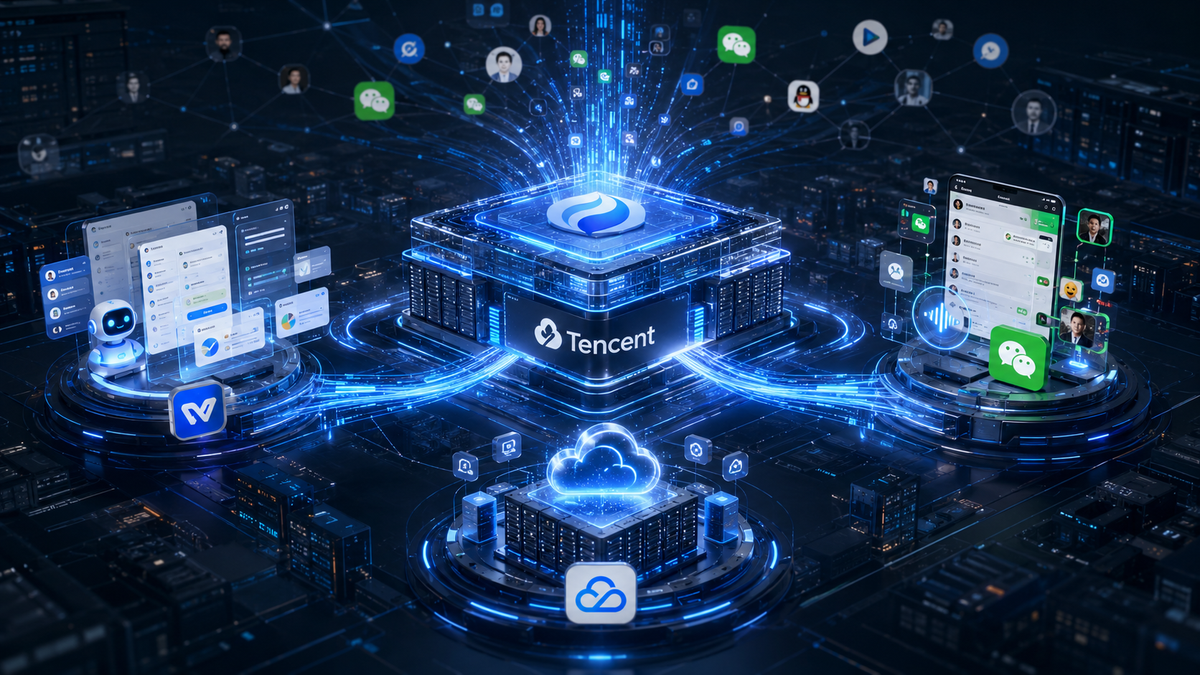
The company is connecting its foundation model, cloud infrastructure, engineering frameworks, and application network into a reusable agent production system. The harness architecture developed through CodeBuddy and WorkBuddy—covering task orchestration, tool invocation, context management, and output verification—is being standardized as shared infrastructure rather than rebuilt for each product. Tencent Cloud provides the model access layer, runtime environment, and governance controls.
The result is what the company describes as a "Buddy family" of agents, each able to enter new verticals—research, office productivity, data analysis, education—by combining the common infrastructure with domain-specific skills and business context.
What makes this more than a product roadmap is the feedback architecture. WeChat, WeCom (enterprise WeChat), Tencent Docs, Tencent Meeting, and cloud storage are simultaneously task sources, business context providers, and execution interfaces for agents. Products that were previously independent are being woven into a shared task chain. Each deployment generates feedback that improves the underlying platform; a more capable platform reduces the cost and time required to build the next agent.
This is the structural logic behind BofA's assessment that the balance of power is shifting. In the early LLM era, the scarce resource was research capability and frontier model performance—areas where Tencent fell behind. In the agent era, the scarce resources are high-frequency use cases, relationship networks, organizational context, payment infrastructure, and the experience of turning complex services into reliable infrastructure. Tencent holds most of these cards.
What Is Tencent's Financial Buffer—and What Are the Risks?
The "Midway" thesis would be less credible without a strong base business providing operational cover.
Tencent's Q2 2026 operating profit was RMB 75.6 billion, up 9% year-on-year. Stripping out investment in new AI products (Hunyuan, Yuanbao, WorkBuddy), the underlying business generated RMB 86.1 billion in operating profit, up 19%. The gap—approximately RMB 10.5 billion—represents the current cost of the AI offensive. The core business is absorbing it without distress.
AI is also beginning to contribute positively to existing revenue lines. Marketing services revenue grew 22% in Q2, domestic gaming revenue grew 17%, and management attributed part of both to AI-driven improvements. The investment is not purely forward-looking.
There is also an infrastructure floor. Management noted that newly acquired computing capacity could be leased to third parties at prices that have risen since the commitments were made—providing downside protection if internal demand develops more slowly than projected. The analogy to AWS is instructive: Amazon built computing infrastructure for internal use, standardized it, and eventually monetized it as the company's highest-margin business unit.
The risks are real, however. BofA simultaneously issued a HKD 780 target price and cut its three-year earnings forecasts due to depreciation pressure from the capital expenditure surge. The next-generation Hy4 model has not yet been publicly benchmarked. WorkBuddy's paid conversion data has not been disclosed. Xiaowei has not launched at scale. The monetization timeline for the RMB 52.8 billion quarter remains genuinely uncertain.
Where Does the Revenue Eventually Come From?
Tencent's AI monetization is likely to arrive in distinct waves rather than a single inflection point.
Wave one—existing business enhancement: AI-improved advertising targeting, faster game development cycles, and more efficient content distribution. These gains are already partially visible in current financials but are difficult to label explicitly as "AI revenue." Meta's experience is the relevant precedent: years of AI investment in recommendation systems paid off primarily through advertising system improvements before any AI product was directly monetized.
Wave two—cloud and token infrastructure: GPU rental, model-as-a-service, Hunyuan API access, and WorkBuddy token consumption all convert infrastructure into recurring revenue. This layer is already generating income and scales with external adoption of Tencent Cloud's AI services.
Wave three—platform and application economics: WorkBuddy's larger opportunity is not a subscription tool but an open agent platform—where developers contribute skills, model providers integrate, and enterprises connect proprietary knowledge and workflows. Network effects in platform businesses are Tencent's established competency. Xiaowei's opportunity is to become the AI interface layer for WeChat's existing transaction network: helping users find services, compare options, and complete purchases through mini-programs, with Tencent earning through merchant fees, advertising, and transaction growth.
The critical uncertainties in wave three are user trust (willingness to delegate decisions), merchant participation, and the ability to keep inference costs low enough to make the economics work at scale.
What Happens Next—and What Would Confirm or Refute the Thesis?
The "Midway" framing is a directional judgment, not a guarantee. Several developments over the next 12 to 24 months will determine whether the thesis holds.
Confirming signals would include: Hy4 benchmark performance competitive with global frontier models; WorkBuddy paid user and revenue disclosure showing durable monetization; Xiaowei's broader rollout demonstrating user retention and transaction attachment; Tencent Cloud AI revenue growth that offsets depreciation pressure on margins.
Refuting signals would include: WorkBuddy losing its usage lead to Alibaba's or ByteDance's competing products; the co-design feedback loop failing to produce measurable model improvement at scale; Xiaowei encountering user resistance or regulatory friction that limits its scope; margin compression that forces a reduction in AI investment before the monetization waves arrive.
The structural argument for Tencent's position is that the agent era rewards exactly the assets Tencent has spent two decades accumulating. The execution risk is that those assets must be integrated and deployed effectively—something the company demonstrably struggled with in the early foundation model phase.
What is clear is that Tencent has placed its chips on the table. The RMB 52.8 billion quarter is not a forecast or a roadmap—it is a committed position. The next phase of China's AI competition will be determined less by who has the best model and more by who can convert model capability into durable, monetizable products embedded in daily workflows. That is a contest Tencent, for the first time in this AI cycle, is genuinely equipped to win.
Related Coverage:
Tencent's RMB 52.8B AI Bet Signals a New Phase of China's Compute Race