
Tesla Turns to ByteDance's Doubao as China Forces an AI Localization Pivot
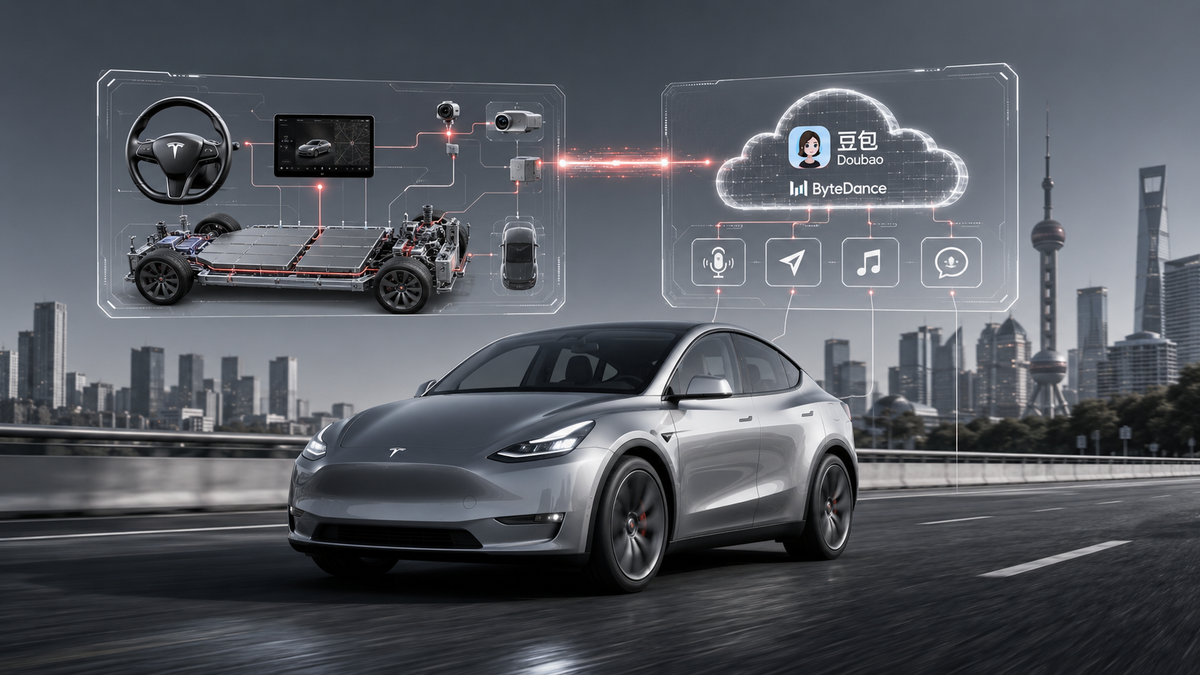
Regulatory walls and a shrinking 4.9% market share forced Tesla to do what Elon Musk swore he never would: install a rival's large language model into his cars.
Volcano Engine, the cloud and AI infrastructure arm of ByteDance, confirmed on August 19, 2026, that Tesla China's in-vehicle infotainment system has gone live with the Doubao large language model, with the rollout pushed to existing owners via over-the-air update. The announcement marks the first time in Tesla's more than a decade of China operations that a third-party AI model has been embedded in its vehicle architecture — a stark departure from the Grok-powered cockpit Musk deploys in North America.
Shares of Tesla were not immediately available for comment on trading response, but the strategic significance is hard to overstate: the world's most vocal proponent of vertically integrated AI has effectively outsourced its China cockpit intelligence to a domestic competitor, under terms that keep vehicle control functions firmly locked to Tesla's own stack.
Regulatory Reality Kills the Grok Option Before It Starts
The decision was less a strategic choice than a compliance necessity. Grok, developed by Musk's xAI, has not received service registration approval from China's Cyberspace Administration under the country's Generative AI Service Management Provisions. Its servers are domiciled in the United States, creating insurmountable barriers around cross-border data flows, content moderation obligations, and algorithm filing requirements.
Beyond the regulatory wall sits a structural language deficit. Grok's training corpus skews heavily toward English, leaving it poorly equipped for the contextual ambiguity endemic to Mandarin spoken commands — the kind where "make that smaller in the back" could reference cabin temperature, seat recline angle, or audio volume depending on conversational context. Doubao, trained on Chinese-language data at scale, handles such disambiguation natively.
Tesla's solution is a dual-model architecture. According to Tesla China's official in-vehicle voice assistant terms of service, Doubao handles navigation inputs, media playback, climate control, and owner's manual queries, while DeepSeek Chat covers open-ended conversation, weather, and general information retrieval. Both models are routed through Volcano Engine's unified API layer.
Doubao Wins a Year-Long Musk-Supervised Evaluation on Raw Scale
The integration did not happen overnight. According to sources familiar with the process, Tesla conducted a rigorous vendor selection in China in which Musk himself participated in the review. The timeline stretches from an initial partnership agreement in August 2025, through regulatory filing completion in Shanghai in April 2026, a public announcement at the FORCE Summit in June 2026, a software push of version 2026.14.13 on July 31, and finally the August 19 general rollout confirmation — approximately 12 months of validation.
Doubao's case rested on verifiable infrastructure scale. As of June 2026, the model processes a daily average of 180 trillion tokens, placing ByteDance in a cohort of only three global AI operators — alongside OpenAI and Google — operating at that throughput tier, representing more than tenfold growth within one year, according to Sina Finance. The Doubao app itself commands 382 million monthly active users, a figure that exceeds the combined MAU of Alibaba's Qwen and DeepSeek.
Automotive credentials are equally concrete. Volcano Engine President Tan Dai disclosed at the Beijing Auto Show in April 2026 that Doubao is already deployed across more than 7 million smart vehicles, covering over 50 automotive brands and 145 distinct models, completing more than 30 million in-cabin interactions daily — the highest installed base of any AI model in China's automotive cockpit segment. The system supports recognition of more than 10 Chinese dialects with a 0.5-second response latency, delivered via an end-to-end voice architecture.
Critically, Doubao in the Tesla environment appears as a standalone application offering preset personas — including roles labeled "Encyclopedist," "Music Enthusiast," and "Storyteller" — alongside multiple voice identities. Tesla China's customer service has confirmed explicitly that the current version carries no vehicle control permissions; commands that actuate hardware functions remain routed through Tesla's native system. The cockpit intelligence layer is leased; the vehicle control layer is not.
Sliding Market Share Exposes the Cost of Cockpit Complacency
The urgency behind this integration is legible in Tesla's China sales trajectory. Tesla's share of China's new energy vehicle market has contracted to 4.9% in 2026, down from a peak of 7.8% in 2023, with five consecutive quarters of year-on-year volume declines, according to data cited by Sohu. The Model 3 recorded monthly deliveries below 4,000 units at its recent trough, a figure that Xiaomi SU7 has consistently surpassed.
The competitive backdrop is unforgiving. NIO's NOMI assistant delivers emotionally responsive, anthropomorphic interactions. Li Auto's "Li Xiang Classmate" system handles multi-turn conversational commands that cascade across full-vehicle functions. Against that benchmark, Tesla's legacy voice interface — essentially a command-recognition parser — represented a widening product gap in the segment where Chinese consumers have proven most discriminating.
The longer strategic arc, as analyzed by 36Kr, points toward a "Doubao + FSD" dual-core architecture that would mirror the "Grok + FSD" intelligence stack Tesla operates in North America, with Doubao handling interaction intelligence and Full Self-Driving (FSD) — pending its own China regulatory approval — handling driving intelligence. That pairing would constitute a complete AI capability loop for a Chinese-market Tesla.
Meanwhile, the domestic LLM land grab inside Tesla's cockpit is not finished. Multiple Chinese media outlets have confirmed that Alibaba's Qwen is in advanced integration testing for Tesla China's in-vehicle system, with capabilities including vehicle control, navigation, and task execution described as "all within the plan."
Impact Assessment: What This Signals for China's AI-Auto Supply Chain
For China's domestic large language model sector, the Tesla integration functions as a high-visibility proof-of-concept — a globally recognized hardware brand certifying the production readiness of a Chinese AI stack. For ByteDance specifically, the deal extends Doubao's automotive footprint beyond domestic OEMs into a foreign brand with global brand equity, adding a reference customer that strengthens enterprise sales narratives.
For Tesla, the calculus is defensive. The company has effectively traded ideological consistency — Musk's long-stated conviction that AI must be built end-to-end in-house — for market relevance in its second-largest sales geography. The concession is bounded: Tesla retains control of the vehicle actuation layer, and Doubao's role is confined to the conversational interface. But the precedent is set. In China, the cost of regulatory intransigence and localization failure has now been quantified in five consecutive quarters of market share erosion.
The question for investors is whether cockpit AI parity, achieved through third-party integration, is sufficient to reverse that trend — or whether the deeper competitive deficit lies in product cadence, pricing, and the FSD approval timeline that remains unresolved.
Related Coverage:
ByteDance Folds Feishu Into Doubao as Tencent, Alibaba Tighten AI Agent Push