
Horizon and D-Robotics Are Building China’s Answer to NVIDIA’s Physical AI Empire
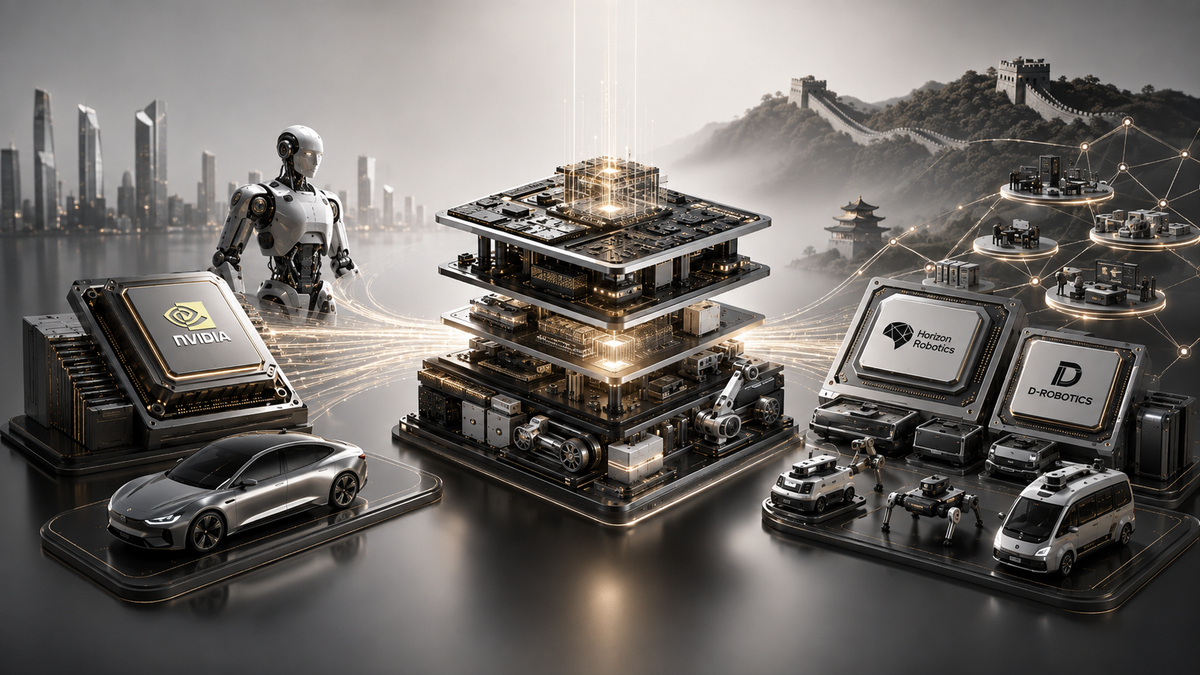
Two Chinese chip companies are mounting the most credible challenge yet to NVIDIA's dominance in autonomous driving and embodied AI — not by outperforming its silicon, but by undercutting its economics and replicating its ecosystem playbook.
The convergence of Horizon Robotics and its sister company D-Robotics onto a shared infrastructure strategy marks a structural inflection point in China's physical AI supply chain. With domestic humanoid robot shipments projected to surge from roughly 18,000 units in 2025 to as many as 100,000 units in 2026 — a figure cited by China's Ministry of Industry and Information Technology (MIIT) at the World Artificial Intelligence Conference in July 2026 — the cost calculus that once justified NVIDIA's premium pricing is breaking down at precisely the moment volume economics begin to bite.
The timing is not coincidental. NVIDIA's Jetson Thor-based T5000 production module carries a unit price of US$2,999 at volumes above 1,000 units — a bill-of-materials burden that was tolerable when robotics firms were burning capital to prove capability to investors, but becomes untenable when the industry pivots to factory-floor deployment at scale.
Scaling Pressure Exposes a Structural Flaw in NVIDIA's Robotics Architecture
NVIDIA's grip on the humanoid robotics compute stack has been near-total. Unitree Robotics integrated Jetson Orin into its G1 EDU platform; Agibot deployed NVIDIA Orin in the high-compute board of its LingXi X2 flagship; Galaxy General Robotics was among the first to deploy the next-generation Jetson Thor; and UBTECH Robotics adopted Jetson Thor as the compute foundation for its on-device large models. The rationale was straightforward: NVIDIA's Thor delivers approximately 7.5 times the compute performance of its predecessor Orin, and its Isaac Sim, Omniverse, GR00T, and COSMOS toolchain — backed by a developer community exceeding two million — provided the fastest path from lab prototype to commercial deployment.
But the architecture carries a hidden cost. NVIDIA's Jetson series embeds two Arm Cortex-R52 cores, which function as a safety island and cannot be repurposed for real-time motion control. As a result, leading robotics integrators have been forced into a dual-chip configuration: NVIDIA Orin or Thor for cognitive inference (the "brain"), paired with a Rockchip RK3588 or Intel Core processor for motion control (the "cerebellum"). Cross-chip scheduling introduces latency jitter and incremental power draw — a combination that undermines both cost targets and the millisecond-level closed-loop stability required on production lines.
D-Robotics's Single-Die Bet Attacks the Dual-Chip Status Quo
D-Robotics's competitive response is architecturally direct. Its Xuri S600 SoC integrates cognitive and motion-control functions on a single die: a four-core BPU Nash delivering 560 TOPS of INT8 inference performance, 18 Arm Cortex-A78AE cores handling perception and cognition, and six Cortex-R52-plus cores with a real-time MCU managing motion control. Brain and cerebellum share the same package.
The commercial logic is equally direct. Eliminating the second chip removes one component's material cost and power budget, while collapsing cross-chip scheduling latency into intra-die communication. The architecture trades raw peak compute for system-level efficiency — a trade-off that becomes increasingly rational as manufacturers shift from capability demonstration to volume production. D-Roboticst CEO Wang Cong has framed the company's ambition explicitly: not as a robot body manufacturer, but as the foundational infrastructure provider for the entire robotics industry — a "picks-and-shovels" platform that avoids competing with its own customers.
The developer traction is early but notable. D-Robotics's RDK Studio AI-native development workbench has attracted a developer base that has crossed 100,000 — a fraction of NVIDIA's two-million-strong CUDA community, but a credible starting point for ecosystem accumulation.
Horizon Robotics Breaks Into Urban NOA After a Three-Year Lag
The autonomous driving front tells a parallel story of delayed entry followed by deliberate repositioning. For the better part of three years, high-end urban Navigate-on-Autopilot (NOA) — the industry benchmark for advanced driver assistance — was effectively an NVIDIA-only market. NIO, XPeng, and Li Auto all launched urban NOA around 2022 on NVIDIA DRIVE platforms; algorithm houses including Momenta and DeepRoute.ai validated their urban driving capabilities on NVIDIA silicon. Even cost-sensitive deployments for traditional automakers reduced the Orin X count from two chips to one, rather than switching platforms.
Horizon Robotics' earlier Journey 5 chip could not support urban NOA. The architecture carried a CPU bottleneck that proved inadequate for the dense interaction and decision-making complexity of urban environments — a product design misstep that cost the company the urban NOA window.
The correction arrived in 2025. Horizon's Journey 6P entered mass production in the second quarter of 2025 and began vehicle integration in the fourth quarter, paired with the company's HSD algorithm reference platform. The combination finally delivered urban NOA at production scale — roughly three years after NIO, XPeng, and Li Auto had established the category. At the Chongqing Forum in 2026, Horizon CEO Yu Kai articulated the company's "rural encirclement" doctrine: early competition targeted Mobileye, Texas Instruments, and Renesas in the sub-100-TOPS segment; the high-compute urban NOA market above several hundred TOPS was always NVIDIA's territory. Journey 6P and the forthcoming Journey 7 — which targets compute performance comparable to NVIDIA's Thor-X — represent Horizon's push into that contested urban core.
At the 2026 shareholder meeting, Yu Kai defined Horizon's commercial positioning in terms that deliberately echo the semiconductor industry's most successful platform model: "The 'Arm plus Android' model is our consistent commercial positioning, committed to becoming the foundational enabler for autonomous driving and robotics."
An Ecosystem Race That Will Take Years to Resolve
The strategic convergence between Horizon Robotics and D-Robotics — both tracing their lineage to the same founding team — produces a division of labor that mirrors NVIDIA's own physical AI stack. Horizon addresses the automotive compute layer; D-Robotics addresses the robotics compute layer. Both companies have explicitly committed to infrastructure positioning over product sales, prioritizing toolchain depth and developer lock-in over near-term hardware margins.
The challenge ahead is substantial. NVIDIA spent more than a decade welding together DRIVE and Jetson hardware, CUDA software, Isaac simulation, Omniverse digital twins, and the COSMOS and GR00T model frameworks into a unified developer experience. That accumulated switching cost — not any single chip's benchmark performance — is the actual competitive moat. Horizon and D-Robotics are building their respective stacks from a position of relative youth: Horizon's toolchain is maturing on the automotive side; D-Robotics's full-stack — spanning chip, hardware development kits, IDE, SDK, algorithm libraries, and cloud platform — is still in early accumulation.
The cost advantage that both companies currently wield is real but fragile. In a market where price competition is already intense across China's robotics and automotive supply chains, margin compression could starve the R&D investment required to close the toolchain gap. The 2026 humanoid shipment ramp — whether it reaches GGII's forecast of 62,500 units or MIIT's more optimistic 100,000-unit target — will test whether volume-driven cost leadership can fund the ecosystem depth required to make the platform transition sticky.
For NVIDIA, the near-term revenue impact in China's physical AI segment is manageable. The structural signal, however, is clear: the era of uncontested platform dominance in autonomous driving and embodied AI is ending, replaced by a two-front competitive dynamic that will intensify as China's robotics industry scales.
Related Coverage:
Volkswagen Taps Horizon Robotics in White-Box AI Deal, Targeting L3 Autonomy by Late 2027
D-Robotics Enters Consumer Drone Market with AI Chip in New Antigravity A1