
Horizon Bets on ‘Non-Famous’ Yihang in China’s ADAS Race
Chinese autonomous driving supplier Yihang Intelligent Technology has secured a strategic investment from chipmaker Horizon Robotics, a move that validates its decade-long, low-profile focus on mass production in the nation’s fiercely competitive smart car market.
Horizon Robotics has invested approximately 200 million yuan (US$27.7 million) for a 9.27% stake in Yihang, becoming its fourth-largest shareholder, according to people familiar with the matter. This backing from a leading automotive chip supplier signals growing confidence in Yihang’s strategy of providing cost-effective, production-ready systems to automakers.
The investment comes as the automotive industry re-evaluates the “all in-house” approach to advanced driver-assistance systems (ADAS), with many automakers now favoring collaboration with specialized suppliers to accelerate deployment and control costs. Yihang, which founder Chen Yuxing describes as a "non-famous" company, has focused on this model to secure key partnerships and production contracts.
The partnership with Horizon reinforces Yihang's push into the high-volume, mid-range ADAS market as it develops more advanced technologies. “Every financing round we've had is backed by a mass production project,” Chen said, highlighting a pragmatic approach that has helped the company survive and grow over the past decade.
A Pragmatic Path to Funding
Since its founding in 2016, Yihang has prioritized production-readiness over hype. The company secured its angel funding from Mingshi Capital only after its four-person team successfully completed a 1,000-kilometer autonomous driving test. Li Auto Inc., then known as CHJ Automotive, also participated as an angel investor, sharing a vision for developing controllable, proprietary smart driving solutions.
This focus on near-term application stood in contrast to many startups of that era, which pursued more ambitious but less commercially viable Level 4 autonomous driving. Chen credits this mass-production DNA as a key reason for the company’s survival.
Navigating Automaker ‘Frenemies’
Yihang's ten-year history mirrors the evolving relationship between automakers and their tech suppliers. Between 2018 and 2020, many Chinese car companies grew frustrated with the limitations of "black box" solutions from suppliers, which restricted their ability to customize and upgrade features. The first-generation Li ONE, for instance, used a Mobileye solution that limited the automaker's control over the algorithm.
This frustration sparked a wave of in-house development. Geely Automobile Holdings invested heavily in ECARX, Great Wall Motor incubated Haomo.ai, and Chery Automobile established Dazhuo Intelligence. However, full-stack self-development proved costly, time-consuming, and often struggled to keep pace with rapid technological iteration.
“Full-stack self-development isn't the only way; what's key is full-stack controllability and efficient implementation,” Chen noted. In the last two years, the industry has shifted back toward a hybrid model of collaboration. Yihang has capitalized on this trend by forming a deep partnership with BAIC Group, supplying the ADAS for its BJ40 model in 2023 and securing a contract for the Arcfox T1 in 2025. This relationship was solidified by a Series C investment from BAIC Capital.
Expanding in the Mid-Range Market
Yihang is strategically targeting the mid-range ADAS segment, which represents the largest market volume. In the first 11 months of last year, penetration for highway Navigate on Autopilot (NOA) in China’s passenger car market was 7.2%, while more advanced city NOA stood at just 1.5%, according to data from Gasgoo Auto Research Institute, highlighting the growth potential for more accessible systems.
The company offers a mid-range ADAS solution that costs under 5,000 yuan, a price point that makes it viable for vehicles in the 100,000 to 200,000 yuan range. The system enables functions such as highway NOA, memory-based commute NOA, and multi-level memory parking. According to Chen, the cost is expected to decrease further with scaled production.
A Pipeline for the High End
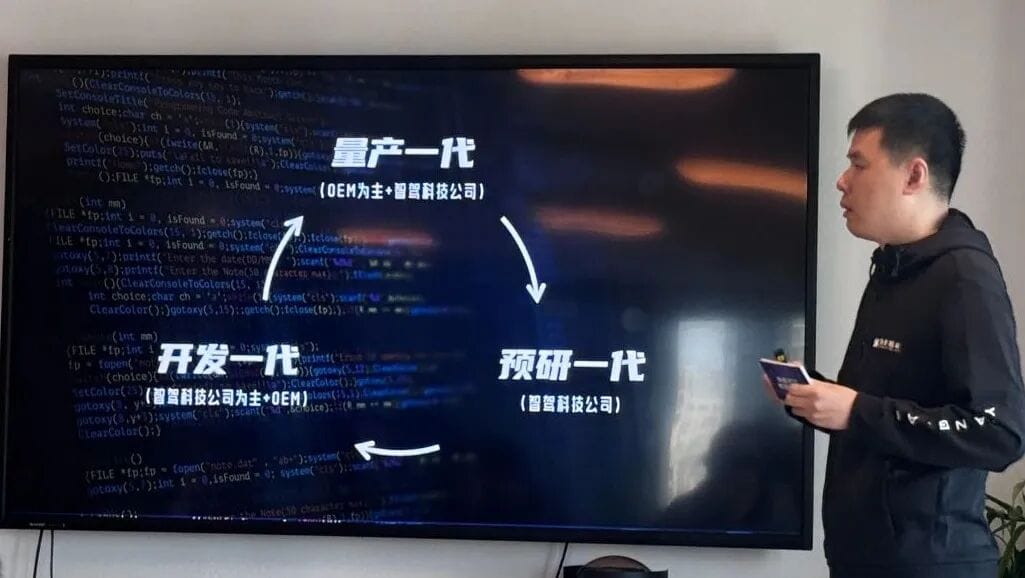
While expanding its mid-range footprint, Yihang maintains a forward-looking development strategy summarized as: "Mass produce one generation, develop the next, and pre-research the one after that." This approach leverages data from mass-produced projects to train its next-generation models, creating a virtuous cycle of improvement.
The company is already developing a high-end solution built on Nvidia's 512-TOPS Orin chip. This system utilizes an end-to-end architecture combined with a diffusion model to enable “parking space to parking space” autonomous driving. While the client cannot be disclosed, Yihang has reportedly secured a contract for this advanced system on a major automaker’s flagship model, signaling its readiness to compete at the upper end of the market.