
Huawei and BAIC Target Niche Wagon Market to Drive New Growth Amid Auto Wars
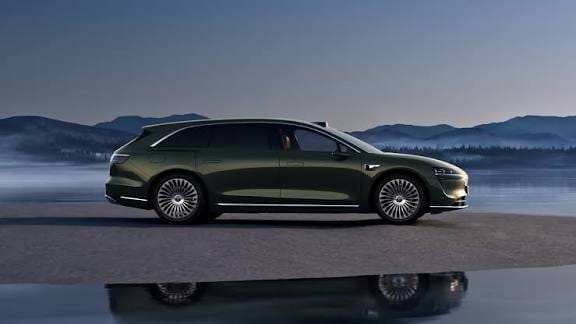
Huawei Technologies Co.’s automotive alliance is venturing into China’s niche station wagon market with a new electric vehicle co-developed with BAIC Group, testing whether its technology-centric ecosystem can turn a marginal segment into a new growth driver.
The Stelato S9T, the first station wagon under the Harmony Intelligent Mobility Alliance (HIMA) banner, was officially launched on the evening of September 16, 2025. The vehicle is priced between RMB 309,800 yuan (US$42,700) and RMB 369,800 yuan, positioning it in the highly competitive premium segment of China’s electric vehicle market.
Underscoring the partnership's depth, BAIC Group has committed to investing 20 billion yuan over the next three years to build out the Stelato brand jointly with Huawei. “BAIC is going all-in on Stelato to build a brand strategic community with Huawei,” said Zhang Jianyong, Chairman of BAIC Group, at the launch event.
The move marks a strategic pivot for HIMA, which has so far focused on popular categories like SUVs and sedans with partners such as Seres Group Co. The launch of the S9T signals an attempt to find new avenues for expansion by tackling less-proven vehicle categories, putting it in direct competition with existing premium wagons from rivals like Nio Inc. and Zeekr Intelligent Technology Holding.
Wager on an Untapped Market
The station wagon, or “travel car,” has long struggled to gain mainstream acceptance in China, where consumer preference has overwhelmingly favored traditional sedans for formal appeal and SUVs for their perceived presence and space. Models from foreign brands like Volkswagen, Volvo, and Audi have historically achieved only modest, cult-like followings without making a significant market impact.
However, the rise of electric vehicles is reshaping consumer tastes and vehicle design possibilities. The versatile nature of wagons—offering SUV-like cargo capacity with sedan-like handling—is increasingly aligned with modern consumer lifestyles that blend urban commuting with outdoor activities like camping. This has prompted brands like Nio and Zeekr to explore the segment with models such as the ET5T and 001.
Stelato enters a competitive field. The S9T offers a base cargo capacity of 729 liters, expandable to 1,677 liters, catering to family road trips. It will nevertheless face tough comparisons with rivals like the Zeekr 001, which boasts a maximum of 2,144 liters of cargo space. Success will depend on convincing buyers in the crowded 300,000-yuan-plus price bracket to choose a relatively unfamiliar vehicle type over established alternatives.
Huawei’s Ecosystem Playbook
The Stelato S9T’s launch is less about a single product and more about a strategic penetration of a new vehicle category for HIMA. The alliance is betting that its core strength—a seamlessly integrated hardware and software experience—can differentiate the S9T. Rather than competing on a single metric, HIMA’s strategy is to offer a comprehensive package of technology, performance, and user experience.
True to this playbook, the S9T's entire lineup comes equipped with Huawei’s advanced Qiankun ADS 4.0 intelligent driving system. This system is supported by a formidable sensor array, including a 192-line high-performance LiDAR, three high-precision solid-state LiDARs, and five 4D millimeter-wave radars. “The Stelato S9T is equipped with Huawei's flagship 9-series black technology,” stated Richard Yu, Huawei’s consumer business group chairman.
Despite Huawei’s powerful brand recognition, HIMA faces two key challenges. First, its multi-partner strategy, which includes Aito, Luxeed, and now Stelato, risks blurring brand identity and creating confusion over whether consumers are buying a BAIC car or a Huawei car. Second, the S9T must provide a compelling reason for families to choose it over the numerous mature SUV and sedan models already popular in its price range.
BAIC’s 20 Billion Yuan Commitment
BAIC’s 20-billion-yuan investment signals a deepening of its collaboration with Huawei, elevating the relationship from a technical partnership to a “brand strategic community.” The capital is earmarked not just for a single model but for the long-term development of the Stelato brand as a dedicated business unit within the HIMA framework. The funds will be allocated across four key areas: design, intelligent driving, smart cabin, and quality and safety.
This heavy investment is a pragmatic response to the intensifying competition in China’s auto market, which is shifting from rapid expansion to a zero-sum battle for existing customers. With mainstream segments becoming increasingly saturated, targeting niche markets offers a potential window of opportunity.
The success of the Aito brand has already provided a blueprint for HIMA’s partner-led model. The Stelato S9T now serves as a crucial test of whether that success can be replicated and scaled across different partners and vehicle types. For Huawei and BAIC, the 20 billion yuan represents more than just capital; it is a live-fire exercise in integrating technology, manufacturing, and brand-building to break new ground. Whether this niche gambit can capture a mainstream audience remains the critical question.