
Huawei Founder Ren Zhengfei on AI, Computing Power, and the Next Generation of Tech Talent
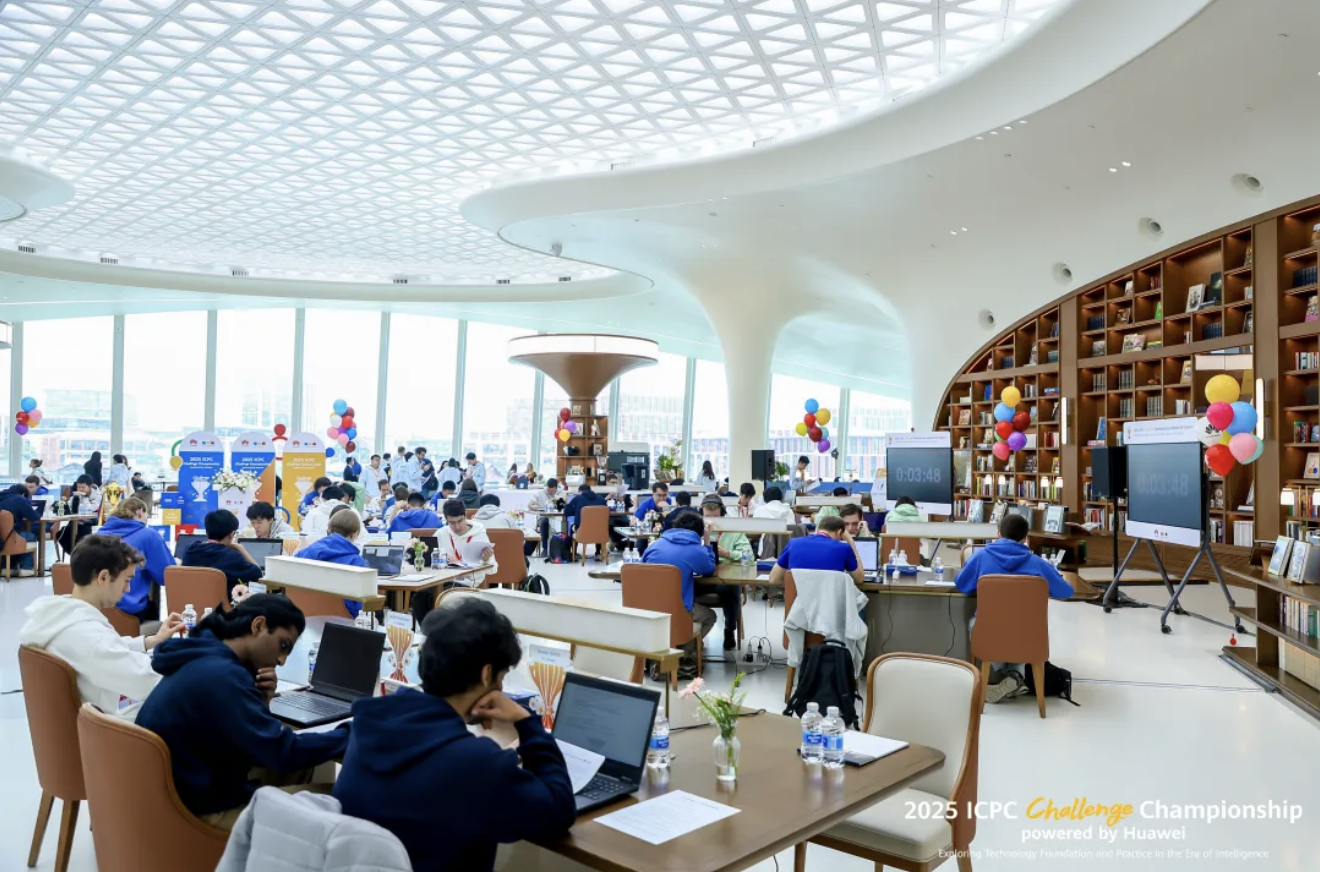
On December 5, Huawei released the official minutes of a strategic dialogue between its founder, Ren Zhengfei, and representatives from the International Collegiate Programming Contest (ICPC). The meeting, which took place on November 14, 2025, was held at the "Shell Library" within Huawei’s Lianqiuhu R&D Center in Shanghai. The content covers critical themes ranging from the trajectory of artificial intelligence and industrial applications to the cultivation of global talent.
The release of these remarks provides a window into how Huawei is navigating the current technological landscape amidst global competition. In his address to ICPC coaches and gold medalists, Ren drew sharp distinctions between scientific invention and industrial application, outlining a pragmatic strategy that focuses on utilizing AI to solve concrete problems in sectors like mining, steel production, and healthcare. His comments also highlighted a shifting dynamic in the global talent market, contrasting the compensation strategies of U.S. tech giants with the rising wave of equity-driven entrepreneurship among China's youth.
The following is a translation of the speech and meeting minutes:
Ren Zhengfei believes that we are currently in an era of rapid change. Young people radiate the light of youth; they are role models for their peers, and the hope of the era rests on them. Regarding youth development, Ren pointed out that everyone’s life path is different: some explore the frontiers by "reaching high," while others root themselves in foundations by "reaching low." Both are contributions to society.
He particularly encouraged capable youth: "If you can reach high, do not reach low, and do not take the commercial path. One day you will be able to touch the truth. If one day you can no longer climb higher, you can walk down from the 'Himalayas,' and you can 'lay eggs' (create value) all along the way. You would absolutely be a hero. Fighting from high ground to low ground is easy."
The current state of Chinese youth gives him hope. "Meta Platforms, Inc. (Meta) gives a few young people signing bonuses of hundreds of millions of dollars and annual salaries of tens of millions of dollars. There is not much fluctuation of sound on the Chinese internet regarding this. Why? They are not envious," Ren mentioned. He noted that currently, "There is a large group of entrepreneurs in China with very strong capabilities. Seven or eight people partner to build a company, or twenty to thirty people partner up; the equity is entirely theirs, and if they do well, they take as much as they want." He added, "In three to five years, or five to ten years, China will witness earth-shattering progress."
He also cited the example of XPeng [specifically referring to XPeng Robotics]: "At the launch event, they cut open the outer skin on the spot, and inside it was all 'steel'." This daring spirit to try and venture out is exactly what the future looks like.
Speaking of the currently hot topic of AI, Ren’s viewpoint is very clear: Do not fixate on "invention," fixate on "application." "AI invention at most creates one IT company, but application can strengthen a country." He calculated that if coal washing accuracy improves by 0.1%, multiplied by China's 4 billion tons of coal production, the value is astonishing; if blast furnace ironmaking efficiency improves by 1%, the fuel saved is immeasurable.
Huawei’s own AI exploration also revolves entirely around "application." He stated that the company’s research "focuses on the next 3-5 years." The goal is to use large models in blast furnaces to calculate furnace temperatures through data, predicting the silicon content of molten iron two hours in advance. It can also be used in mines, allowing miners to operate machinery from the surface, avoiding gas and collapse hazards. Furthermore, it should be used in hospitals; the pathology model at Ruijin Hospital and the remote ophthalmic diagnosis at Sun Yat-sen University are existing examples.
How should different countries approach AI? Ren feels one cannot apply a "one size fits all" approach. For a country like Indonesia, the priority is not to vie for leadership in large models, but to apply AI to port automation, "using the centimeter-level positioning of BeiDou, so that as soon as a ship approaches the electromagnet, it is sucked to the shore, which is much simpler than cables." China’s direction, meanwhile, is to solve practical problems: urban safety, unmanned cement production, and the 5G-R dispatching system for high-speed rail traveling at 450 km/h.
Some worry about insufficient computing power, but Ren feels that "in the future, computing power will be in surplus, it will not be the shortage that is imagined."
In his view, "building thousands or hundreds of large models are all correct explorations," but he warned, "Is demand a linear structure? What if it is non-linear?" Ren stated, "We are called Huawei Technologies Co., Ltd., not Huawei Science Company. Science is what you study; we apply science and technology." He added, "You theoreticians shouldn't panic; Fourier didn't know back then that his equations would change the world."
Near the end of the symposium, Ren mentioned the changes brought by the internet. "In the past, how could children in mountain valleys attend prestigious schools? Now, just click the screen." He feels that education is changing from "physical concentration" to "logical dispersion," which will allow more talent to emerge.
"You are the light of the era." Ren emphasized again to the young people present that regardless of whether they pursue scientific research or entrepreneurship, "Do not care about whether you have money, do not care about whether your youth will be sacrificed, do not attach too much weight to metrics." "Do not care about who chooses what, and do not care about what your classmates or friends choose. Care about what suits you. Only you understand yourself. Choose a profession and forge ahead; it doesn't matter if you don't succeed. The majority of people in this world are not successful. The road of non-success is also full of learning. Through non-success, a large number of hypotheses have been tested, and tested hypotheses are immense wealth accumulated by you."
Excerpt from the Meeting Minutes:
Veronika Soboleva: Good morning everyone! First of all, thank you very much, Mr. Ren, for bringing the ICPC teams to such a beautiful campus at Lianqiuhu. We are very honored to be here today. All participating members represent the ICPC; they have worked very hard this year. They come from over thirty countries and regions, numbering more than 110 people, including coaches and contest winners from around the world. Some colleagues are participating remotely, and some are participating on-site. We are very happy to be here to share our ideas and listen to your insights. Thank you very much to Huawei for the thoughtful arrangements, and thank you for bringing the coaches and contestants of the entire ICPC community here. We have three parts of key work, including connecting academia, institutions, and industry, so this is a very good event. Welcome everyone!
ICPC Chair: First of all, thank you very much for inviting us to this beautiful campus. This is a place that is fantastic in every aspect, a good place to make friends and gather together. I want to express my gratitude to everyone for providing us with such an opportunity. There is a very good word in English, "together." Being able to gather together—thank you very much!
Mr. Ren: Thank you very much, ICPC Chair, coaches, and young world gold medalists. We believe that we are in an era of rapid change. Hope lies in young people; you are radiating the light of youth. You are role models for young people, and the hope of the era is entrusted to you, the youth.
In your industry, I am an outsider. I do not fully know what should be done, and I also have some confusion about this era. To establish communication with everyone in this era, to build a friendly bond, and through this bond to perceive the pulse of the world and perceive the dreams of you young people—I am very fortunate. Everyone feels the leap of the era together, not knowing what kind of future technology will hold, forcing us to work hard together to explore and advance in this era. I do not know everyone well and cannot make a systematic speech. I still want to communicate with everyone and hear everyone's opinions.
Veronika Soboleva: Thank you very much, Mr. Ren. Over the past three days, everyone has attended many seminars at Huawei, raised many questions, and solved many challenges. I know everyone has many questions about AI to discuss with Mr. Ren. This year (2025), the ICPC Challenge is also focused on AI, with this as the main topic. I know there will also be many questions related to education, as well as differences and challenges around the world, because the levels and conditions in various parts of the world are different.
1. Veronika Soboleva: From the discussions among the contestants yesterday, I heard a question. We have now arrived at the era of AI and are facing the challenges brought by AI. How does Huawei view this? Not just for the entire ICPC community, but how does the large global community solve the challenges brought by AI? We have many different ideas; what needs to be done? We would like to hear how you view the future of AI. What problems do we need to solve, and how can we solve these challenges together?
Ren Zhengfei: regarding AI issues, I am an outsider. I think the relationship between AI and humanity can be understood in several stages. From twenty years from now to the next one thousand years, this is a problem for sociologists and anthropologists to study. Yuval Noah Harari is a representative figure; his Nexus explores the profound changes and potential impacts that AI technology development may bring to social structures and human existence. With the deduction of big data and large models, whether what he says is fact—perhaps in twenty years, you young people will be able to know these things and perceive this era.
The stage of the next ten to twenty years should be for great prophets and great scientists to conceive in their minds what the future technological society structure will be.
Our company's research focuses on the next 3-5 years: how large models, big data, and massive computing power can be applied in industry, agriculture, and the technology sector. For example, in blast furnace ironmaking, using large models to know in layers the reasonable control of the furnace temperature at each level, appropriately and reasonably lowering the furnace temperature, optimizing the control of fuel and ore configuration, and deducing what the silicon content of the molten iron will be in two hours, determining the proportion of fuel and ore to be input. This can increase the efficiency of the blast furnace by 1%.
Our country can already use unmanned methods to "dig coal" at depths of 500 to 700 meters or deeper underground. Why? The situation of the long and narrow tunnels in the unmanned coal mines is completely stitched into a complete and continuous real-time video through data collection, so people on the ground or far away can operate coal mining machinery to dig coal, predicting gas explosions, water permeation, and collapses, ensuring the safety of miners. After the coal is transported to the ground, coal washing is used to select the coal. Using large models can also improve the selection accuracy by 0.1%, producing more refined coal. Meanwhile, in open-pit mines, excavation and loading can be completely unmanned, with hundreds of heavy-duty mining trucks and excavators running completely without humans. Port loading and unloading, stacking, and customs clearance are becoming unmanned. For example, at Tianjin Port, unmanned loading and unloading operations—from container loading and unloading to stacking and customs clearance—are all unmanned. The Chancay Port in Peru is the same. So, we focus on these places.
Secondly, human physical health. Does everyone know about physiological slides? The pathology large model at Ruijin Hospital is already in large-scale use, using large model inference to analyze slides to help doctors improve their diagnostic capabilities. There is also the ophthalmic model at Sun Yat-sen University, which can use mobile phone photos or specialized instrument photos for remote diagnosis, helping doctors in remote areas improve their diagnostic capabilities.
Everyone also knows about passenger vehicle autonomous driving models, as well as the Xiaoyi dialogue model in cockpits and on mobile phones, etc. We focus on these places, setting our sights on using large models to solve practical problems in production and consumption. Of course, there is still a lot of room for progress, and much accumulation is needed.
2. Question: Mr. Ren, I am a coach from Shanghai Jiao Tong University. I won the ACM ICPC World Championship three times in 2002, 2005, and 2010. I later established the ACM Class, hoping to cultivate our own computer scientists, not just to win more championships. I was thinking that since the establishment of the ACM Class in 2002, over more than twenty years, the influence of the ACM Class globally has actually been quite significant. Now many students go abroad for further studies, and I hope they will return after their studies.
With the arrival of the AI era, China hopes to introduce talent, but technological development cannot always rely on introducing talent; we should create talent ourselves. Only by being an education powerhouse can we become a technology powerhouse. In this era, how can China spend more energy on education ahead of the curve? Now many scientific and technological achievements do not come from academia, but from industry. For example, school-enterprise cooperation can no longer quickly solve the problems of Chinese education.
Ren Zhengfei: Because we are an enterprise, the attribute of an enterprise is to create commercial value, while the attribute of a school is to explore the future of humanity. Schools do "0 to 1" research innovation. If "0 to 1" fails, it doesn't matter; it cultivates a large group of talent. Talent steps on the theoretical foundations of their predecessors to climb higher step by step, creating a new future. Enterprises turn the theories created by schools into industrial reality.
I recently met a great entrepreneur. He said that our country's hydroelectric generators are advanced in the world—both turbine and impulse types are advanced—but the original inventions were from Austria, France, the United States, and other Western countries. Including China's trains, ships, and textile machinery, the original inventions were basically Western; calculus and geometry were proposed by the West. Universities are actually researching and exploring "0 to 1."
China will catch up and provide original creations. Let me give an example: the best weather model in the world was actually proposed by a 22-year-old young man in our company. This weather model utilizes meteorological data from European meteorological satellites. He used the entire universe as a wind tunnel and the earth as a model. I heard many people say that this weather model is used to predict grain yields, power generation, and the accurate routes of typhoons. So, China may also have original creations. Of course, the entire High Voltage Direct Current (HVDC) transmission system is an original creation. Including the architecture design of StarFlash transmission, which is a world-class invention.
Our company also has a 22-year-old Russian girl who invented a new remainder algorithm, which may change the implementation structure of our AI chip multiplier-accumulator and improve chip capability, but it hasn't been adopted yet. Why? The chips we invented have gone through six or seven years and haven't been put into production yet; we cannot change to a new architecture again.
Therefore, the purpose of education is education, and the purpose of enterprise is commerce. If we mix them, we will regress.
3. Question:Hello, Mr. Ren. I am a teacher from The Chinese University of Hong Kong, Shenzhen. previously, I participated in programming competitions for nearly fifteen years before ultimately choosing to join the academic world rather than the industry. I did this because I wanted to contribute to society, especially by cultivating the next generation of competitive talent and promoting technological development. However, I deeply feel that current scientific research—whether in terms of computing power or data—urgently requires close cooperation between enterprises and universities.
For instance, the questions for this "Champion Cup" originated from the industry and were drawn from the era of large model AI. The champion is a doctoral student who graduated from Zhejiang University and is currently studying at the Georgia Institute of Technology. Therefore, I feel that this competition and the final results serve as an excellent model of exchange and cooperation between schools and enterprises. Mr. Ren, in the environment of this new era, regarding competitive talent from both home and abroad—especially young talent—what kind of help do you hope Huawei can provide in the future? What depth of exchange and cooperation do you hope to achieve to promote the continuous generation of new results?
Ren Zhengfei: I believe that every person’s life has a different path. Some reach for the heights, while others work on the ground; both make contributions to society. There will also be some university students who become workers—"workers of the new era." Three years ago, we recruited over 3,000 undergraduate graduates from remote areas. After three years of training, we granted them specialized certification within our company to work as operators in chip production and precision manufacturing. In the future, there will be a new understanding of the term "worker"; some production personnel in precision industries will need to have received higher education. The idea that college students can be "workers" is a responsibility for the future of higher education.
Of course, we also need a group of people to reach for the heights—to touch the world, or even touch the universe, and touch the future of humanity. People need to strive, but different people walk different paths. Not everyone needs to reach for the heights; teaching students in accordance with their aptitude is a very important educational model.
However, if you are capable of reaching high, do not aim low, and do not take the path of commercialization; one day you will be able to touch the truth. If one day you climb as high as you can and cannot go any higher, you can walk down from the "Himalayas." You can "lay eggs" along the way down, and when you reach the bottom, you can "farm," "raise cattle," or "raise pigs"—you are absolutely a hero. It is easy to strike from a high position downward. I encourage the youth of today: those who have the potential to reach the heights must walk to the highest point.
Meta gives several young people signing bonuses of hundreds of millions of dollars and annual salaries of tens of millions of dollars, yet there is not much fluctuation in the voice of the Chinese internet. Why? There is no envy anymore. Currently, there is a large group of entrepreneurs in China who are extremely capable. Seven or eight people team up to form a company, or twenty to thirty people form a partnership; the shares are entirely theirs, and if they do well, they take as much as they want.
There are very many innovative companies run by Chinese youth. In three to five years, or five to ten years, earth-shaking progress will occur in China. In the field of robotics, there are millions of young people in China working on it, and surplus capital is investing energy to drive and train them. Regardless of whether they succeed or fail commercially, millions of outstanding teenagers and youths have grown up. This is beneficial for China’s industrial modernization, agricultural modernization, and technological modernization. They are the backbone of our country's march toward modernization. Chinese young people no longer have mechanisms to envy others; China's own mechanisms have formed. There are also many people returning from studying overseas who team up with their own classmates to start businesses. The youth no longer envy others; they envy themselves and want to hurry up and accomplish things themselves.
Recently, the robot from XPeng came out and walked a "catwalk." People started to disbelieve it, saying there was a real person inside. At the press conference, XPeng cut open the robot’s outer skin with scissors on the spot to show it was full of "steel" inside. The robotics industry has also made great progress. These small companies are very formidable; they represent the future world and showcase a future world.
Making a true "human" is still very difficult, considering the energy efficiency ratio of the brain and the neural density of the skin. In this world, there must always be people exploring the future. Human society has risen to success from one failure after another. China will see relatively large progress in three to five years. A strong China is conducive to world prosperity.
4. Question: Hello, Mr. Ren! I am from Beijing Jiaotong University and am currently a junior. In the ICPC World Finals held in Baku this year, I won the world’s third-place gold medal. I am very grateful for the support from Huawei. I would like to discuss personal development with you. Just now, it was mentioned that we are in the era of AI, an era of rapid development. In the future, I will go to the School of Computer Science at Peking University to pursue a doctoral degree under the supervision of Professor Xie Tao. I have now preliminarily come into contact with some scientific research work, especially publishing papers to propose new ideas. Since these are frontier explorations, it is inevitable to encounter some skeptical voices. Whether in ICPC competitions or in life, one encounters many voices of doubt and those who do not have high expectations. Huawei has also had such moments in its history. I would like to ask Mr. Ren how you view these voices, and how one breaks through doubts to keep moving forward during such moments? Thank you, Mr. Ren.
Ren Zhengfei: It is quite normal to advance amidst skepticism. Many important scientific breakthroughs faced doubts at the very beginning. For example, when Fourier proposed that arbitrary functions could be represented by trigonometric series, it was not accepted by the Paris Academy of Sciences; Higgs' submission predicting the existence of the boson was rejected; the uncertainty principle of the Copenhagen interpretation was opposed by Einstein, and so on. During its industrial development, Huawei faced skepticism when promoting 5G Polar codes and Massive MIMO, constellation shaping in the optical field, and multi-lens mobile phone photography. To achieve breakthroughs, one must dare to welcome challenges and innovate boldly.
The China State Railway Group is currently testing a new 5G-R wireless dispatch system on railways. For high-speed trains running at 450 kilometers per hour, 5G-R is used to carry wireless dispatching. This 5G-R symbiotic radar checks line safety in real-time and monitors the axle safety of high-speed trains; this represents a massive stride forward. Everyone knows that in China’s heavy-haul rail transport, a single train pulling 30,000 tons of coal relies on radio dispatching. Radio previously used GSM-R to control train intervals, capable of controlling trains with a cargo load of 20,000 tons each, transporting densely to Qinhuangdao. In the future, this will be upgraded to 5G-R, capable of supporting the operation of over ten thousand trains running at 450 km/h and 30,000-ton freight trains. As you know, more than 10,000 high-speed trains are dispatched daily now, and passing through every point involves a calculation point. With such a massive rail transport network, how does artificial intelligence manage command and dispatch?
The core technology leader of the 12306 system [China’s official railway ticketing system] was once a young girl. She is a "Model of the Era," having built 12306 into a super-large-scale real-time ticketing system leading the world in traffic and transaction volume. China's networks are becoming increasingly complex, including freight networks. These urgently await very cutting-edge mathematics to solve complex problems. You can make your academic direction concrete and specific.
China adds more than 8,000 kilometers of railways annually. In the future, China's railway mileage will reach hundreds of thousands of kilometers, forming the longest and most complex railway network in the world. When you become the pillar of society in the future, China may have 300,000 to 400,000 kilometers of trunk rail lines, not including intercity railways and subways. The scheduling, warehouse management, loading management, and coordination management of such a dense transport network constitute extremely complex science, requiring formidable mathematics PhDs to solve these problems.
If you come from a transportation university, the problems that transportation urgently needs to solve are very complex problems.
5. Question: Hello, Mr. Ren! I am a coach from the Beijing University of Posts and Telecommunications. I have led BUPT's best competition students for seven years. Some joined Huawei this year and are now working in the Data Communication product line. My question is: In your view, how long will it take for Artificial General Intelligence (AGI) to be realized? If it can be realized, many professions and positions will be replaced by artificial intelligence. How should young people in China choose their majors and directions in university in the future? My child is also taking the college entrance examination next year, and I would very much like to hear your opinion.
Ren Zhengfei: Regarding Artificial General Intelligence, the United States and China have different directions in their pursuit of artificial intelligence. The U.S. is exploring Artificial General Intelligence (AGI) and Artificial Super Intelligence (ASI), addressing questions of what a human is and what the future of human society holds; they want to solve a problem holistically. This era still requires a cognitive process. China, on the other hand, is researching how to solve how things are done, creating more value, and solving development problems. The safety of cities, the progress of public education and health, unmanned mining production, and unmanned cement production—where coal workers go to work wearing ties, suits, and rings—this is the current concretization. Imagine the dust-filled mines, the extremely cold mining areas, the extremely hot construction sites, and the extremely high-altitude factories; how spectacular it will be when production becomes unmanned in the future.
What should be done with employees made redundant by unmanned operations? We must develop re-education engineering. For example, implementing a voucher system to provide some tuition subsidies to laid-off personnel, and turning some empty schools and factories into vocational schools to conduct vocational re-education for laid-off workers. In the past, our vocational education mostly diverted students from junior high school to build vocational colleges. Junior high students are too young to truly master informatics. After massive automation, it may lead to some people having no work. However, from a national perspective, total wealth is increasing. For example, in a factory, production with humans is 100; without humans, it is 120. The personnel made redundant can undergo re-education and re-employment, transferring to concrete work. Therefore, we will face staff reductions in many positions. The state will take these people in through re-education projects and transform them into the talent the country needs, because artificial intelligence brings an increase in the country's total wealth.
Programming software is currently said to require humans. With the widespread application of large models and agent technology in software development, AI-assisted computer software programming has already released about 30% of the workload of software engineers. In the future, this may reach 60-70%. Why can't the progress of unmanned operations be faster? We still have to take it slowly to ensure the social structure develops stably. Therefore, the social benefit brought by artificial intelligence is an increase in total wealth. How to share this wealth? How to reconstruct some people for re-employment? This is the new subject.
6. Question: Hello, Mr. Ren. I am a PhD student from Princeton University, and my current research direction is Large Language Models (LLMs) in Artificial Intelligence. A common problem faced by academia is limited computing resources. I know that Huawei has faced certain restrictions on key components in recent years. Under such long-term resource-constrained circumstances, how will you overcome this, and how will you make the next choices? Thank you!
Ren Zhengfei: I believe that in the future, there will be a surplus of computing power, not the shortage you imagine. Building thousands or hundreds of large models are all correct explorations. How large have large models become now, and how much computing power is required? When explaining supernodes, Huawei mentioned the 950, 960, and 970, but how many "970s" do we need generally? Where can the 970 be used? How many units are needed, and how are the clusters connected? This is a linear technical deduction, a hypothesis of computing power that can certainly be realized. However, regarding the demand out there, we do not yet have the ability to predict and deduce it well. Is demand a linear structure? What if it is non-linear? Therefore, the era of computing power surplus will definitely arrive. Those who build models should not worry; how models can be useful to society is also not a problem you need to worry about. Models are trained and reasoned for applications across thousands of industries; whether they can generate commercial applications in the future is for other people to do—specifically, industry application engineers.
People online often say that Huawei is not involved in science; we are indeed involved in technology. We are called Huawei Technologies Company, not Huawei Science Company. Science is what you study; we apply science and technology. However, internally, we classify some people as "scientists" as a job category. It does not benchmark against social standards; it is just a specific designation code, so there is no need to be pedantic about it.
So, you pursue theory and take the path of science. Do not worry about whether your science will receive social application. If you are always worried about social application, you are not a scientist, but an application expert. Engaging in theory is great because theory is thought out and deduced, so there are very few of such people. Think about how difficult the Fourier transform, Laplace equation, and Maxwell's equations are; they are "fantasies" created by mathematical derivation and physical intuition. When they wrote down the equations, how did they know at that time that this would be so useful to human society? We do well in industry, but how do we respect originality? This is the issue of how we resolve our relationship with Europe and the United States.
7. Question: I am an undergraduate student, currently a senior, from Jakarta, Indonesia. I heard previously, especially from my professors, about the development of AI technology and AI applications in Indonesia. My professor told me that the focus of AI in Indonesia is more on utilizing existing technologies rather than seeking new technological breakthroughs. I personally might pursue further studies in the future, so I want to ask Mr. Ren, how do you view this? Do you have any suggestions? Or are there any words you would like to say to us young contestants, especially those of us who want to further our studies and work in the technology field?
Ren Zhengfei: I agree with that professor's remarks. For you, the most urgent matter is not to compete for world leadership in computing power and large models in this world, but to emphasize "application" leadership. This suits your country's national conditions. For example, Indonesia has a large number of ports; ship automation and port automation are areas that urgently need to be addressed by artificial intelligence. Currently, your applications in shipping and ports are already quite developed. Secondly, the distance between your islands is fifty or sixty kilometers, so establishing complete radio communication is also very easy.
Combining China’s BeiDou satellites with Huawei technology, positioning on Earth can reach centimeter-level precision, which is suitable for you. Previously, when your ships docked, using cables and such was very complicated. Now, once close to the electromagnet, it is sucked to the shore; mooring is much simpler. Artificial intelligence will definitely play a significant role in Indonesia's industrial takeoff. This includes how to apply it well in agriculture; currently, in some places in China, farmland cultivation poses as unmanned.
8. Question: I was born in Indonesia and am currently studying at the University of Toronto. Max Planck created quantum mechanics, and in many Western countries, they are not only talking about AI but also quantum computing. Quantum is now used in the encryption field, and there are also quantum chips; these are frontier areas. Quantum chips can break all encryption software. Currently, quantum chips are not stable enough and cannot produce stable results. But in the near future, after massive research, I feel that quantum progress is inevitable. So I am very curious about China's thoughts on quantum chips. Is this an area Huawei is focusing on? Will Huawei want to win in the competition of quantum chips in the future?
Ren Zhengfei: Thank you. You are a student of Hinton—how great! Nobel Prize winner Geoffrey Hinton is the father of deep learning, and Richard Sutton is a Turing Award winner; both are in artificial intelligence.
Quantum science will break through sooner or later. Quantum usage in computers will certainly be realized, bringing huge advantages, especially in specific calculations.
Research on quantum computers is a proposition for humanity and for nations; Huawei cannot shoulder the problem of quantum research. However, when quantum computers come out, we might purchase them. As for quantum breaking various encryption systems in the world, we will "block with generals when soldiers come" (deal with the problem when it arises). This includes nuclear fusion. Some people say "nuclear fusion will definitely succeed." I believe it, but when? I don't know. If nuclear fusion succeeds, all energy revolutions will change. Does that mean we shouldn't build power plants today and just wait for nuclear fusion to succeed? Therefore, you see that we are still investing heavily in power system construction in 2025.
Quantum computing will definitely succeed. As for what artificial intelligence will definitely become in the future, we do not know. We cannot refrain from making efforts in other aspects today just because that future exists.
9. Question: I study at the National University of Singapore (NUS). Thank you very much for today's event and the exchange with us. The United States poaches a lot of top talent from all over the world; even from some small countries, the US sends people to poach talent back. I agree with this positive power-law distribution. Computer science, academia, and entrepreneurs all believe that these students can drive the development of industry and society. Therefore, I think for a company to become the best, it must fight for these talents. But these people, these good students, have significant power of choice. The most excellent people may go to financial companies to do hedge funds because they get more money there. Do you agree with this statement?
First, is attracting talent globally important? What is China's plan, and what is Huawei's plan? How to compete for these optimal talents? Even though they have various choices, and regardless of language and cultural differences or challenges, they are still willing to come to China, to Huawei. What kind of plan does China have? What kind of plan does Huawei have?
Ren Zhengfei: American soil is suitable for growing crops. It is a good thing that a large number of talents go to the United States to grow; it is not a bad thing. This includes many Chinese youths going to the United States, taking root and sprouting there, and participating in the creation of some new technological civilizations. The founder of Google is Russian; the Android they created—isn't the whole world enjoying it! It is also beneficial to China. It cannot be said that Apple, Microsoft, Nvidia, and Intel are not creating value for our country; they are also creating value.
The technological civilization created by the United States is not harmful to the world; it is beneficial. We should also support the development of American technological civilization because if the US creates technological civilization and locks it up without letting others use it, how can the US make money? In the process of earning your money, it fundamentally promotes your industrial progress. Without European civilization, how could we possibly have cars, trains, and ships?
We also crave globalization and being able to stand on the shoulders of giants. Our self-reliance is forced; it is an act of helplessness. Relying entirely on oneself is no match for globalization. In many aspects, we rely on ourselves and lag behind the commercially available chips used by domestic enterprises by at least one generation.
China is relatively backward, so naturally, it needs to rise more, and it also needs to absorb some talent. The current environment is already much better than in our youth. How happy, sunny, and full of tension young people are. Now China also has the soil and opportunities for talent, and many youths are starting businesses here, but our speed in chasing the United States is still slow.
As a company, Huawei cannot accommodate too many people; we cannot support them and might even have to lay people off. Our communication with the ICPC does not carry any hidden agenda; it is not saying "all talent should come to us." You might not necessarily be able to play your role if you come here to work, because geniuses need a platform. Of course, the food in Singapore is about the same as ours.
So, judging from various current situations, China needs to be more open. It must learn the strengths of all civilized countries in the world and accommodate the world's civilizations; it cannot be closed off and defensive. Reform and opening up opened the country's gates, letting the world's civilization in. It did not produce a clash of civilizations; civilizations superimposed to jointly create a value, which is today's New China. Opening up has made China rich, but rich to what extent? It is not enough. China's wealth must have quality. The Central Committee of the Communist Party has now proposed "New Productive Forces," which means you have to go "work out" and make your "muscles" a bit stronger so we can do better. If our products are of high quality, won't the people of the world welcome us? If our products go abroad and the quality is not good enough, and everyone says Chinese products are bad, China will not have an international market, and China's development will be hindered.
Our company was once a small, closed company, working slowly behind closed doors. Now we are slowly opening the door. From the time I met Nika by the Moscow River a few years ago, through you, I met seven or eight hundred people. These are the bonds, the bonds between different countries, and the bond of the Huawei company started from there. Mathematics has no borders; theory has no borders. We see the papers you publish and we use them; you can also see the papers we publish. Our platform for exchange is the "Huang Danian Tea House" online platform. You can call out to someone with shared insights on the network platform; they might appear suddenly in Iceland, completing the exchange through a globalized technology network platform.