
Huawei Launches Xiaoyi Claw Beta, Bringing OpenClaw AI Agent Framework to HarmonyOS Ecosystem
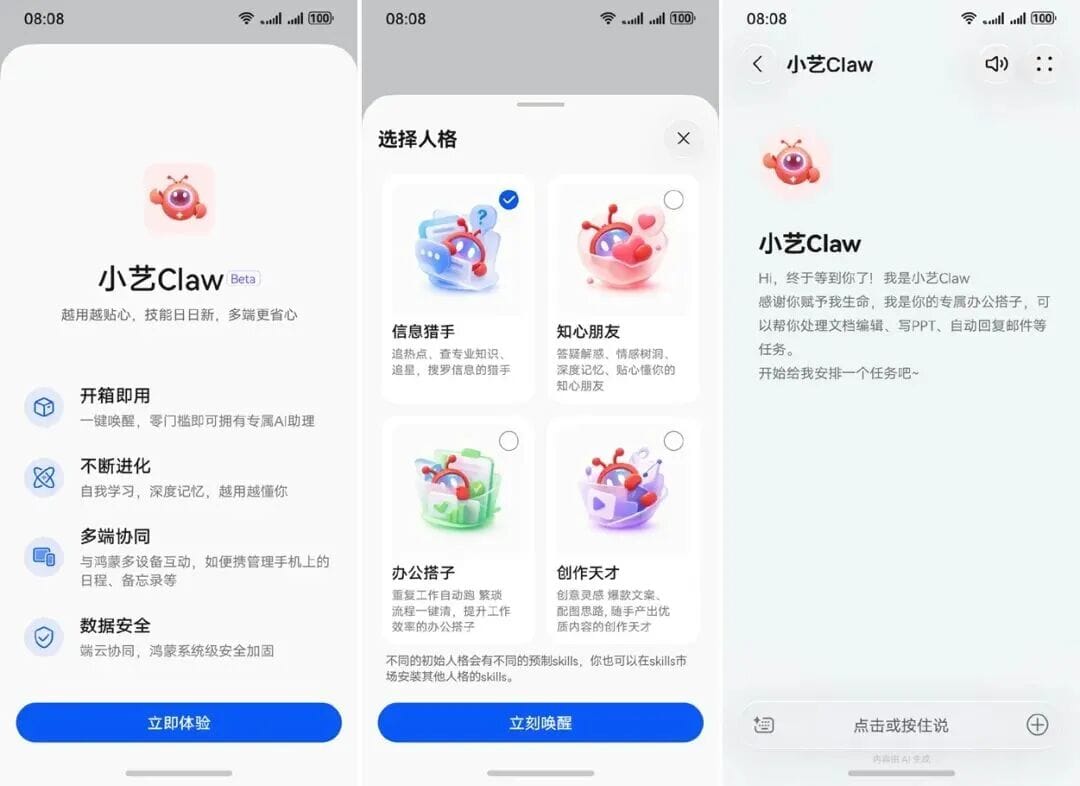
Huawei Technologies has officially unveiled Xiaoyi Claw, a HarmonyOS-native AI agent built on the OpenClaw open-source framework, marking a significant step in the company's push to embed agentic AI capabilities directly into its proprietary operating system.
He Gang, CEO of Huawei's Terminal BG, announced the launch on social media, sharing screenshots of the Xiaoyi Claw interface. The move signals Huawei's intent to translate the rapidly growing momentum around OpenClaw — which has attracted widespread interest from developers and enterprises — into a consumer-ready product accessible to mainstream HarmonyOS users.
Unlike conventional AI assistants that operate in a passive, query-response mode, Xiaoyi Claw is designed as a system-level integration within HarmonyOS, enabling it to execute multi-step tasks autonomously. The company positions the product as lowering the barrier to AI agent adoption, removing the technical complexity that has largely confined OpenClaw usage to developer communities.
From Developer Tool to Consumer Product
The OpenClaw framework has gained significant traction in recent months, drawing interest from corporations and individual developers alike. However, its practical deployment has remained out of reach for most general users due to technical prerequisites.
Huawei's approach with Xiaoyi Claw is to abstract that complexity entirely. Users can activate the agent with a single prompt through the Xiaoyi App by selecting the "New Agent" option and choosing "OpenClaw Mode." Each account is currently limited to creating one OpenClaw-mode agent during the beta phase.
The agent is designed to learn and adapt over time, capturing user behavior patterns and preferences to progressively personalize its responses — a feature Huawei describes as making the assistant more attuned to individual users with continued use.
Productivity and Multi-Device Integration
In workplace scenarios, Xiaoyi Claw is capable of handling document editing, PowerPoint drafting, and automated email replies, while also breaking down complex, multi-step tasks without requiring user intervention at each stage. Huawei frames this as a meaningful productivity enhancement for users looking to reduce time spent on repetitive workflows.
The agent also leverages HarmonyOS's distributed architecture to support seamless task handoff across devices — including smartphones, tablets, and PCs — enabling continuous AI assistance regardless of which HarmonyOS device a user is working on.
Beta Rollout With Gradual Expansion Planned
Xiaoyi Claw is currently available in a closed beta, restricted to whitelisted users, and supports devices running both HarmonyOS and HarmonyOS NEXT. Huawei said it will refine the product based on feedback collected during the testing phase and plans to progressively broaden access before a full public rollout.
The launch positions Huawei as one of the first major device manufacturers to integrate an OpenClaw-based AI agent natively into a mobile operating system, potentially raising the competitive stakes in the broader AI assistant market as the technology moves from experimental to everyday use.