
Huawei to Launch New Watch and Earbuds, Solidifying Lead in Wearables Market
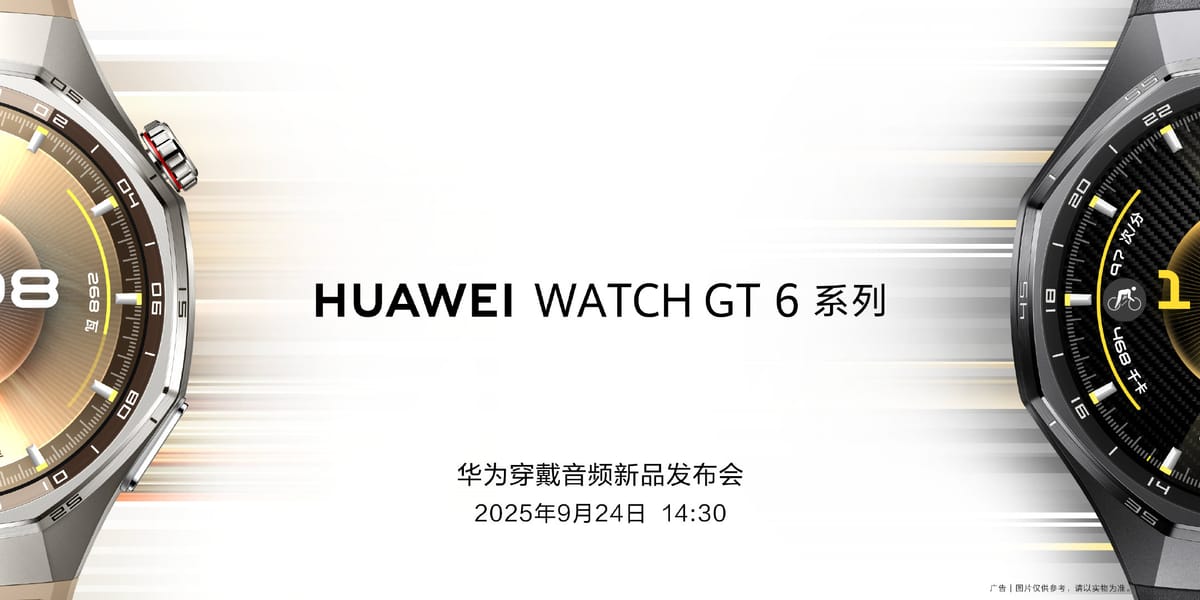
Huawei Technologies is set to unveil its next-generation smartwatch and earbuds at a launch event on Sept. 24, a strategic move to reinforce its dominance in the global wearables market just as new data confirms its number one position.
The company has officially announced the event, where the flagship HUAWEI WATCH GT 6 series will be the main highlight. The launch will also feature the debut of the new HUAWEI FreeClip 2, an open-ear audio device.
This product refresh comes as Huawei was crowned the top vendor in the global wrist-worn device market for the second quarter of 2025, according to a report from International Data Corporation (IDC). The upcoming release is poised to strengthen the company’s competitive edge and capitalize on its growing market share.
The announcement underscores Huawei's focus on expanding its consumer electronics ecosystem through continuous innovation in high-growth segments. By integrating proprietary technologies like its NearLink connectivity and HarmonyOS, the company aims to entrench its leadership in a market that is increasingly shifting towards sophisticated health and lifestyle integration.
New Generation of Wearables
The HUAWEI WATCH GT 6 series is expected to consist of two models, the GT 6 and GT 6 Pro, and will be the first in the GT line to feature Huawei's NearLink technology, which is anticipated to enable functions like a digital car key.
Leaked information suggests the new watches will offer significant upgrades in battery life and enhanced functionalities for sports enthusiasts, particularly for cycling, with on-screen metrics such as power units indicating more professional-grade tracking. The devices are also expected to feature an upgraded health monitoring experience, leveraging its proprietary Xuanji sensing system for more accurate tracking of heart rate, sleep, and stress levels.
Alongside the smartwatches, the company will introduce the HUAWEI FreeClip 2 open-ear earbuds. The new model will reportedly feature a large 12mm dynamic driver and HarmonyOS Sound 2.0 to deliver enhanced audio quality. The design incorporates technology to minimize sound leakage, aiming to provide a clear listening experience without being an in-ear device.
Topping Global Charts
Huawei’s upcoming launch builds on a position of market strength. In the second quarter of 2025, the company secured a 20.2% share of the global wrist-worn device market and a commanding 33.4% share in its home market of China, ranking first in both, according to IDC data.
The global wrist-worn device market grew 12.3% year-over-year to 49.2 million units in the second quarter. China, the world's largest market for these devices, outpaced global growth, with shipments surging 33.8% to 20.8 million units, buoyed by government subsidies and the "618" shopping festival.
Huawei’s recent growth has been driven by the strong performance of its WATCH 5 and FIT 4 series, which saw shipments climb 11.7% year-over-year. The company has also achieved significant growth in emerging markets, including the Asia-Pacific region, the Middle East and Africa, and Latin America.
From Niche Gadget to Health Staple
Since launching its first smartwatch in 2015, Huawei has steadily built its presence in the wearables sector, maintaining its position as the top vendor in China for six consecutive years and surpassing 200 million cumulative global shipments of its wrist-worn devices.
The market is benefiting from broader trends, including a rising awareness of personal health and fitness spurred by government initiatives like the "Health Management Year" by China’s National Health Commission. This has fueled demand for high-end sports watches, a segment that now accounts for 10% of the total market value for wearable bands in mainland China.
Industry analysts believe that as technological innovation continues and the consumer ecosystem matures, smart wearables are transitioning from novelty items to essential daily tools for health management and convenience. This evolution signals a robust long-term outlook for the sector, with significant potential for market leaders to further expand their value proposition.