
Huawei’s Kirin 9050 Pro Tests a New Scaling Path Under Chip Sanctions
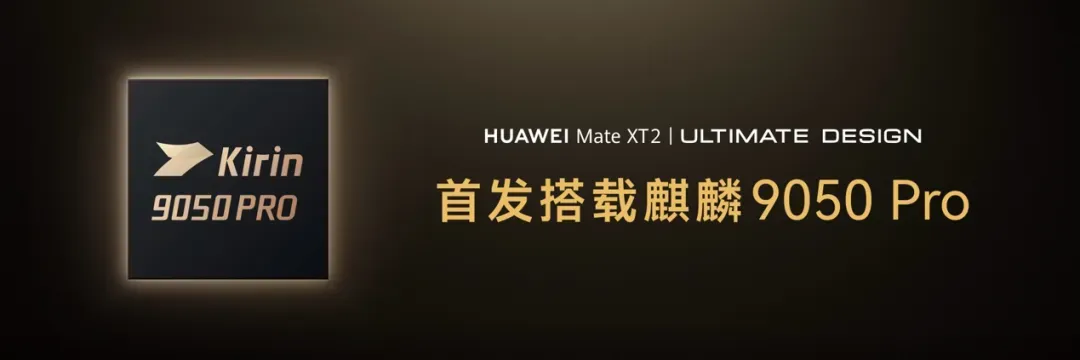
Huawei launched the Kirin 9050 Pro on September 7, 2026, its first flagship-class mobile processor in six years, embedding it inside the second-generation tri-fold smartphone Mate XT 2—a device that now serves as both a commercial product and a public proof-of-concept for an alternative semiconductor scaling paradigm.
The announcement, made at a joint HarmonyOS 7 and Mate XT 2 launch event in Shenzhen, drew immediate attention from industry analysts tracking China's semiconductor self-sufficiency drive. The chip's debut closes a gap that opened in late 2020, when U.S. export controls severed Huawei's access to advanced foundry capacity at Taiwan Semiconductor Manufacturing and Samsung Electronics. What makes the Kirin 9050 Pro strategically significant is not merely that it exists, but how it was engineered to perform: through latency compression and logic-folding rather than transistor miniaturization.
Tao's Law Moves From IEEE Paper to Production Silicon
In May 2026, He Tingbo, president of Huawei's HiSilicon semiconductor unit, formally proposed the "Tao (τ) Law" at the IEEE International Symposium on Circuits and Systems—positioning it as a successor framework to Moore's Law. Where Moore's Law prescribes geometric shrinkage of transistors to double performance roughly every two years, Tao's Law targets temporal miniaturization: compressing the signal propagation delay (τ, the time constant in circuit theory) within a chip's critical paths.
The Kirin 9050 Pro is the first mass-production chip explicitly designed around this principle. Its core enabling technology, logic folding, is architecturally distinct from conventional 3D chip stacking. Standard 3D integration stacks completed dies at the packaging stage, connecting them through a limited number of inter-die channels. Logic folding, by contrast, redistributes standard logic cells across vertical layers during the design phase, multiplying internal interconnect density and dramatically shortening signal travel distances. Huawei describes the difference as the gap between two standalone buildings linked by a corridor versus a single duplex structure with staircases throughout.
The practical output: overall system performance on the Mate XT 2 is 42% higher than its predecessor, the Mate XTs, according to Huawei's internal benchmarks. The Lingxi CPU core—configured as one prime core, two performance cores, four efficiency cores, two small cores, and a dedicated low-power micro-core for always-on tasks—delivers a 24% single-core peak gain and 52% multi-core improvement. Large-file open speeds are up 50%; multitasking fluidity improves 35%.
The Maliang GPU, equipped with hardware-accelerated ray tracing, doubles compute units and cache, achieving a 142% rendering performance uplift and supporting real-time tracing of 50 million light rays. For video creators, 4K export speed rises 40%. The DaVinci-architecture NPU runs the industry's first on-device Mixture-of-Experts (MoE) full-modal large model, with 30 billion total parameters and 2 billion activated parameters—enabling functions such as photo library organization entirely offline.
On thermal management, a multi-path heat-dissipation packaging design paired with a graphene cross-axis vapor chamber system reduces peak gaming temperature rise by 2.5°C, sustaining performance under sustained load—a critical engineering constraint in the thin tri-fold form factor. Security credentials include dual hardware security units, support for post-quantum cryptography algorithm detection, and EAL5+ CCRC certification.
Financials Reveal a Company Trading Profit for Technology Sovereignty
The Kirin 9050 Pro's emergence is inseparable from a deliberate, multi-year capital allocation decision. In the first half of 2026, Huawei reported revenue of RMB 467.819 billion (approximately US$64.97 billion), up 9.55% year-on-year. Research and development expenditure reached a record RMB 121.382 billion (approximately US$16.86 billion)—exceeding net profit attributable to shareholders of RMB 23.427 billion (approximately US$3.25 billion) by more than five times. Net profit fell 36.77% year-on-year, a decline Huawei's management has implicitly framed as the cost of building the next technology cycle.
This ratio—R&D spend at roughly 26% of revenue and more than five times net income—has few precedents among global hardware companies and underscores the existential framing Huawei has applied to chip development since 2019. The internal project tasked with solving the manufacturing problem was named "Moye" by founder Ren Zhengfei, a reference to a Chinese legend in which a swordsmith's wife sacrifices herself to complete a blade. The metaphor was intentional: without a viable chip, Huawei's high-end product line had no future.
HarmonyOS Ecosystem Reaches Inflection Point, Amplifying Chip Value
A chip's commercial value is only realized through the software stack running on top of it. Huawei's HarmonyOS 7 now runs on 85 million active devices as of September 7, 2026, with the company projecting it will cross 100 million by Q4 2026. The milestone matters for a structural reason: developer investment in an operating system ecosystem scales with addressable user base, and 100 million active devices represents a threshold at which third-party application optimization becomes commercially rational at scale.
Huawei's rotating chairman Xu Zhijun described the 2025 full-line migration to HarmonyOS as "changing engines mid-flight"—and the results appear to validate the risk. Within less than a year of completing the transition, Huawei has reclaimed the top position in China's smartphone market by unit share, according to company statements.
The Mate XT 2's tri-fold form factor—a 10.2-inch unfolded display at 3.5mm thickness—serves as HarmonyOS 7's most demanding test environment. Three applications can run simultaneously in full-screen split view, with drag-and-drop window replacement. The Xiao Yi AI assistant, upgraded with multi-agent coordination, executes photo categorization and organization entirely on-device, with no cloud upload required. Over 100 applications have completed dedicated tri-fold optimization. The on-device ECG function—capturing a 30-second cardiac reading by gripping both lateral frames—marks the first time a smartphone has integrated this clinical-grade feature, enabled by the tri-fold's stable bilateral contact geometry.
Sanctions Pressure Persists, But a Reproducible Engineering Path Now Exists
The Kirin 9050 Pro does not resolve Huawei's access constraints. Advanced lithography equipment and leading-edge process nodes remain subject to U.S. and allied export controls, and legislative efforts to tighten restrictions further are ongoing. Huawei remains the primary named target in successive rounds of semiconductor-related export rule amendments.
What the chip does establish, however, is that a performance-competitive, mass-producible high-end mobile processor can be built within those constraints—and that the performance trajectory is sustainable. For China's domestic semiconductor supply chain, the significance is upstream: volume production of a flagship chip generates real purchase orders that allow equipment and materials suppliers to refine processes against specific engineering problems and accumulate manufacturing experience in high-end chip production. Xu Zhijun has publicly called on industry partners to intensify investment in EDA tooling and advanced packaging, identifying these as the highest-leverage bottlenecks remaining.
For global semiconductor strategists, the Kirin 9050 Pro presents a case study in constraint-driven innovation. Path dependency—the tendency of incumbents to continue optimizing established scaling approaches while they remain profitable—has historically meant that paradigm shifts originate at the margins. Huawei's position since 2020 has been structurally analogous to that of a company with no incumbent path to protect, which may explain why logic-folding moved from theoretical framework to production silicon in roughly 12 months from its public introduction.
The Mate XT 2's market performance will determine whether the architecture earns a second generation. But the engineering question—whether Tao's Law can sustain high-end chip competitiveness outside the Moore's Law scaling ladder—has received its first mass-market answer.
Related Coverage:
Huawei’s τ-Law Gets Its First Silicon Test: 55% More Density, 66% Lower NPU Power