
Humanoid Robot Wars: China Racks Up Orders While US Players Tout Tech And Tussle With "Fake News"
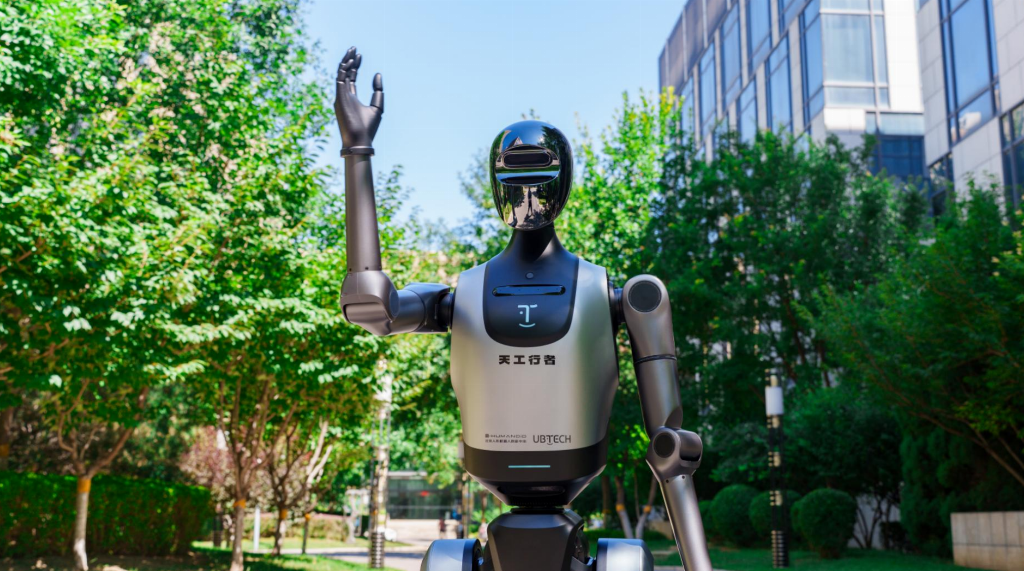
The humanoid robot race is no longer about futuristic demos and hype cycles; it is rapidly morphing into a battle of tangible commercial contracts versus ambitious, capital-intensive technological promises. A new J.P. Morgan research report, published on October 20, 2025, lays bare a stark divergence in the sector. While Chinese OEMs are quietly amassing a significant and growing order book for delivery this year, their US counterparts like Tesla and Figure AI are navigating production hurdles and market volatility, even as they push the boundaries of AI and hardware design. The report is a must-read for any investor trying to separate real-world traction from market noise.
As J.P. Morgan notes, the industry has shifted from "hype to tangible, scalable business models despite ongoing debates." The evidence for this is most pronounced in China.
China's Order Bonanza
Chinese OEMs are demonstrating impressive momentum, securing contracts for delivery in 2025 across manufacturing, commercial services, and even government projects. Leading the charge is UBTECH Robotics, which has seen a torrent of orders for its Walker S2 robot.
The bank highlights the scale of this commercialization, stating, "UBTech’s latest series of major order wins for Walker S2 underscores its accelerating commercialization, with cumulative orders now reaching c.RMB 630 million yuan (approx. US$87 million) YTD – equivalent to c.950 units and already well above its 2025E delivery guidance."
These are not small-scale pilot programs. The report details a series of major wins for UBTech, including a record-breaking RMB 250 million order from a domestic enterprise, and contracts with Miracle Logistics Automation and an auto parts company. The company is now targeting over 2,000 units in annual shipments for 2026.
Similarly, the privately-held Agibot is making deep inroads into industrial automation. J.P. Morgan notes its recent wins, including "a contract with Ningbo Joyson Electronic for automotive parts manufacturing and a multi-hundred million RMB order from WingTech Technology for consumer electronics precision manufacturing."
The West's Tech-Forward, Cash-Heavy Gamble
While Chinese firms are focused on shipping units, US leaders are locked in a different kind of race—one defined by technological leaps, massive fundraising, and significant volatility.
Tesla remains the sector's bellwether, with its long-term ambition to produce one million Optimus units per year. However, J.P. Morgan echoes market sentiment that near-term execution faces headwinds. The report states that "technical challenges...have led to downward revisions in output for 2025, with the annual target reportedly cut from 5,000 to 2,000 units."
Meanwhile, Figure AI is flexing its financial muscle. The startup's recent Series C funding round is a testament to the immense investor appetite for a general-purpose humanoid robot. J.P. Morgan observes: "Figure AI’s recent 1B+SeriesC funding round at a post−money valuation of 39B marks a critical milestone, accelerating its efforts to scale...into real-world environments." The round, backed by heavyweights like NVIDIA, Intel Capital, and Brookfield, will fuel the scaling of its newly unveiled Figure 03 robot, a machine designed for mass manufacturing and home use. Yet, like Optimus, its timeline for large-scale commercial deployment remains a forward-looking target rather than a current reality.
'Fake News' and 'Competitive Accusations' Roil The Market
The high stakes of the robotics race have fostered a climate of intense scrutiny and speculation, fueling market volatility. J.P. Morgan bluntly addresses this undercurrent, pointing to a trust deficit in the sector.
"The environment is marked by frequent accusations among OEMs regarding the authenticity of order announcements, technology breakthroughs, and customer wins," the report warns. "Fake news and market speculation – such as Sanhua Intelligent Controls denied RMB 5B order – have fueled volatility and skepticism."
This combative atmosphere underscores a key tension: as the industry matures, the pressure to demonstrate real progress is leading to both legitimate breakthroughs and unverifiable claims. For investors, this means due diligence is more critical than ever. While J.P. Morgan remains constructive on sector leaders, their report serves as a crucial reminder that in the humanoid robot wars, the map is not the territory, and a signed contract is worth more than a thousand slick demos.