
From Roads To Skies: Morgan Stanley Sees China's 'Second Act' In Flying Cars And AI
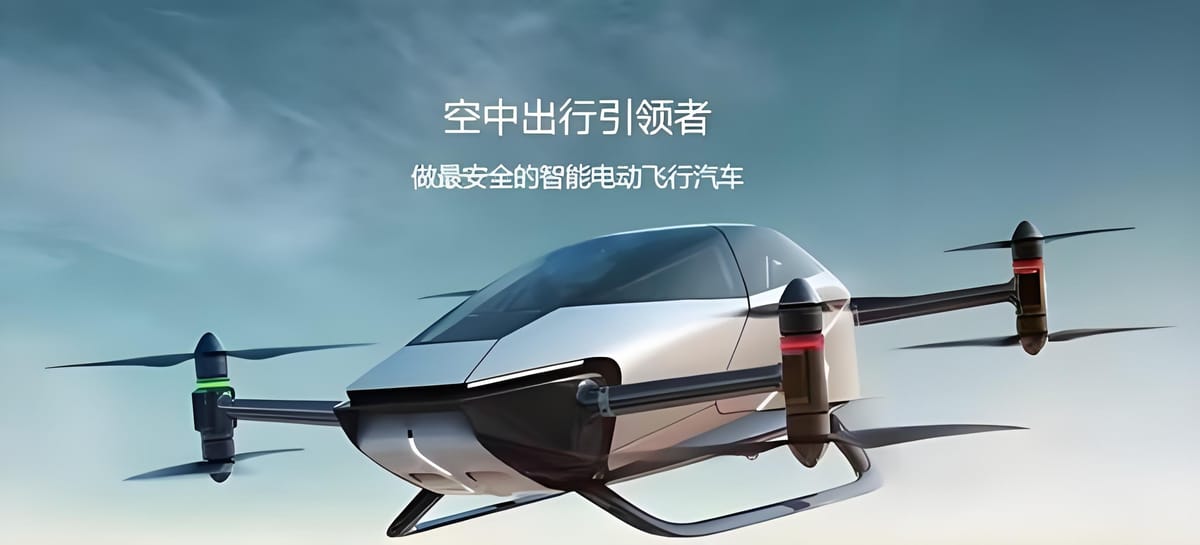
In a note that is sure to capture the attention of investors fixated on China's electric vehicle race, Morgan Stanley has shifted its focus from the crowded highways to the open skies. In a report dated October 20, 2025, analyst Tim Hsiao and his team argue that while EVs have become mainstream, the next frontier of growth and technological supremacy lies in electric Vertical Take-Off and Landing (eVTOL) aircraft—colloquially known as "flying cars."
The report suggests that China's world-leading EV ecosystem has inadvertently laid the perfect foundation for this new industry. For investors wondering what the "second act" is for China's auto-tech giants, Morgan Stanley posits that the answer lies in a trio of AI-driven opportunities: Autonomous Driving (AD), AI Embodiment (robotics), and the burgeoning "low-altitude economy."
A "Pivotal Year" Moment
The Morgan Stanley team draws a compelling parallel between the current moment for eVTOLs and the nascent EV scene nearly a decade ago, suggesting we are at a similar inflection point. The recent 7th China Helicopter Exposition in Tianjin, they note, felt like a major auto show in 2016 when EVs were just starting to move from a niche sideshow to the strategic core of the industry.
"Some eye-catching eVTOL and unmanned aerial vehicles were gaining traction at the 7th China Helicopter Exposition last week in Tianjin China as feasible options to low-altitude economy. The event reminded us of 2016, a pivotal year when EV models had been trickling into major auto shows and moving from a sideshow to strategic focus."
This shift is no longer theoretical. The bank highlights concrete commercial and technological milestones that underscore the accelerating momentum. EHang, a pioneer in the space, has just launched a new, fully autonomous aircraft.
"Earlier last week, EHang officially launched the VT35, a brand new pilotless eVTOL aircraft with 200km range, which is capable of fully autonomous point-to-point navigation backed by triple-sensor fusion (LiDAR, millimeter-wave radar, and camera) without pilot intervention."
Meanwhile, established EV makers are aggressively moving into the space. XPeng, through its subsidiary Aeroht, is seeing significant international demand for its modular flying car, which combines a terrestrial vehicle with an aerial drone. The company recently secured a large batch of orders from the Middle East, demonstrating a clear global appetite for its technology.
"XPeng’s flying car subsidiary, Aeroht, also announced that it had secured 600 additional orders for its “Land Aircraft Carrier.” Purchase agreements were signed with Ali & Sons Group (UAE), Almana Group (Qatar), AlSayer Group (Kuwait), and the UAE Chinese Business Council, bringing the company’s global order book to approximately 7,000 units."
A Virtuous Cycle: From EVs to eVTOLs and Back
Morgan Stanley argues that the development of eVTOLs is not a separate industry but a direct and symbiotic extension of China's established EV dominance. The immense scale of the EV supply chain, from batteries and electric motors to advanced sensors, provides a critical advantage for getting the eVTOL industry off the ground.
"China's EV ecosystem is forging the tech foundation, supply chain and use case to allow the eVTOL industry to emerge in scale. In return, eVTOLs are exploring a high-value frontier that pushes tech boundaries, trickling back down to the EV ecosystem."
This feedback loop is crucial. The extreme safety and performance requirements of aviation will force breakthroughs in battery density, autonomous navigation, and lightweight materials, which will then flow back to improve the next generation of ground-based electric vehicles.
The 'Second Act': Finding Growth Beyond The Gridlock
With the domestic EV market becoming a brutal, high-volume, low-margin fight, the report stresses the need for differentiation. Morgan Stanley believes the most forward-thinking companies are already pursuing this "second act," leveraging their core competencies to capture the next wave of AI-powered growth.
"With EVs now a given in China, it is important that auto names reinvent themselves in a 'second act' to capture AI lift-off and diversify growth prospects. We believe it's time to focus on the 'AAA' opportunities - AD, AI embodiment and AI datacenter (AIDC) and like names with concrete and tangible breakthroughs."
In this new landscape, the bank identifies a handful of players as being particularly well-positioned to carve out a dominant niche. This includes the "EV trio" of Li Auto, NIO, and the aforementioned XPeng, alongside key technology enablers like LiDAR-maker Hesai Technology and robotaxi firm WeRide.
For investors, the message is clear: while quarterly EV delivery numbers will continue to dominate headlines, the real, long-term value may be created by those companies that are successfully transitioning from simple horsepower to AI-driven "brainpower"—both on the road and in the air.