
Inside Meta’s Multi-Billion-Dollar Acquisition of Manus: Founder Xiao Hong on the Darkest Hour
On December 30, 2025, Meta Platforms, Inc. announced the completion of a landmark acquisition, agreeing to buy Butterfly Effect, the company behind the AI Agent product Manus, for several billion US dollars. The deal ranks as Meta’s third-largest acquisition to date, following WhatsApp and Instagram. Upon completion, Butterfly Effect will continue to operate independently, while its founder Xiao Hong, an alumnus of Tencent’s Qingteng program, will assume the role of Vice President at Meta.
The transaction moved at an unusually rapid pace. Multiple people close to the deal said that the entire negotiation—from formal contact to final agreement—took just over ten days. Prior to the acquisition, Butterfly Effect had been seeking a new funding round at an estimated valuation of around US$2 billion. Against the backdrop of Meta’s recent overhaul of its AI research structure, aggressive recruitment of top researchers, and sustained increases in computing power investment, the acquisition is widely seen as a critical step in advancing Meta’s “superintelligence” strategy.
Butterfly Effect was founded in 2021 and initially entered the market with Monica, an AI browser plugin, becoming one of the few profitable application-level products in China’s AI sector. In March 2024, the company launched Manus, a general-purpose AI Agent capable of orchestrating multiple tools to complete complex tasks, quickly drawing attention both in China and overseas.
Momentum peaked in 2025. In November, Manus ranked first in Asia on a list of “Global Most Promising Startups.” Notably, its viral global demo video was produced in less than a week using borrowed equipment and basic editing tools—an embodiment of the company’s culture of “heavy investment in fundamentals, extreme minimalism in form.” In December 2025, the company announced that its annual recurring revenue (ARR) had surpassed US$100 million, soon followed by Meta’s acquisition offer.
For Meta, the deal represents more than the absorption of a product or team; it is a strategic bet on the future form of AI applications. For the China-born startup, Manus has now been formally integrated into the core ecosystem of a global technology giant.
Alexandr Wang (汪韬), head of Meta Superintelligence Labs (MSL), shared the news publicly, noting that the Manus team is at the forefront globally in addressing the issue of “capability overflow” in today’s large language models. MSL is also expanding its team in Singapore, where the roughly 100 existing members of the Manus team have joined the local organization.
Despite this acclaim, Manus’s trajectory has been marked by unconventional choices. Over the past two years, Xiao Hong has led three major counter-consensus decisions: halting a seven-month AI browser R&D project in favor of giving AI its own “computer”; prioritizing zero marketing spend during periods of expensive traffic by betting on compute power to improve experience; and reshaping the organization so that around 80% of code is generated by AI, in an exploration of what an “AI-era company” might look like.
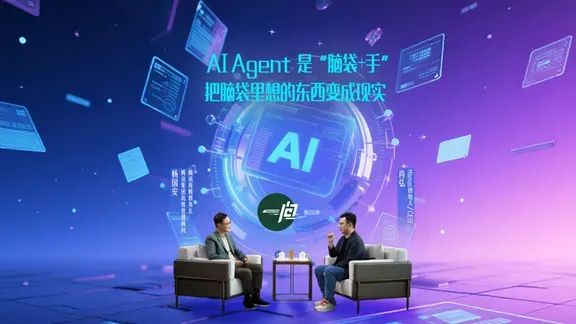
From serial entrepreneur to leader in the Agent space, how does Xiao think about competition and the future? Recently, he sat down with Yang Guoan, Senior Management Advisor at Tencent Group and Dean of Tencent Qingteng, for an in-depth dialogue on the Tencent interview program One Question, reflecting on Manus’s key trade-offs and sharing his views on product logic and organizational evolution in the AI era.
Below is the edited transcript of the conversation.
A Paradigm Shift: When AI Moves From “Giving Answers” to “Delivering Results”
Yang Guoan: Over the next ten years, what will be the biggest change AI brings to your industry?
Xiao Hong: At its core, it’s the reshaping of product development models. Software development will increasingly be led by AI systems. With AI assistance, much leaner teams will be able to dramatically shorten development cycles. For everyday life, this means two things: product iteration speeds will become almost unimaginable, disrupting every industry; and AI capabilities will become universal, requiring everyone to learn how to use AI efficiently for self-improvement.
Yang: You believe that “model capabilities will spill over, while applications are the core of value.” How did you reach that conclusion?
Xiao: It comes from continuous observation. When we were building Monica, the browser plugin, we realized that “context” was key, so we let the plugin automatically capture webpage information instead of forcing users to copy and paste. Later, when Cursor took off, it showed that once models’ coding capabilities mature, a chatbot is no longer the optimal product form—you need a carrier that fits the coding workflow.
These cases made us realize that while technical capabilities keep evolving, product forms often lag behind. By the end of last year, we saw the emergence of “Agents” capable of complex planning and autonomous execution, but without good productization. That was our opportunity—to seize the window created by capability spillover.
Yang: What is the most fundamental change from answer-giving chatbots to result-delivering agents?
Xiao: A chatbot gives you an answer, but you may still need two hours to turn it into a result. An agent tries to deliver the result directly. For example, it can conduct research and generate a polished PowerPoint presentation in minutes, with no human intervention.
This brings three profound changes: first, costs plummet—customized PPTs once exclusive to consulting firms can now be generated by real estate agents; second, diversity explodes—agents can generate multiple versions in parallel; third, fault tolerance improves—if a task fails, the agent can automatically reflect and retry, increasing completion rates.
Yang: How will this change organizational forms?
Xiao: Our bolder vision is that while some AI-enabled large companies will become even stronger, there will also be a proliferation of micro-individuals. Empowered by AI, one or two people will be able to accomplish what previously required an entire company. AI removes the burden of building organizations and managing processes, directly delivering results.
Yang: In my research on digital transformation, I focused on standardization and automation for cost reduction. Your view excites me—agents can handle non-standard tasks, which seems even more disruptive. Which industries will be hit first?
Xiao: The key is that agents combine “thinking + execution.” AI expands the breadth and depth of thinking, while humans make the final judgment. The impact will first sweep through highly digitized “desk-based” work.
Giving AI a “Computer,” Not “Grabbing the Mouse”
Yang: Manus adopts a “large model + cloud virtual machine” architecture. What’s the core advantage?
Xiao: We asked ourselves: what is the ultimate “shell” for AI? The answer is the computer. In the digital world, computers are the terminal through which humans do everything. If you give AI its own computer, in theory it can do everything humans can.
The biggest advantage of virtual machines is handling long-tail tasks—installing specific software, running self-written code—within its own environment. I remember being shocked the first time I saw Manus execute a git clone command, downloading an open-source project into its own “computer” to solve a problem. It looked just like a human using tools.
Speed and resource consumption are challenges, but in the long run they will be solved. The ability to address long-tail problems that generic solutions can’t handle is our moat.
Yang: You once invested seven months in an AI browser but ultimately abandoned it. Why?
Xiao: It was a critical strategic decision. We launched the AI browser project in early 2024. Given our success with Monica, it seemed logical to build a browser that could execute tasks directly. We spent over six months developing it, even compiling an open-source Chrome kernel ourselves and embedding AI capabilities.
But we abandoned it for two reasons: a macro-level strategic judgment and a micro-level product experience issue.
Yang: What principles guide those destiny-shaping decisions?
Xiao: Always start from the question: what fundamental problem can technology solve for users? Then derive the business model. The real difficulty isn’t analysis—it’s having the courage to stick to a clear answer, overcome inertia, and turn it into organizational consensus and action.
Yang: What determines the tipping point for agent adoption?
Xiao: Two layers. First, core capabilities: cost, speed, longer context, and instruction-following over long contexts. These directly affect affordability and completion rates. Second, a capability I’m personally excited about—general computer-use ability. Once AI can recognize and learn to use software on its own, products like Manus can handle more professional and industry-specific software. This breakthrough could come this year or early next year, unlocking many new scenarios.
Yang: What happens if agents can directly call existing software?
Xiao: The biggest change is “liberation from attendance.” Tasks that require people to sit in front of specialized software can be automated. AI can handle basic judgments, with humans approving key steps. This will fundamentally overturn software operation logic and work styles.
Trading Expensive Compute for Growth
Yang: The PC era had “Andy and Bill’s Law.” Does that show value is created jointly by technology and applications?
Xiao: Exactly. It inspired us to ask: in a time of rapid technological evolution, can we temporarily ignore cost and speed, and focus solely on extreme quality? We track cutting-edge models and spare no expense to deliver the best experience—turning expensive compute into a core competitive advantage.
Yang: You insist on product-driven growth with zero marketing budget. Is it sustainable?
Xiao: When building Monica, we noticed that in 2024, about one-third of costs were salaries, one-third token fees, and one-third advertising spend. Advertising platforms would raise prices once we became profitable. So we asked: what’s expensive today but cheap tomorrow? Tokens are expensive now but will get cheaper; user acquisition will only get more expensive. So we aimed to turn token costs into user acquisition costs—by building a product so good that users share it voluntarily.
That’s why Manus launched with zero marketing budget. Its social media virality came from meeting user expectations for the future of AI products.
Yang: Why prioritize individual users over enterprises?
Xiao: It’s about matching technology maturity. Agents are still evolving rapidly. Enterprises need stability; individual users tolerate change and embrace innovation. Early on, C-end markets maximize iteration speed advantages.
Yang: How do you coexist with giants that may build their own agents?
Xiao: We position ourselves as the “best experience integrator.” No single model can dominate all capabilities. As an application layer, Manus can integrate the best models and deliver a superior experience—similar to how phone makers work with chipmakers.
Yang: How will Manus reach mass adoption?
Xiao: Two keys: absolute experiential differentiation, and scenario-based communication. Manus doesn’t just give answers—it generates interactive webpages, making results tangible. We also work with creators in vertical industries to showcase real scenarios in familiar language.
When “One Person Becomes a Company”
Yang: How does AI reshape organizations?
Xiao: As AI boosts individual efficiency, organizations must focus less on control and more on enabling high-quality decision-making. We’ve returned to tighter collaboration, with core partners working together daily without meetings, focusing on deep thinking.
AI “augments,” not replaces. Humans retain final judgment and aesthetic decisions. Disruptive decisions stem from asking fundamental questions and having the courage to act on clear answers.
Yang: What does a perfect AI-native organization look like?
Xiao: We’re at 60 points. A 100-point organization has AI embedded in every workflow, becoming the first instinct—just like Googling today.
Yang: How do you identify AI-native talent?
Xiao: By observing real usage. True AI-native users have far higher usage volumes; AI is deeply embedded in their workflows.
“There’s No Software”: Letting AI Consume the Old World
Yang: How will agents impact the software industry?
Xiao: Two fronts. For engineers, tools like Cursor and Claude Code have transformed workflows. At Manus, nearly 80% of code is AI-generated. Engineers focus on requirements, code review, and architecture.
For non-technical roles and internal IT systems, AI agents will replace internal development and outsourcing. Iteration will be faster and more personalized. This impact is underestimated today, and we will soon release related products.
Yang: How will AI reshape SaaS?
Xiao: Existing SaaS must successfully transform with AI—some estimates suggest about half may fail. New entrants should rebuild products with AI-native thinking based on validated needs.
Yang: With increasing agent autonomy, how do you think about ethics and safety?
Xiao: This requires long-term reflection. In one test, Manus tried to find train schedules, then attempted to draft an email when data was unavailable—it even considered registering an email account. That was both impressive and alarming.
Our principles are to leverage model providers’ safety guardrails and require user confirmation at key points, preventing AI from over-representing users. Our responsibility is to unlock potential while remaining cautious and respectful of long-term impacts.