
Insta360 Storms Gimbal Camera Market With Luna Ultra, Sells Out in Five Minutes
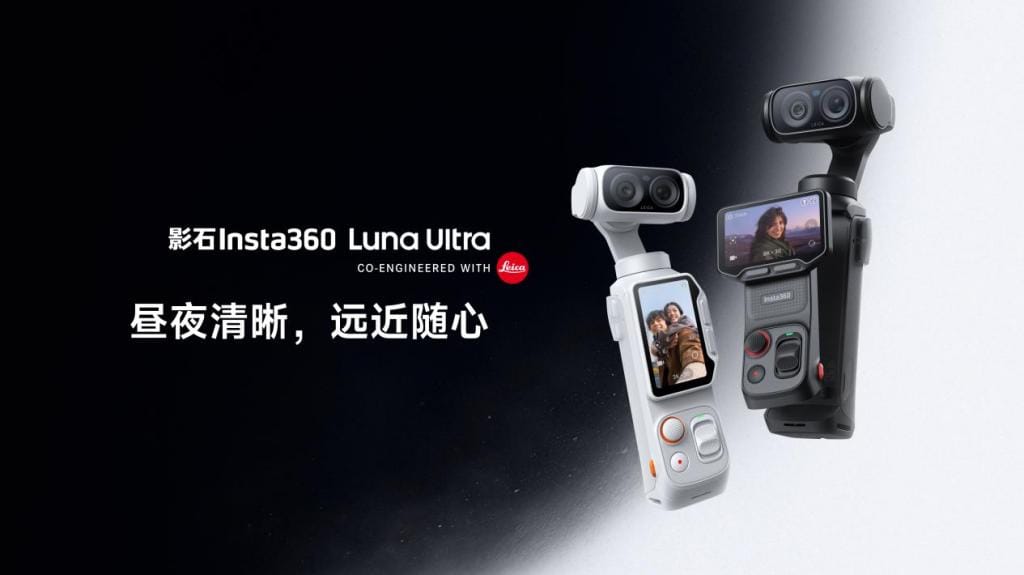
Insta360 has entered the handheld gimbal camera segment for the first time, launching the Luna Ultra on June 10 with dual Leica lenses and a triple-chip AI architecture — and the market responded instantly, with inventory clearing across major e-commerce platforms within five minutes of listing.
The sellout, replicated simultaneously across domestic and international channels, signals more than pent-up demand. It marks a strategic inflection point for Insta360, a company historically defined by 360-degree action cameras, now staking its next growth phase on a category that IDC data shows expanded 83% in unit volume and 86% in revenue in 2025 alone. Queues formed at the company's Shenzhen Yifang City retail location within hours of launch, while store staff confirmed initial allocations were being fulfilled in pre-order sequence.
The timing is deliberate. With vivo, OPPO, Honor, and Xiaomi all understood to have gimbal camera projects in active development — expected to reach market within 2026 — Insta360's window to establish category leadership is measured in quarters, not years.
Dual Leica Optics Redefine What a Handheld Gimbal Can Deliver
Luna Ultra's hardware specification represents a meaningful departure from the segment's prior ceiling. The device pairs a 1-inch primary sensor capable of 8K video capture with a 1/1.3-inch telephoto unit supporting 12x optical zoom and 6x lossless zoom — both lenses carrying Leica Summicron certification, a partnership that extends Leica's color science from stills into video output for the first time in this product category.
Powering the imaging pipeline is what Insta360 calls a "triple-chip AI architecture": a Qualcomm 4nm flagship SoC flanked by two dedicated image processing chips. The configuration enables 4K 60fps low-light video recording — an industry first according to the company — and supports AI-driven noise suppression in portrait telephoto shooting. Battery capacity stands at 1,550mAh, rated for four hours of continuous recording, with fast charging restoring 80% capacity in 23 minutes. Internal storage is 47GB.
Two hardware innovations address the structural limitation that has constrained solo-creator workflows in the category. A detachable wireless transmission control screen operates at up to 20 meters with full camera control and an integrated wireless microphone. A head-tracking module — worn as an accessory — synchronizes gimbal and lens orientation to the user's head movement, enabling what the company describes as "look-to-shoot" capture. Both features are presented as industry firsts.
The domestic launch price starts at RMB 3,999 (approximately US$555), positioning Luna Ultra above mass-market smartphone-adjacent devices but below professional interchangeable-lens systems.
A RMB 97 Billion Market Attracts Smartphone Giants, Pressuring Margins Across the Board
The competitive context surrounding Luna Ultra's launch is structurally significant. IDC's Q4 2025 global handheld smart camera market tracker recorded full-year 2025 shipments of 16.65 million units, with revenue reaching RMB 46.1 billion (US$6.4 billion). The agency projects the market will exceed 40 million units annually by 2030, implying a compound annual growth rate approaching 20% over five years.
That trajectory has attracted entrants with substantially deeper distribution infrastructure. Smartphone manufacturers including vivo, OPPO, Honor, and Xiaomi bring established optical supply chains, retail footprints, and — critically — existing user ecosystems that can accelerate gimbal camera adoption among mainstream consumers who have not previously considered dedicated imaging hardware.
Liang Zhenping, a veteran industrial economist, told Shanghai Securities News that smartphone OEMs will leverage device ecosystem integration as a primary acquisition lever, widening the addressable market while simultaneously raising the competitive bar for category incumbents. He identified three persistent technical bottlenecks constraining the segment: the conflict between mechatronic integration density and chassis space; the thermal and power management challenge of running 4K encoding and AI tracking in a compact enclosure; and the optical compromise between telephoto capability and device footprint.
Insta360's AI triple-chip architecture is a direct engineering response to all three constraints — though whether the thermal performance holds under sustained 4K 60fps load in real-world conditions will be tested by reviewers and early adopters in the weeks ahead.
Profit Compression Reflects a Calculated Long-Term Bet
Insta360's financial profile heading into this product cycle reveals the cost of competing at this intensity. Full-year 2025 revenue reached RMB 9.741 billion (US$1.35 billion), up 74.76% year-on-year, while net profit attributable to shareholders declined 6.62% to RMB 929 million (US$129 million). — a divergence that management has framed as intentional rather than symptomatic.
In Q1 2026, revenue accelerated further to RMB 2.481 billion (US$344.6 million), a year-on-year increase of 83.11%, while net profit attributable to shareholders fell 52.02% to RMB 84.62 million (US$11.75 million). The margin compression reflects three concurrent pressures: elevated strategic R&D spend, intensifying market competition, and component cost inflation in memory and storage.
Insta360 invested RMB 1.53 billion (US$212.5 million) in research and development in 2025, a 96.95% year-on-year increase. R&D spending reached RMB 465 million (US$64.6 million) in Q1 2026, up 101% year-on-year. The company is simultaneously developing two drone platforms (including the Yiling A1 panoramic drone), the Luna gimbal camera line, a wireless lavalier microphone, three additional undisclosed product categories, and three custom chip designs.
Overseas revenue accounted for 69.03% of Insta360's 2025 core business revenue at RMB 6.676 billion (US$927 million), underscoring the company's dependence on international markets — and its exposure to any deterioration in cross-border trade conditions.
Founder and CEO Liu Jingkang addressed the profit trajectory directly in his shareholder letter, characterizing near-term margin sacrifice as a deliberate exchange for long-term market position. His "barrel theory" framing — in which competitive strength is determined by the weakest operational capability across manufacturing, testing, algorithms, marketing, and roughly 20 other dimensions — articulates a moat-building logic that prioritizes compound operational excellence over any single technological advantage.
AI Roadmap Positions Luna as a Platform, Not a Product
The strategic significance of Luna Ultra extends beyond its launch-day specifications. Allen, the product lead for Insta360's Luna line, described the device's positioning as a "cameraman robot" — a framing that aligns with Liu Jingkang's previously articulated vision of building a photography robot platform in which AI constitutes the "brain" while cameras, stabilization systems, and drones form the "body."
Multiple AI features are described as forthcoming post-launch updates, suggesting Insta360 intends Luna Ultra to evolve through software in a manner more consistent with a connected platform than a conventional consumer electronics SKU. The AI auto-editing capability already embedded in the device — enabling automated clip selection and assembly — is an early expression of this direction.
Liang Zhenping characterized the broader category as systematically undervalued by current market consensus, arguing that handheld imaging devices are transitioning from single-function capture tools into AI-native smart terminals with multimodal interaction capability and broad scene applicability. The "revenue growth without profit growth" dynamic visible at Insta360 and likely across the competitive set, he suggested, reflects investment in that longer-arc transformation rather than structural margin deterioration.
Whether the market assigns that terminal value to Insta360's equity — the company is listed on the Shanghai Stock Exchange — will depend on how cleanly the Luna platform executes against the smartphone OEM wave arriving later in 2026.
Related Coverage: