
Insta360’s Liu Jingkang: A Panoramic Drone Is “the Automobile in the Age of Horse-Drawn Carriages”
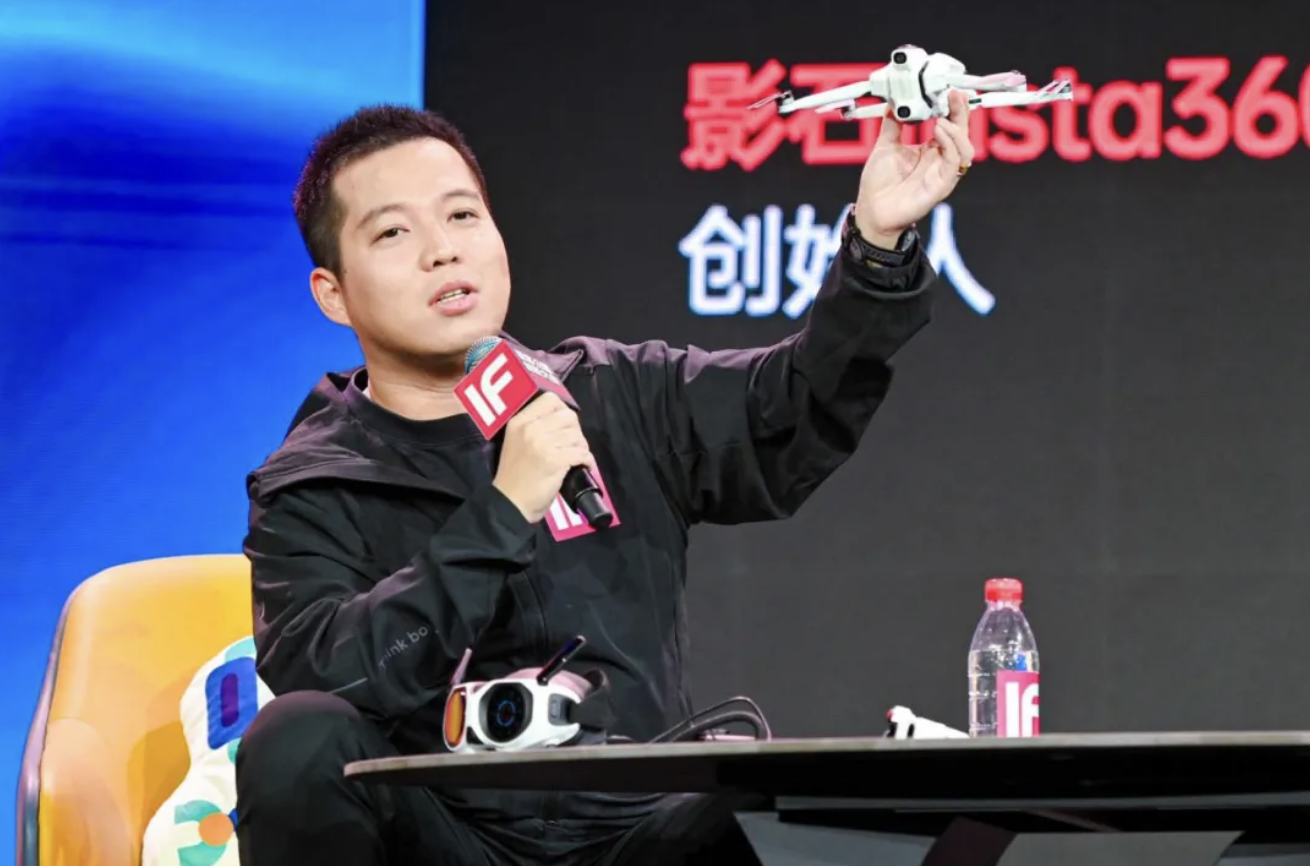
In an era when almost everything is converging toward AI, choosing to challenge entrenched hardware incumbents by moving in the opposite direction is itself a bold gamble. In June 2025, Insta360 rang the opening bell for its IPO, drawing a formal close to its first decade as a startup. Just six months later, in December 2025, the company unveiled what it calls the world’s first panoramic drone, the Antigravity A1—an announcement that signaled not an end point, but the beginning of an entirely new chapter.
The juxtaposition is striking. Having grown from a team of a dozen people into a roughly 4,000-strong company with a market capitalization exceeding RMB 100 billion (about US$14 billion), Insta360 chose not to consolidate its gains but to “re-start” in the drone market. For global observers of technology and consumer electronics, the move raises a fundamental question: why would a newly listed hardware champion voluntarily enter a field dominated by powerful incumbents?
What follows is the full translated text of the interview and discussion between Liu Jingkang, Founder of Insta360, and Zhang Peng, Founder of GeekPark, as presented at the GeekPark Innovation Conference 2026, organized by GeekPark. The conversation explores how Liu views the “next generation of imaging,” why he believes drones represent a non-consensus opportunity, and how Insta360 is positioning itself at the intersection of hardware, software, and AI.
Insta360’s 2025: From IPO to Panoramic Drones
Insta360’s 2025 could be described as a “double strike.” The IPO ceremony in June marked the conclusion of a ten-year entrepreneurial journey. The December launch of the Antigravity A1, a panoramic drone incubated by Insta360, opened what feels like an entirely new level.
From a small founding team to a super-unicorn valued at more than RMB 100 billion, the company’s decision to re-enter exploration mode in the drone sector is dramatic enough to prompt a simple but persistent question among onlookers: why drones?
Liu Jingkang, Founder of Insta360, offered his answer on stage at the GeekPark Innovation Conference 2026:
The real question was never “whether to build a drone,” but rather—what is the ultimate form of imaging?
For Insta360, drones are not a bid to squeeze into a red-ocean market dominated by giants. They are the logical continuation of the company’s mission, an attempt to understand the essence of the industry and to capture non-consensus opportunities.
From the classic metaphor of “the automobile in the age of horse-drawn carriages,” to an idea Liu conceived during a 40-minute shower about how a panoramic drone should be controlled, a single core judgment runs through his thinking: the ultimate demand in imaging is not the device, but the content.
Users are not attached to hardware for its own sake. What they want is an experience that requires no learning, causes no interruptions, and allows life to be recorded naturally.
While much of the industry remains focused on specifications, pricing battles, and competition within existing demand, Insta360 has chosen a harder but more deterministic path: building the operating system for the next generation of imaging devices, and creating a more intuitive and immersive way to capture content.
This is not an impulsive attempt to “challenge competitors,” but a proactive choice in the company’s own evolution.
Seen from this perspective, Insta360’s status in 2025 becomes clear: the IPO was never the finish line. It was a starting point. Drones, AI-enabled end-to-end imaging generation, and cross-category capability upgrades are the real challenges ahead.
At the GeekPark Innovation Conference 2026, Zhang Peng, Founder of GeekPark, sat down with Liu Jingkang for an extended conversation. What followed was not just the story of how a new product was born, but how an imaging company is trying to understand the very nature of “next-generation imaging.”
Key Takeaways from Liu Jingkang
- The technological barrier to drones is lower than that of cars or smartphones, but the market size is far from small.
- A panoramic drone is to the drone market what the automobile was to the age of horse-drawn carriages.
- Drones tolerate weaknesses very poorly; strong points cannot compensate for shortcomings in safety.
- The ultimate demand for imaging is not tools, but photos and videos.
- Price wars are a privilege of incumbents, not of startups or new entrants.
- Many companies eventually disappear, but their historical value lies in the markets they invent, change, or create.
- Imaging ultimately serves three needs: recording, sharing, and creation.
- When many small scenarios are served well and aggregated, the total market can be much larger than commonly assumed.
- Only when a major mistake will not force you off the table should you attempt your boldest moves.
Transcript of the Conversation
(Compiled by GeekPark)
01
A Moment of Calm at IPO
Zhang Peng: Welcome back to the GeekPark Innovation Conference. Your company went public this year, and you look thinner. Is this image management now that you’re the head of a listed company?
Liu Jingkang: Thanks for having me. It wasn’t because of the IPO. Right after listing, I actually gained more than 10 kilograms. I only lost the weight in the past month or two through sheer willpower. As the business becomes more complex, I—as a typical “P-type” person—need to be more planned and self-disciplined. I started with weight management as a form of psychological preparation.
Zhang: What did you actually feel at the moment of listing?
Liu: It felt like finishing final exams and being about to start vacation, but still not having left campus; or like an annual company meeting ending, but you haven’t gotten home yet. It was a brief pause between two things—one milestone completed, the next challenge not yet begun, and no relatives asking questions yet. My mind completely relaxed, and my attention briefly returned to myself rather than work.
02
“Building a Car” in the Age of Horse-Drawn Carriages
Zhang: Many people are curious about your move into drones. Not the “what” or the “how,” but the “why.” Why enter a field with such a dominant incumbent?
Liu: There are three main reasons.
First, it is a continuation of our mission. Since 2016, our mission has been to “help people better record and share their lives.” Over the past decade, and for the next ten years, this mission guides our choices.
Whether it’s our own action cameras, competitors’ cameras, or smartphones made by phone manufacturers, cameras are just tools. Consumers don’t buy tools to master tools. They want good photos and good videos. They want their important life moments preserved and shared.
Most people don’t understand camera movement, editing, or retouching. A great imaging experience is one where you can enjoy the moment, while a “photographer” takes care of shooting, editing, and polishing.
So the ultimate need is not the tool itself, but photos and videos. The biggest obstacle is the learning curve, and the way people are distracted by filming when they should be enjoying the moment.
We have thought about this problem for a decade. Five years ago, we concluded that the answer would likely be robotic products—not humanoid robots, which are too big and heavy, but compact, mobile drones.
Second, market competition. Although incumbents are far ahead in drones, let’s be realistic. Many new-energy carmakers generate hundreds of billions of yuan in revenue, with the best reaching the trillion-yuan scale. Yet a single drone or handheld gimbal product line can already exceed RMB 20 billion (around US$2.8 billion) in annual sales.
The difficulty of developing drones is far lower than that of building cars, even lower than smartphones. This makes drones a “non-consensus” opportunity—highly concentrated, but not inherently difficult. Everyone competes fiercely in cars and smartphones, while overlooking this category.
We also have a theory in product research: “look at the demand behind the demand.”
If you ask customers in a horse-carriage market what they want, they’ll say they want horses that never rest, better suspension, sofa-like seats, or air-conditioning. That’s like asking for better drone specs today.
But if you ask why they need a carriage, they’ll say they want to get from point A to point B faster. The solution doesn’t have to be a carriage—it could be a car.
In drones, “point A to point B” means aerial photography and seeing the world from new angles. Traditional drones are hard to operate and prone to crashes.
Our panoramic drone is like introducing the automobile into a carriage market. With a panoramic camera and VR headset, users fly where their fingers point and shoot where their eyes look. No complex learning is required. The interaction is natural.
Because the VR headset fully envelops your field of view, you experience space like a bird in flight. It’s not just a new way of filming—it could become a new form of travel.
Third, capability requirements. Compared with making action cameras five years ago, drones demand comprehensive upgrades in R&D, engineering, supply chain, marketing, and service.
When people talk about incumbents achieving “dimensionality reduction” by entering adjacent categories, it works the other way too. For us, drones are an exercise in “dimensionality expansion.” They require broader and deeper capabilities.
Companies that survive multiple cycles over decades usually have a clear core trajectory and continuously extend their capabilities along it. We saw drones as a way to pull the entire organization forward.
Today, our capabilities are incomparably stronger than five years ago. We still lag incumbents in many respects, but we are far more capable than we once were.
03
Innovation, Pricing, and Competition
Zhang: Why not take the simpler route—higher specs, lower prices?
Liu: First, it’s the nature of the market. Imaging is an open market, more like gaming than pure efficiency tools. You don’t praise a game because it’s cheaper or runs faster; you praise it because it’s fun.
Imaging needs are diverse. There’s no single convergent metric. Cameras aren’t just about image quality, battery life, or price. Many users don’t know how to shoot or edit well, and helping them do so is where our differentiation lies.
This openness makes it possible to avoid price wars.
Second, price wars are the privilege of giants. Startups don’t have that luxury. We invested five years and substantial resources into drones. Our funding comes from operating profits, which require reasonable margins driven by differentiation.
Third, many pioneers disappear, but their significance lies in what they create. The inventor of a category is often not the company that ultimately dominates it.
If one day we fail and others popularize panoramic drones, that’s fine. Without us, the category might not exist at all. Solving unsolved problems—not defeating rivals—is our core value.
04
Hardware Opportunities in the AI Era
Zhang: Are you optimistic about AI-driven hardware startups?
Liu: Very much so. Not because AI is powerful, but because business models have changed. Users are now accustomed to paying for software.
Hardware startups are still much harder than software ones—we employ over 600 different roles—but AI entrepreneurship today is far more viable.
As for AI replacing cameras, I don’t think so. Imaging serves three needs: recording, sharing, and creating.
Recording is about capturing real moments. Sharing is social comparison—when everyone can use AI templates, authenticity becomes more valuable. Creation is tied to personal skill and effort.
AI levels the playing field, but it doesn’t eliminate the desire for expression.
05
Bold Imagination and Bottom-Line Thinking
Zhang: Your culture emphasizes “Think Bold.” How do you balance courage and recklessness?
Liu: Two principles.
First, bottom-line thinking. You must know your worst-case scenario and ensure it’s survivable.
Second, engineering thinking—first principles. Break down what really matters, distinguish necessary from sufficient conditions, and move forward step by step.
Zhang: Your “Think Bold” fund supported a creator known as “Amazing Ayu” with RMB 1.8 million (about US$250,000) to help repay debts incurred during his projects. Isn’t that risky?
Liu: Bold ideas drive invention and art. Our fund supports ideas that are bold but verifiable. Creators like Ayu inspire many people, and we want to reduce their burdens so they can keep creating.
Zhang: Five years from now, what do you hope to see?
Liu: First, that we survive competition with giants.
Second, that we create truly world-class products that change behavior—like the Sony Walkman once did.
Third, that Insta360 becomes a long-chain collaboration platform, where people gain entrepreneurial skill sets and go on to create impactful things elsewhere.
If we achieve one or two of these, I’ll be satisfied.