
Kimi vs. DeepSeek: Diverging Paths in China's AI Race
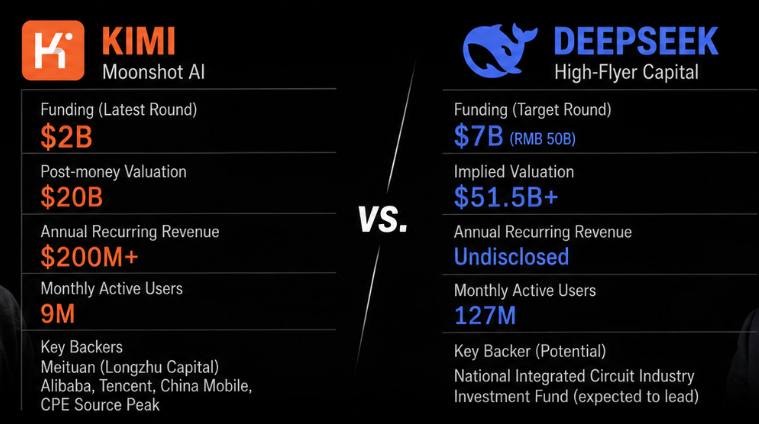
Two of China's leading AI startups—Kimi (backed by Moonshot AI) and DeepSeek—announced massive funding rounds within days of each other this week, exposing a fundamental split in how investors value commercial traction versus long-term infrastructure potential in the generative AI sector.
Kimi closed approximately $2 billion led by Meituan's venture arm Longzhu Capital, achieving a post-money valuation of roughly $20 billion. The company disclosed annual recurring revenue (ARR) surpassing $200 million, driven by paid subscriptions and API usage. Meanwhile, DeepSeek—which has historically relied on internal funding from quantitative trading firm High-Flyer—opened its first external financing round targeting RMB 50 billion (US$6.94 billion). Founder Liang Wenfeng plans to contribute RMB 20 billion personally, holding 40% of the round. Reports suggest China's National Integrated Circuit Industry Investment Fund may lead, pushing DeepSeek's implied valuation beyond $51.5 billion—2.5 times Kimi's figure despite undisclosed revenue.
Monetization vs. Ecosystem: Why Revenue Leaders Trail in Valuation
The valuation gap reflects a structural tension in AI investing. Kimi has executed a textbook commercialization playbook: its monthly active users stand at 9 million, while paying customers generate measurable cash flow. The company's four funding rounds since 2023 totaled over RMB 37.6 billion (US$5.22 billion), with Alibaba holding approximately 36% equity after an $800 million 2024 investment—part cash, part cloud compute credits on Alibaba Cloud infrastructure.
DeepSeek took the inverse route. Its API pricing remains one-tenth of OpenAI's comparable services, prioritizing developer adoption over margins. Monthly active users hit 127 million—14 times Kimi's scale—yet the startup has released no revenue data. When capital markets reward "potential to become infrastructure" over current profitability, DeepSeek's broader reach commands a premium. However, according to The Information, post-financing DeepSeek will "accelerate revenue planning and commercial deployment," signaling pressure to justify its valuation with financial performance.
Technical Convergence Beneath Competitive Surface
Both companies target trillion-parameter open-source models, but via distinct architectures. Kimi's K2.6 release achieved a 58.6% score on SWE-Bench Pro through agent-based parallel programming, while DeepSeek V4 standardized million-token context windows with 384K-token output capacity. Paradoxically, their research increasingly overlaps: DeepSeek V4's technical paper cites Kimi's Muon optimizer; Kimi K2 integrates DeepSeek's Multi-Head Latent Attention (MLA) mechanism. OpenAI's own publications acknowledge both as the earliest teams to replicate its o1 reasoning architecture outside the U.S.
Simultaneously, both are reducing dependency on Nvidia hardware. DeepSeek V4 will support Huawei's Ascend 950 chips later this year, with Cambricon processors already achieving "Day 0" compatibility. Kimi K2.6 enables hybrid inference across domestic semiconductor platforms. This dual push—matching frontier model capabilities while diversifying compute supply chains—positions the pair as complementary rather than purely rival forces in China's AI stack.
Capital Structure: Cloud Credits vs. Cash Control
Kimi's funding mix reveals venture capital's evolution in the AI era. Alibaba's $800 million commitment included substantial compute credit components rather than pure equity financing, effectively pre-selling cloud services while recording them as revenue. Tencent later joined as a co-investor, creating an unusual dynamic where two internet rivals co-own a strategic AI asset. The latest $2 billion round added China Mobile and CPE Source Peak, further entangling Kimi in stakeholder interests beyond pure financial return.
DeepSeek's RMB 50 billion target relies on Liang's personal RMB 20 billion anchor, bypassing complex governance structures. High-Flyer's quantitative trading profits funded model development through 2026 without external term sheets or LP return timelines. The incoming state-backed IC Fund participation, however, may redefine DeepSeek's mission from private research lab to national AI capability project—shifting valuation logic from price-to-sales multiples toward strategic asset pricing.
Guangdong Founders, Diverging Playbooks
CEO Yang Zhilin (Kimi) and founder Liang Wenfeng (DeepSeek) share Guangdong origins and technical pedigrees, but adopted opposing control strategies. Yang implemented dual-class share structures and appointed Zhang Yutong—formerly of GSR Ventures—as president to handle fundraising and commercialization, freeing him to focus on architecture research. This institutional approach triggered disputes: early investor conflicts over fiduciary duties and team departures from Yang's prior startup Recurrent AI surfaced as Kimi scaled, per reports by Anyong News.
Liang's method relies on capital itself: his 40% personal stake in the new round eliminates governance ambiguity, but demands liquidity most founders lack. High-Flyer's balance sheet enables this approach; Kimi's market-driven path required calibrating investor influence from inception. Neither model is inherently superior—each fits its resource base—but DeepSeek's transition to external funding means it will increasingly face the same accountability pressures Kimi navigated earlier.
The Narrowing Gap Ahead
DeepSeek's June V4.1 release will reportedly add enterprise tooling, marking a pivot toward Kimi's commercial territory. As external capital enters, the company's luxury of ignoring short-term revenue will erode. Conversely, Kimi's $200 million ARR provides a reference point for how AI startups translate user scale into cash flow—a roadmap DeepSeek may soon need.
Both remain dependent on each other's open-source contributions while competing for developer mindshare. The technical collaboration beneath their business rivalry suggests China's AI leaders are building a shared foundation even as their funding sources diverge. Whether measured by revenue today or ecosystem leverage tomorrow, the pair are testing alternate hypotheses about what makes an AI company valuable in 2026—and capital markets are placing bets on both answers.
Related Coverage:
Kimi AI Valuation Quadruples to $20 Billion in Six-Month Fundraising Sprint
DeepSeek Seeks $300M at $10B Valuation as Nvidia Dependence Becomes Existential Liability