
LandSpace Achieves China's First Private Rocket Recovery, With Reflight the Next Test
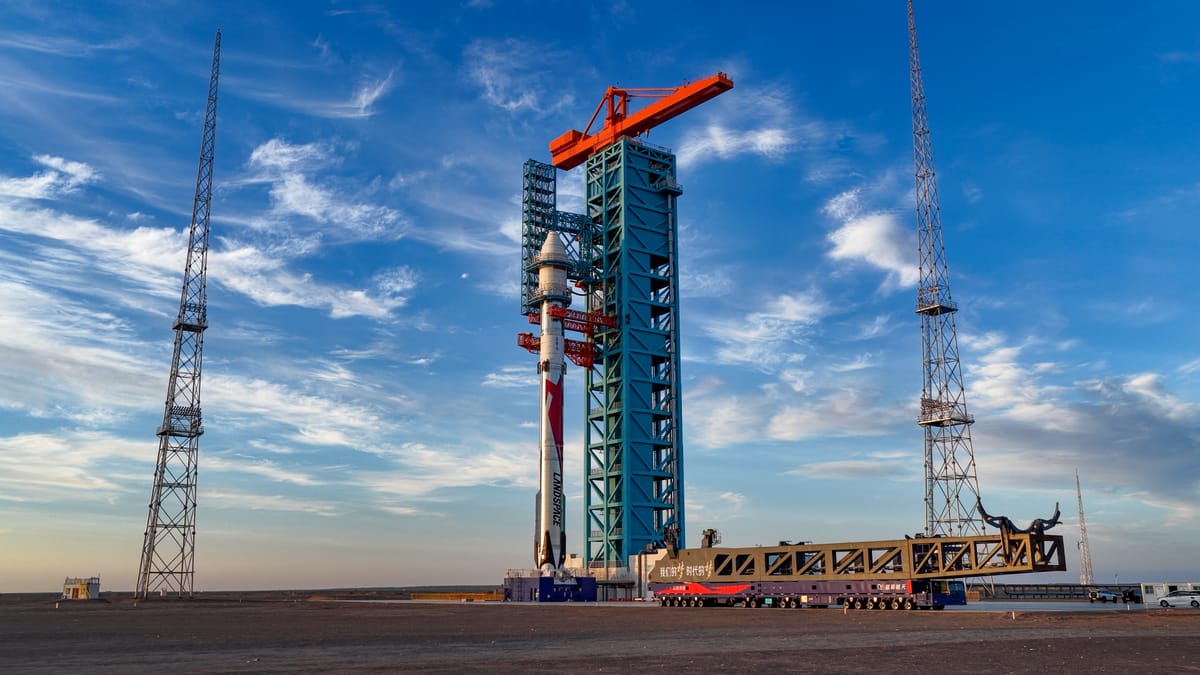
China's first successful land-based vertical rocket recovery by a private commercial launch vehicle marks a pivotal engineering inflection point — but the harder test of reflights and unit economics still lies ahead.
LandSpace Technology achieved what Chinese commercial aerospace has been racing toward: the first successful land-based vertical recovery of an orbital-class rocket first stage on Chinese soil, clearing a technical hurdle that directly underpins its pending RMB 7.5 billion (US$1.04 billion) STAR Market IPO. Yet investors and analysts tracking the sector know that sticking a landing is merely the opening bid in a far more demanding commercial competition.
The Zhuque-3 Yao-2 launch vehicle lifted off from the Dongfeng Commercial Aerospace Innovation Test Zone on August 19, 2026, successfully delivered the Honghu-03 satellite to its target orbit, and guided its first stage to a controlled vertical touchdown at a 60-meter-by-60-meter landing pad in Minqin County, Gansu Province — a site whose compact footprint LandSpace says reflects the precision of its autonomous landing control system. The Shanghai Stock Exchange lists LandSpace's IPO application, accepted on December 31, 2025, as currently under inquiry, making every flight data point a de facto due-diligence submission.
Recovery Success Validates a Three-Year Technology Bet
The significance of Yao-2 cannot be read in isolation. In December 2023, LandSpace's Zhuque-2 became the world's first liquid oxygen-methane rocket to reach orbit — a milestone that established the company's propulsion credentials. Zhuque-3 Yao-1, launched in December 2025, completed orbital insertion but failed at the final landing burn phase, leaving the first-stage recovery incomplete.
The engineering gap between Yao-1 and Yao-2 was deliberate and targeted. LandSpace engineers reduced the number of engines firing during the terminal landing sequence, simplifying control logic and cutting system complexity. The vehicle also gained a predictive impact-point safety control function, enabling autonomous real-time calculation of projected landing coordinates. Second-stage performance was upgraded via a higher-expansion-ratio nozzle to boost payload capacity for future low-Earth-orbit constellation missions. A non-pyrotechnic stacked satellite separation mechanism — designed for multi-satellite deployment — was also integrated, signaling the company's intent to compete for constellation batch-launch contracts.
The technical architecture — liquid oxygen-methane propellant, stainless steel airframe, landing-leg vertical recovery — mirrors the design philosophy pioneered by SpaceX for Falcon 9, adapted to a domestic supply chain. LandSpace's choice of land recovery over sea-based net capture, the method used by Chang Zheng-10B in its July 10, 2026 debut at Hainan Commercial Spaceport, reflects a deliberate trade-off: lower ground infrastructure cost at the expense of geographic flexibility.
China's Recovery Race Resets Its Own Benchmark
The competitive landscape in Chinese reusable launch has compressed dramatically within 12 months. Since late 2025, at least six programs have entered active recovery validation: Zhuque-3, Chang Zheng-12A, Chang Zheng-10B, Galactic Energy's Zhishen-1, iSpace's Hyperbola-3, and CAS Space's Lijian-2. The sheer density of parallel programs signals that Chinese state and commercial actors have collectively concluded that reusability is no longer optional for cost-competitive launch.
That consensus, however, is shifting the industry's benchmark question. Landing a booster is now table stakes. The metrics that will differentiate operators over the next 24 to 36 months are relight frequency, turnaround time between flights, annual launch cadence, and ultimately cost per kilogram to orbit. LandSpace has not yet disclosed a target reflights-per-booster figure or a per-launch price point for Zhuque-3.
The SpaceX reference is instructive and sobering. As of July 2026, a single Falcon 9 booster had completed its 36th flight, and Reuters data indicates Starlink missions account for approximately 79% of Falcon 9 launches year-to-date in 2026. That captive manifest — an internal customer generating predictable, high-frequency demand — is what converts recovery capability into genuine cost leverage. LandSpace has no equivalent anchor tenant at this stage.
IPO Narrative Gains Engineering Support, Commercial Proof Remains Outstanding
The financial logic connecting Yao-2 to LandSpace's STAR Market filing is straightforward. In a traditional expendable liquid rocket, the first stage represents roughly 70% of total vehicle cost, while propellant accounts for just 1% to 3%. A recoverable and reflown first stage allows that 70% cost center to be amortized across multiple missions — theoretically compressing per-launch pricing by an order of magnitude at scale.
The operative word is "theoretically." Post-recovery economics are materially more complex than the gross margin arithmetic suggests. Returning a booster requires carrying additional return propellant, grid fins, landing legs, and attitude control hardware — all of which reduce net payload capacity. Post-landing inspection cycles, engine health assessments, and component replacement schedules will determine actual turnaround costs and intervals. The distinction between recovery count and refly count is critical: the former measures how many boosters come back; the latter measures how many actually launch again.
LandSpace has publicly stated it will pursue its first recovery-reuse flight as soon as operational data from Yao-2 permits. Until that refly is executed and its cost structure disclosed, the IPO prospectus will carry a meaningful gap between demonstrated engineering capability and proven commercial model. STAR Market investors, already accustomed to scrutinizing pre-revenue deep-tech listings, will likely price that gap into their valuation frameworks.
The company's RMB 7.5 billion fundraising target implies a premium to peers at a stage where recurring launch revenue has yet to be established. Yao-2 narrows the engineering risk discount. It does not eliminate the execution risk premium.
What Comes Next Defines the Investment Thesis
LandSpace's roadmap from here runs through three sequential gates: execute the first refly of a recovered Zhuque-3 booster; demonstrate a sub-30-day turnaround cycle; and secure commercial contracts that fill a meaningful launch manifest. Each gate carries independent technical and commercial risk.
The broader implication for China's commercial space sector is that the recovery milestone, once a differentiator, is rapidly becoming a commodity. The companies that translate recovery into reflight, and reflight into a reliable annual launch cadence, will command the economics that justify current valuations. For LandSpace, Yao-2 answers the question regulators and investors were asking about Yao-1. The next question — can this rocket fly again, faster, and cheaper — is the one that will ultimately determine whether the IPO pricing holds.
Related Coverage:
LandSpace's Zhuque-2 Rocket Delivers Satellites, Marking New Commercial Milestone