
Leapmotor vs. Xpeng: Two Roads to Profitability in China's EV Industry
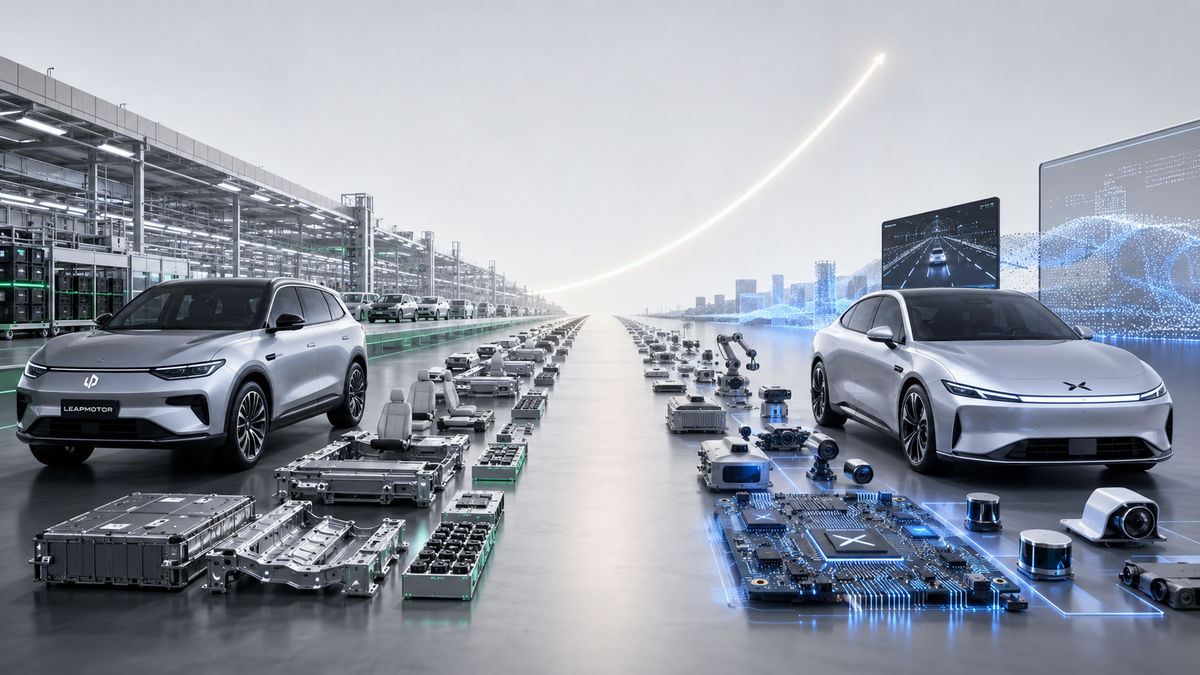
Both companies posted roughly ¥35 billion in first-half revenue. One turned a profit. The other spent twice as much on R&D. Here's why that gap tells a larger story about how China's EV shakeout is unfolding.
What Is This About?
China's electric vehicle market has entered a phase where revenue scale alone no longer separates winners from losers. Leapmotor and Xpeng both generated around ¥35 billion in revenue in the first half of 2026 — yet one posted a net profit of ¥210 million while the other recorded a net loss of ¥3.12 billion.
The divergence is not accidental. It reflects two fundamentally different theories of what an EV company should be: a high-volume, low-margin manufacturer that competes on cost efficiency, or a technology platform that uses cars as the initial delivery mechanism for AI, software, and robotics capabilities.
Understanding how these two models work — and where each is vulnerable — offers a lens into the structural dynamics shaping China's broader EV industry consolidation.
Why the Same Revenue Can Mean Very Different Businesses
The headline numbers look similar. The underlying economics do not.
In the first half of 2026:
- Leapmotor delivered 356,000 vehicles, generating ¥38.11 billion in revenue and a net profit of ¥210 million
- Xpeng delivered 166,000 vehicles, generating ¥32.77 billion in revenue with a net loss of ¥3.12 billion
Leapmotor sold more than twice as many cars, yet earned a gross margin of only 11.7%. Xpeng sold far fewer cars but achieved a gross margin of 20.6%.
The apparent paradox — higher gross margin, larger loss — resolves when you look at where each company directs its spending.
How Leapmotor's Model Works: Vertical Integration as a Cost Engine
Leapmotor's core strategic logic is cost compression through vertical integration and platform reuse.
The company develops its own electric drive systems, battery packs, and smart cabin electronics. Its "Clover" centralized computing platform consolidates what would traditionally be dozens of separate electronic control units into a single architecture. The same platform, powertrain, and driver-assistance stack is then reused across multiple vehicle lines — reducing the marginal cost of each new model.
The financial output of this approach is visible in R&D spending ratios. In the first half of 2026, Leapmotor spent ¥2.32 billion on R&D, equal to 6.1% of revenue, or roughly ¥6,500 per vehicle delivered. That figure is intentionally constrained: every technology investment is evaluated against whether it can reduce bill-of-materials costs or be deployed across a sufficient number of vehicles to justify the outlay.
The product range reflects this logic. Leapmotor now covers four series — A, B, C, and D — spanning from approximately ¥60,000 entry-level vehicles to ¥200,000-plus SUVs. The A-series handles volume; the C-series has accumulated over 850,000 cumulative owners; the D-series is testing the premium segment, with the D19 crossing 10,000 monthly deliveries in July 2026.
This is structurally similar to the path taken by BYD and Geely: build scale, internalize supply chain margin, and use volume to absorb fixed costs.
The vulnerability in this model is thin margin tolerance. Leapmotor's net profit margin is approximately 0.5% — less than ¥600 per vehicle. Any combination of raw material price increases, intensified price competition, or higher overseas investment costs could eliminate that margin entirely. Management already revised full-year net profit guidance downward from approximately ¥5 billion to approximately ¥3 billion, with the first half contributing only ¥210 million. The second half needs to deliver roughly ¥2.8 billion — a steep ramp.
How Xpeng's Model Works: Technology as a Separate Revenue Stream
Xpeng is pursuing a structurally different hypothesis: that its investments in chips, AI models, and software will eventually generate revenue independent of vehicle sales.
The company spent ¥5.82 billion on R&D in the first half of 2026 — 2.5 times Leapmotor's total, equivalent to 17.8% of revenue, or over ¥35,000 per vehicle delivered. Full-year R&D spending is expected to reach approximately ¥12 billion, with roughly ¥7 billion directed at AI-related work. This includes the in-house Turing chip, a Vision-Language-Action (VLA) large model for autonomous driving, and early-stage investment in Robotaxi and humanoid robotics.
The near-term financial evidence that this strategy is beginning to work appears in Xpeng's services revenue. In the first half of 2026, services and other revenue reached ¥4.73 billion, up approximately 67% year-on-year, representing 14.4% of total revenue. In Q2 alone, services revenue hit ¥2.7 billion at a gross margin of 75.1% — driven primarily by technology development services provided to Volkswagen, along with parts and accessories sales.
This is what pulls Xpeng's blended gross margin above 20% even as its automotive gross margin sits closer to 12% — roughly comparable to Leapmotor's. The car business itself is not particularly more profitable. The technology services layer is.
The structural risk is concentration and recognition timing. Technology service revenue from the Volkswagen partnership is recognized against project milestones, creating inherent quarterly volatility. Q4 2025 saw an acceleration of milestone recognition; Q1 2026 saw a pullback. More fundamentally, Xpeng currently has one major external technology client. A single high-value project is not the same as a scalable technology business. Whether Volkswagen's own CEA platform eventually reduces its dependence on Xpeng's services — and whether Xpeng can add new external clients — are open questions that will determine whether "technology company" is a permanent identity or a transitional narrative.
The Product Mix Problem Both Companies Face
Despite their different strategies, Leapmotor and Xpeng share a common near-term tension: volume growth is coming from lower-priced vehicles, which compresses per-unit economics.
For Leapmotor, the A-series drives delivery numbers but also pulls average selling prices down. First-half gross margin declined from 14.1% to 11.7% year-on-year, partly due to raw material costs and partly due to product mix shift toward lower-priced models. Management's stated next step — developing a second brand to move upmarket, analogous to Toyota's creation of Lexus — is a logical response, but execution risk is high.
For Xpeng, the MONA M03 (priced in the low-to-mid teens of RMB) accounted for 41% of Q2 deliveries. The newly launched MONA L03 continues in the same price band. Average selling price in Q2 fell to approximately ¥165,000, down ¥10,000 sequentially. The flagship X9 MPV now represents only 7% of deliveries. The newer GX model has solid order intake but faces production ramp constraints.
The tension is explicit: Xpeng needs MONA volume to justify its manufacturing scale, but needs higher-priced vehicles to support automotive gross margins that can absorb its cost structure. Those two requirements are currently pulling in opposite directions.
How Each Company Is Approaching International Expansion
The two companies' overseas strategies mirror their domestic philosophies.
Leapmotor has moved faster internationally. In the first half of 2026, overseas shipments reached 96,000 units, representing 27% of total deliveries, against a full-year target of approximately 200,000 units. The mechanism is a joint venture with Stellantis — Leapmotor International — which leverages Stellantis's existing dealer networks, manufacturing facilities, supply chains, and local operational capabilities across Europe and other markets. Leapmotor contributes product and technology; Stellantis contributes market infrastructure.
This approach is capital-efficient and fast. The trade-off is margin and control. In the early phase of the partnership, gross margins on vehicles sold through Leapmotor International are lower than domestic margins, with the explicit priority being volume and market share over near-term profitability. Local production in Europe reduces tariff exposure, but European component sourcing costs are structurally higher than in China, partially offsetting that benefit.
Xpeng is building a more proprietary international presence, targeting expansion to 680 overseas stores across more than 60 countries and regions. It is also pushing to deploy its VLA model and driver-assistance capabilities internationally — treating software and AI as exportable products, not just vehicles.
The distinction is less about whether each company uses local partners (both do) and more about the degree of control retained. Leapmotor delegates more of the distribution and manufacturing layer to Stellantis. Xpeng aims to retain ownership of brand positioning, product decisions, and technology delivery. The former approach generates results faster; the latter requires more capital and time but preserves strategic optionality.
What the Cash Positions and Robotics Financing Signal
As of the end of June 2026, both companies held comparable cash reserves: Xpeng at approximately ¥40.48 billion, Leapmotor at approximately ¥38.59 billion.
For Leapmotor, that cash position supports a business that is now operationally cash-generative, though barely. The margin for error is narrow.
For Xpeng, the same cash base must cover new vehicle programs, AI infrastructure, channel expansion, and capital expenditure simultaneously. The burn rate is higher.
A notable development on the Xpeng side: in August 2026, its robotics subsidiary Dogotix signed share subscription agreements with investors for $900 million in new shares, implying a post-money valuation of approximately $6.3 billion. The transaction remains subject to closing conditions and should not be treated as fully completed financing. But it establishes that Xpeng's robotics business can be independently valued and capitalized — a meaningful structural development. Leapmotor has confirmed it is planning an embodied robotics effort, but is at an earlier stage without comparable independent valuation.
What to Watch in the Coming Quarters
For Leapmotor, the central question is whether gross margin can stabilize in the 13%+ range in the second half of 2026. The first quarter was weak (9.4% gross margin, net loss of ¥390 million); the second quarter recovered (12.6% gross margin, net profit of ¥600 million). Sustaining that recovery while growing volume — particularly if the product mix continues shifting toward lower-priced models — will test the limits of the vertical integration thesis. Progress on the D-series premium segment and the timing of overseas profitability are secondary indicators.
For Xpeng, the immediate priority is closing the gap between vehicle delivery capacity and the cost structure it is already running. Q3 2026 delivery guidance of 115,000–121,000 units is modest relative to the R&D and SG&A base. The MONA L03 and GX models face supply chain and production ramp constraints. If new vehicle orders cannot be fulfilled promptly, the high fixed-cost base becomes harder to justify. Longer-term, the sustainability of Volkswagen-related technology services revenue — and the emergence of additional external clients — will determine whether Xpeng's blended margins hold.
The Structural Takeaway
Leapmotor and Xpeng are running two different experiments within the same industry shakeout.
Leapmotor is testing whether disciplined cost engineering and platform reuse can produce durable profitability at mid-range price points — the same path that made BYD structurally dominant. The model is working at a basic level, but the profit margins are too thin to absorb significant disruption.
Xpeng is testing whether an EV company can evolve into a technology licensor and AI platform — using vehicle sales to fund capability development that eventually generates higher-margin, recurring revenue streams. The early evidence from the Volkswagen relationship is encouraging. The question is whether that relationship is a proof of concept or an isolated transaction.
Both companies have approximately ¥40 billion in cash. Both face product mix headwinds. Both are expanding internationally through different mechanisms. The divergence in their long-term trajectories will likely be determined less by what happens in the next two quarters and more by whether Leapmotor can move upmarket without losing its cost advantage — and whether Xpeng can convert technology investment into a client base rather than a single partnership.
Related Coverage:
XPeng’s EV Growth Hits a Supply Wall as Its Physical AI Bet Gains Momentum
Leapmotor's 60% Sales Surge Masks a Structural Profit Problem as China's EV Shakeout Accelerates