
ManuPrax Raises Twice in Two Months, Bets on Dexterous Robotics Software
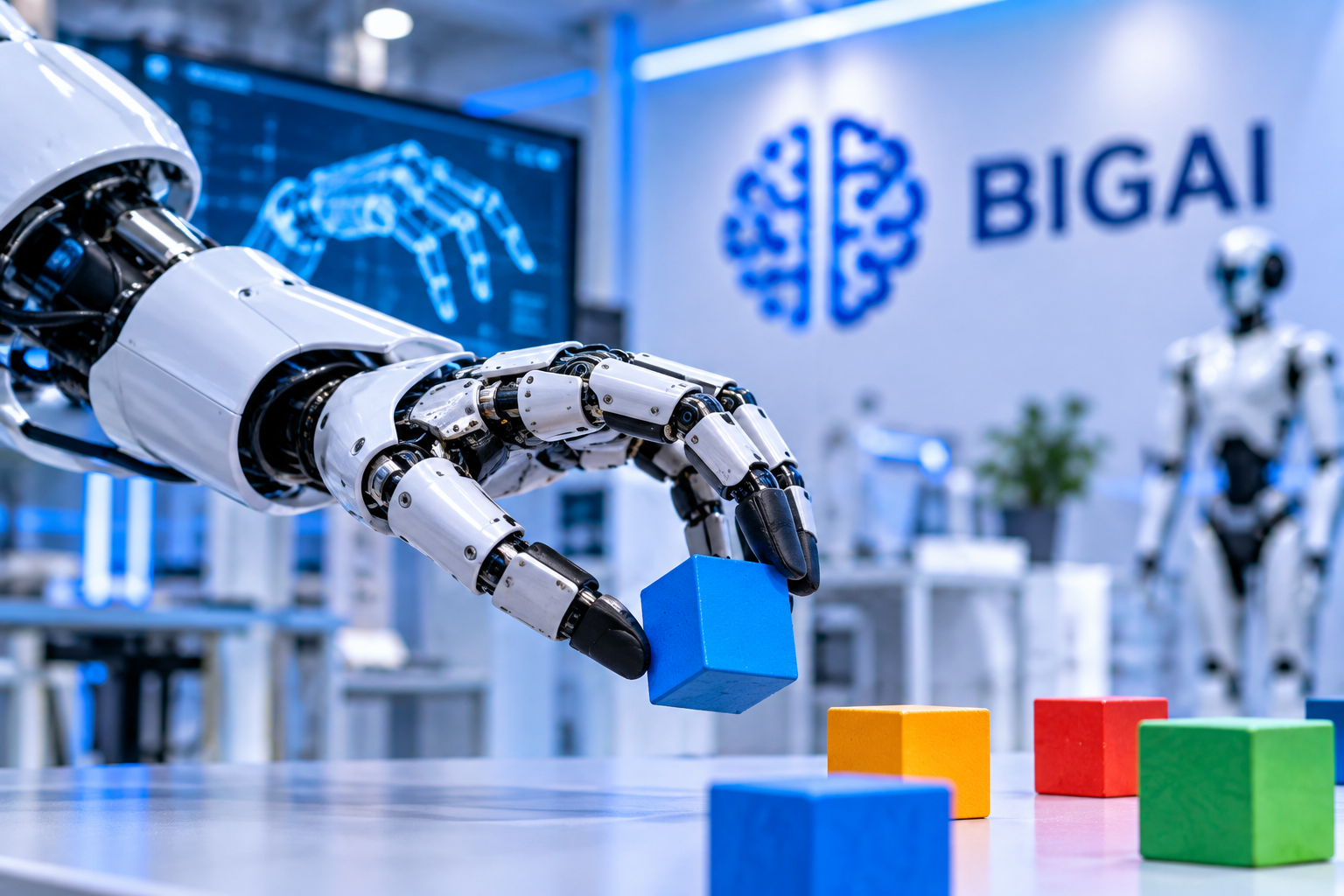
The Beijing startup, founded by two researchers born after 2000, has secured nearly $10 million to build a "cerebellum-layer" dexterous operation model — a direct challenge to the hardware-first orthodoxy dominating China's robotic hand market.
ManuPrax Robotics, a Beijing-based robotics startup registered just this September, has completed two consecutive funding rounds totaling close to $10 million (approximately RMB 72 million), with Alphaist Partners and Yaotu Capital leading respective tranches. Follow-on participants include a relay angel investor and an undisclosed controlling shareholder of a components manufacturing firm — an unusual combination that signals both venture and industrial conviction in the company's early thesis.
The speed of the raise is notable even by the frothy standards of China's embodied AI sector: two rounds closed within two months of the company's formal registration. It suggests that capital is selectively re-engaging with dexterous manipulation plays in late 2026, even as the broader humanoid robot buildout faces commercialization headwinds and margin compression.
Founding a "Cerebellum" While the Industry Chases Better Fingers
The company's founding team is unusually young. CEO Li Puhao, born in 2001, holds a combined bachelor's-master's-doctoral track at Tsinghua University's Department of Automation and has been publishing research on dexterous manipulation since 2021. CTO Chen Zeyuan, born in 2000, completed his master's degree at Peking University and declined a doctoral placement to co-found the company. Chen's prior work spans ClutterDexGrasp and CADGrasp, with research stints at Amazon Fulfillment and Robotics (FAR), Zhiyuan Robotics, and JD.com.
Both founders conducted research at the Beijing Institute for General Artificial Intelligence, where Li Puhao is a doctoral student under BIGAI Director Zhu Songnun — a lineage that carries significant weight in China's AI research community. ManuPrax is an officially backed spinout of BIGAI, embedded within the institute's broader Real2Sim2Real learning architecture.
The institutional backing matters strategically. BIGAI's ecosystem — encompassing the "TongJie" simulation platform, "TongJing" evaluation environment, and "TongNao" task-planning module — provides ManuPrax with a ready-made training, testing and deployment infrastructure that an independent startup would otherwise spend years and capital building from scratch.
Repositioning Dexterous Hands: From "What It Looks Like" to "What It Can Do"
ManuPrax's central technical argument is that the robotics industry has misidentified the bottleneck in dexterous manipulation. Industry discussions have long fixated on hardware metrics — degrees of freedom (DoF), joint count, load capacity, actuator type. The founders contend this framing is flawed.
"Having more joints does not equal stronger operational capability," Li Puhao has argued. A hand that can complete a grasp in a controlled lab environment may fail entirely when object shape, weight, surface texture or contact state changes — which is the norm in any real-world deployment. ManuPrax's thesis is that hardware is merely the carrier of operational capability; the differentiated asset is the software layer that governs how the hand moves, adjusts and recovers.
The company calls this the "cerebellum layer" — a deliberate architectural distinction from both upper-tier large language or vision-language-action (VLA) models and from conventional low-level controllers. In ManuPrax's stack, a foundation model such as a next-generation system like GPT-6 Astra handles environment parsing, task comprehension and high-level planning. The cerebellum layer then translates those objectives into continuous, coordinated, physically grounded motion — adjusting finger angle, contact force and trajectory in real time as the physical interaction evolves.
The English company name encodes this philosophy directly: Manu from the Latin manus (hand), Praxfrom the Greek praxis (action, practice).
Choosing Reinforcement Learning Where Others Follow Human Demonstrations
The company's chosen training methodology sets it further apart. Rather than relying primarily on human demonstration data — the dominant paradigm in robotic manipulation research, exemplified by imitation-learning-based approaches — ManuPrax is pursuing reinforcement learning (RL) as its core training regime.
The logic is scale: human demonstrations are inherently finite and expensive to collect, and they struggle to cover the combinatorial diversity of real-world objects, surfaces and contact states. An RL-trained model, by contrast, can explore and accumulate experience across millions of simulated interactions. The tradeoff is the well-documented simulation-to-reality (sim-to-real) gap: friction, material deformation, sensor noise and contact dynamics in physical environments routinely invalidate policies that perform well in simulation.
ManuPrax is attempting to bridge this gap by combining simulation, human demonstration data, and synthetically generated interaction trajectories into a unified training corpus — and by operating within BIGAI's Real2Sim2Real infrastructure, which is explicitly designed to create continuous feedback loops between physical and simulated environments. Whether this approach can achieve robust generalization at commercially relevant scales remains the key technical question the company must answer in the next 12 to 18 months.
Hardware Commoditization Creates a Window — But the Clock Is Running
The founders' market timing argument is pointed. Li Puhao projects that the profit margins in pure-hardware dexterous hand sales will compress significantly within the next six months, as domestic Chinese manufacturers accelerate production and drive down unit economics. This is not a contrarian view: it mirrors the trajectory of LiDAR, servo motors and other robotics components in prior cycles, where Chinese manufacturing scale rapidly eroded the pricing power of early hardware entrants.
If that compression materializes, the competitive axis shifts. ManuPrax is positioning its dexterous operation model platform — which accepts manipulation targets from upper-tier multimodal models and outputs executable motion across heterogeneous hardware — as the layer that captures value as hardware margins thin.
The platform ambition is credible in design but demanding in execution. Selling software into robotic systems requires demonstrating task-completion improvements that customers can quantify: higher grasp success rates, reduced training data requirements, faster deployment cycles, reliable performance transfer across hardware configurations. ManuPrax has not yet published external benchmark data against incumbent solutions from established players such as Fourier Intelligence or INSPIRE-Robots, and the absence of that data will be the primary friction point in early enterprise sales conversations.
The founders acknowledge this tension directly. Li Puhao has stated that the company is not ruling out a hybrid path — developing or partnering on reference hardware to accelerate real-world data collection and model validation — even as the long-term strategic intent remains platform-oriented.
Ambition Beyond the Workshop Floor
The founders' stated end-state goes beyond product positioning. Chen Zeyuan describes his ultimate goal as deploying robots that relieve humans of mechanically repetitive physical labor — not systems that execute pre-programmed routines, but machines capable of adapting to complex, variable real-world tasks. Li Puhao frames the commercial and scientific challenges as inseparable: the model's value can only be validated by market deployment, not laboratory benchmarks.
ManuPrax is also a deliberate piece of a larger institutional architecture. Within BIGAI's roadmap, dexterous manipulation at the "final centimeter" — the precise contact dynamics involving friction, deformation, sliding and contact-state transitions — is identified as the critical unresolved problem between simulation capability and real-world deployment. ManuPrax's role within the BIGAI ecosystem is to own that layer, feeding real-world operational data back into simulation and training pipelines.
The forthcoming "Mingjing" platform, being established at Chongqing BIGAI, is intended to provide the industrial-scale infrastructure for this data loop — a signal that the institutional bet on ManuPrax extends well beyond early-stage research.
For investors, the company presents a compressed-timeline bet: that software-defined dexterous manipulation can achieve commercial proof-of-concept before the hardware cycle fully commoditizes and before larger, better-resourced incumbents close the algorithmic gap. That window, by the founders' own estimate, may be measured in quarters, not years.
Related Coverage:
RobotEra Founder: Learning from Humans is 'Shortest Path' to General-Purpose Robots