
Fourier Intelligence Builds Meta's First Humanoid Prototype, Exposing the New Hardware Fault Line in AI
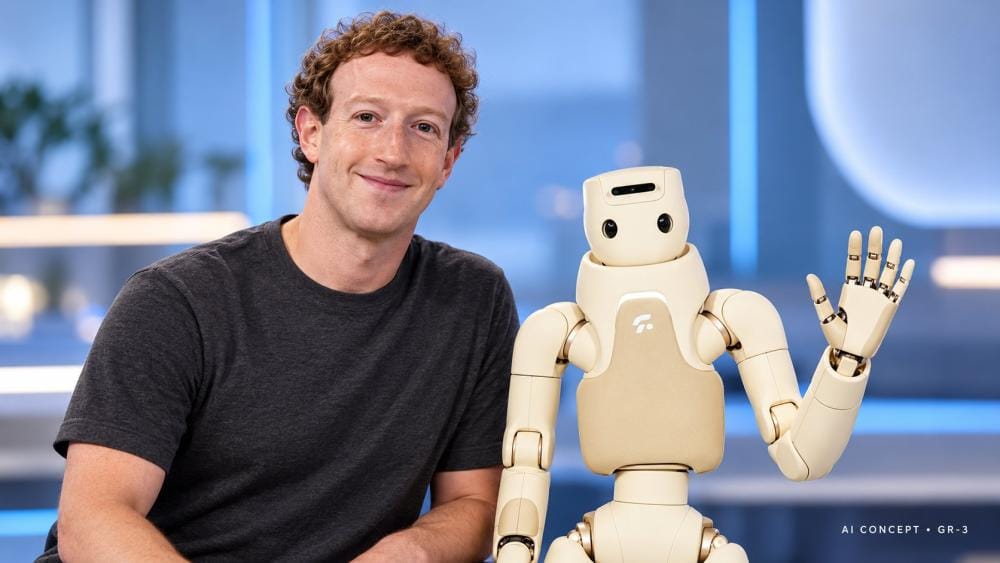
Chinese robotics firm Fourier Intelligence completed a custom humanoid robot prototype for Meta Platforms in roughly three months, delivering the clearest evidence yet that Silicon Valley's AI ambitions are structurally dependent on China's manufacturing ecosystem — even as Washington moves to restrict that very supply chain.
The robot, internally designated "Max," stands 1.5 meters tall, weighs 48 kilograms, and runs on Nvidia's Jetson Thor chip. It was unveiled at a Meta internal robotics summit in late August 2026, marking the most concrete hardware milestone since Meta established its robotics division. A second-generation version, Max 2, entered development in September, with a redesigned torso, upgraded hand dexterity, an integrated projector, and stair-navigation sensors.
The collaboration signals a strategic bifurcation now taking shape across the global robotics industry: American firms supply the AI stack, Chinese manufacturers supply the body.
Fourier's GR Platform Slashes Meta's Development Timeline
Fourier Intelligence, a Shanghai-based company that built its foundation in exoskeleton and rehabilitation robotics before pivoting to general-purpose humanoids, did not build Max from a blank canvas. Meta leveraged Fourier's existing GR-series humanoid platform — a multi-generation product line with accumulated expertise in bipedal locomotion, dexterous manipulation, and tactile sensing — then customized the height, body proportions, head structure, display configuration, cameras, hands, and foot design to meet its own specifications.
Li-Chen Miller, Meta's Vice President of Robotics Products, spent nearly two months on-site at Fourier's Shanghai facility working alongside local engineers. That level of executive immersion reflects how seriously Meta is treating the hardware layer of its AI-to-physical-world strategy.
The speed of delivery — prototype to internal showcase in approximately 90 days — would have been difficult to replicate without an existing mechanical architecture. Building that foundation independently would have required Meta to navigate the full stack of motors, harmonic drives, structural components, and assembly processes from scratch, diverting engineering resources away from the AI and interaction systems that represent Meta's core competitive differentiator.
Muse Needs a Body: How Max Fits Meta's AI Agent Architecture
Max is not a consumer product. Meta spokesperson statements confirm the robot is designated for internal research and experimentation, with no announced sales plans. Its functional purpose is more specific: to serve as a physical test platform for Muse, Meta's AI agent system.
Meta Chief Technology Officer Andrew Bosworth has described humanoid robots internally as the physical embodiment of Muse — a framing that positions Max not as a standalone hardware play, but as a necessary substrate for validating AI capabilities in unstructured real-world environments.
The operational requirements Meta set for Max illustrate the gap between language model capability and physical task execution. The robot must recognize voice commands from five meters, identify hand gestures and waves at three meters, maintain eye contact, and communicate internal states — listening, thinking, speaking, uncertainty — through differentiated visual signals on its facial display. Its hands use a five-finger design capable of grasping small bottles and objects.
These specifications reflect the sensorimotor complexity required for even basic human-robot interaction. A model that can interpret a spoken instruction does not automatically translate that understanding into a reliable sequence of physical actions. Perception errors, motion failures, and environmental variability during task execution generate the ground-truth training data that Meta needs to close the loop between its AI models and hardware performance.
In May 2026, Meta acquired Assured Robot Intelligence, a robotics AI startup focused on models that enable machines to interpret human behavior and adapt to environmental variation. That acquisition, combined with Max's role as a physical testbed, outlines a coherent vertical integration strategy: proprietary AI models running on tested hardware, trained on real-world interaction data.
Fourier's Position Hardens as China's Embodied AI Funding Surges Fivefold
Fourier's selection by Meta does not occur in isolation. Chinese embodied intelligence companies raised RMB 93.5 billion (approximately US$13 billion) across 322 transactions in the first half of 2026 — roughly five times the volume recorded in the same period of 2025. Investment has expanded beyond whole-robot manufacturing into robot AI models, training datasets, and software systems.
The breadth of that ecosystem is directly relevant to why Meta chose Fourier. Human-form robots require integrated supply chains spanning motors, reducers, sensors, structural components, and control systems. China's manufacturing base provides that integration at density and cost structures that remain difficult to replicate elsewhere. It also provides industrial customers and factory environments that serve as real-world testing grounds for robot deployment.
Several Chinese companies are now competing to solve the task generalization problem — enabling robots to learn unfamiliar tasks without exhaustive pre-programmed routines. Spirit AI has deployed approximately 1,000 personnel to document daily life and industrial activity for training data collection. ACE Robotics uses wearable sensors to capture motion and grip-force data from workers in retail and hospitality settings. Ant Group's (蚂蚁集团) robotics unit Robbyant reports its models were trained on 160,000 hours of material, including 50,000 hours of human-guided robot motion data, across 20 robot configurations spanning 17 hardware brands. DexForce uses synthetically generated environments to reduce the cost of real-world data acquisition.
These approaches represent parallel bets on the same underlying thesis: that the next competitive frontier in robotics is not mechanical capability but behavioral generalization.
Regulatory Pressure Threatens to Redraw the Collaboration Map
Meta and Fourier's partnership operates under an increasingly restrictive policy environment. The U.S. Federal Communications Commission (FCC) imposed import restrictions on new Chinese humanoid robots in July 2026, citing supply chain and cybersecurity risks. The initial framework permitted up to 4,000 units for testing and product development. In August, the FCC proposed reducing that ceiling to 40 units absent written authorization.
If that proposal is finalized, Meta's ability to import Max prototypes for domestic testing — and to source components from Fourier and adjacent Chinese suppliers — faces material legal and logistical constraints. The compliance burden would increase at precisely the moment Meta is scaling its robotics infrastructure, with active recruitment underway in Shanghai for supplier development engineers and in Shenzhen for product design engineers and technical project managers. Those job postings suggest a trajectory from single-prototype research toward broader manufacturing readiness, even if no production timeline has been announced.
The regulatory dynamic introduces a structural tension that Meta cannot resolve through engineering alone. Chinese partners offer mature hardware development capability and manufacturing supply chains. American policy is progressively restricting access to both.
Key Performance Data Remains Undisclosed, Limiting External Validation
Despite the internal showcase and confirmed second-generation development, Meta has not published task completion rates, operational endurance, payload capacity, or the degree of human assistance required during demonstrations. The addition of stair-navigation sensors and upgraded manipulation hardware addresses known capability gaps on paper; it does not confirm those gaps have been closed in practice.
For Fourier, the Meta collaboration represents significant commercial and reputational validation — a flagship American technology company selecting its platform over competitors including Boston Dynamics, Figure AI, and domestic Chinese rivals. It also positions Fourier as a preferred partner for companies seeking to compress hardware development timelines through licensed platform customization rather than ground-up engineering.
The broader question for the robotics industry is whether the AI-hardware integration problem can be solved at the pace that current investment levels imply. Consumer deployment of humanoid robots requires reliability, safety certification, and cost structures that prototype demonstrations do not address. The distance between a robot that can gesture, speak, and pick up a toy bottle — and one that can reliably complete household tasks in variable environments without supervision — remains one of the field's most consequential unsolved engineering problems.
Meta and Fourier have built a body. Making it useful is the harder work.
Related Coverage:
Meta's Muse Exposes China's AI Agent Paradox: Mobile Dominance Becomes a Liability
MetaX's Profit Milestone Masks a More Complex Reality for China's GPU Race