
MetaX's Profit Milestone Masks a More Complex Reality for China's GPU Race
China's first profitable domestic GPU maker turned a headline RMB 612 million (US$85 million) net profit in H1 2026 — but the fine print reveals that unrealized investment gains, not chip sales, drove the swing, leaving the sector's commercialization story still unfinished.
MetaX Integrated Circuit (Shanghai) (688802.SH) became the first among China's so-called "Four GPU Dragons" to post a profitable half-year, reporting RMB 612 million (US$85 million) in net profit attributable to shareholders for the six months ended June 30, 2026, versus a loss of RMB 186 million (US$25.8 million) a year earlier. Revenue climbed 44.67% year-on-year to RMB 1.324 billion (US$183.9 million), driven by a sharp increase in GPU shipment volumes across smart computing centers, telecom operators, financial institutions, and energy companies.
The headline number, however, obscures a structural caveat that analysts cannot ignore: RMB 887 million (US$123.2 million) in fair-value gains on trading financial assets — equivalent to 105.75% of total pre-tax profit — inflated the result. Strip those out, and the company's core operating loss, measured by non-recurring-adjusted net profit, was still negative RMB 49 million (US$6.8 million). MetaX's own management flagged this income as "non-sustainable" in the semi-annual filing. The stock closed at RMB 674.90 per share on August 28, 2026, giving the company a market capitalization of approximately RMB 270 billion (US$37.5 billion).
Q2 Surge Signals an Operational Inflection, Not Yet a Confirmation
Beneath the headline noise, a more meaningful signal emerged at the quarterly level. In Q1 2026, MetaX posted a net loss of RMB 98.84 million (US$13.7 million). By implication, Q2 alone generated net profit of approximately RMB 514 million (US$71.4 million) — a year-on-year surge of 1,001.71%. More critically for investors focused on business quality: Q2's non-recurring-adjusted net profit turned positive for the first time, reaching approximately RMB 54 million (US$7.5 million).
That single-quarter operational flip is the data point that matters most. It suggests MetaX's GPU shipment ramp is beginning to absorb its fixed cost base — research and development expenses consumed 39.65% of H1 revenue, or RMB 525 million (US$72.9 million) — though one quarter of positive adjusted earnings is insufficient to declare a sustainable profit cycle. Gross margin held steady at 57.22%, up 1.14 percentage points year-on-year, indicating pricing power has not been sacrificed to win volume.
Fair-Value Gains Dominate the P&L, Distorting the Commercial Narrative
The mechanics of MetaX's paper profit deserve close examination. The company holds approximately RMB 8.7 billion (US$1.21 billion) in cash-equivalent assets — RMB 4.352 billion (US$604.4 million) in cash and RMB 4.351 billion (US$604.3 million) in trading financial assets, including RMB 3.357 billion (US$466.3 million) in bank wealth management products and RMB 994 million (US$138.1 million) in equity instruments — largely proceeds from its December 2025 STAR Market IPO, which raised RMB 4.197 billion (US$582.9 million) at an issue price of RMB 104.66 per share.
Market appreciation of those equity holdings generated RMB 887 million in fair-value changes in H1 2026, compared with just RMB 2.96 million in the same period of 2025. The company's own disclosure explicitly characterizes the sustainability of this income stream as "No." Operating cash flow deteriorated to negative RMB 1.297 billion (US$180.1 million) from negative RMB 883 million (US$122.6 million) a year earlier — a 46.90% wider outflow — confirming that the reported profit generated no cash. The gap between net income and operating cash flow is the clearest evidence that GPU operations have not yet reached self-funding status.
Strategic Stockpiling Reveals Confidence — and Liquidity Risk
MetaX's balance sheet tells a parallel story of aggressive forward positioning. Prepayments surged 163.24% from year-end 2025 to RMB 2.196 billion (US$305 million), while inventories stood at RMB 1.432 billion (US$199 million). Combined, these two line items represent approximately RMB 3.6 billion (US$500 million) tied up in wafer foundry capacity reservations and raw material procurement — a deliberate hedge against supply chain disruptions stemming from U.S. export controls on advanced semiconductors.
This stockpiling strategy signals management's conviction that demand will accelerate in H2 2026. It also introduces execution risk: if customer orders disappoint, the inventory overhang could trigger impairment charges that reverse recent margin progress. Contract liabilities — an indicator of prepaid customer orders — fell 70.10% from year-end 2025 to RMB 35 million (US$4.9 million), a trend that warrants monitoring as a leading indicator of near-term order momentum.
Peers Remain Deep in the Red, Widening MetaX's First-Mover Advantage
MetaX's profitability milestone, even in its qualified form, stands in sharp contrast to the three remaining members of the "Four GPU Dragons." Moore Threads narrowed its net loss to RMB 11.56 million (US$1.6 million) in H1 2026 from RMB 271 million (US$37.6 million) a year earlier, on revenue of RMB 1.736 billion (US$241.1 million) — up 147.42% year-on-year. Enflame Technology reported a net loss of RMB 632 million (US$87.8 million). Biren Technology posted an adjusted loss of RMB 337 million (US$46.8 million) under non-IFRS metrics.
The divergence in financial trajectories reflects differing stages of commercialization. Enflame's R&D spending consumed 408.01%, 181.66%, and 114.63% of revenue in 2023, 2024, and 2025, respectively — a ratio that, while declining, illustrates how capital-intensive the GPU development cycle remains before scale economics kick in. Moore Threads, despite its near-breakeven H1 result, has accumulated losses of RMB 43.22 million (US$6 million) over 2023–2025 alone. The sector's aggregate trajectory, however, points toward convergence: all four companies are growing revenue rapidly, and loss ratios are compressing.
Capital Markets Race Accelerates, Raising the Commercialization Bar
The IPO pipeline for domestic GPU makers has compressed dramatically. Moore Threads and MetaX both listed on Shanghai's STAR Market in December 2025. Biren Technology debuted on the Hong Kong Stock Exchange in January 2026. Enflame Technology is now preparing its own STAR Market listing, with its prospectus highlighting fifth- and sixth-generation AI chip development and industrialization projects as primary use-of-proceeds categories.
Simultaneously, MetaX and Moore Threads are each pursuing secondary H-share listings in Hong Kong — a move that would expose both companies to international institutional investors and create cross-market valuation anchors. MetaX's board and shareholders have already approved the H-share issuance; regulatory approvals from both Chinese and Hong Kong authorities remain pending.
The capital market scrutiny that accompanies public listings raises the stakes for commercialization. Primary market investors historically priced domestic GPU companies on technology differentiation and import-substitution narratives. Secondary market participants demand evidence of order books, revenue quality, gross margin sustainability, and cash conversion. MetaX's H1 2026 report — with its qualified profit, improving but not yet confirmed operating inflection, and aggressive balance-sheet positioning — represents exactly the transitional moment the market is trying to price.
Product Roadmap and Ecosystem Reach Underpin the Long-Term Case
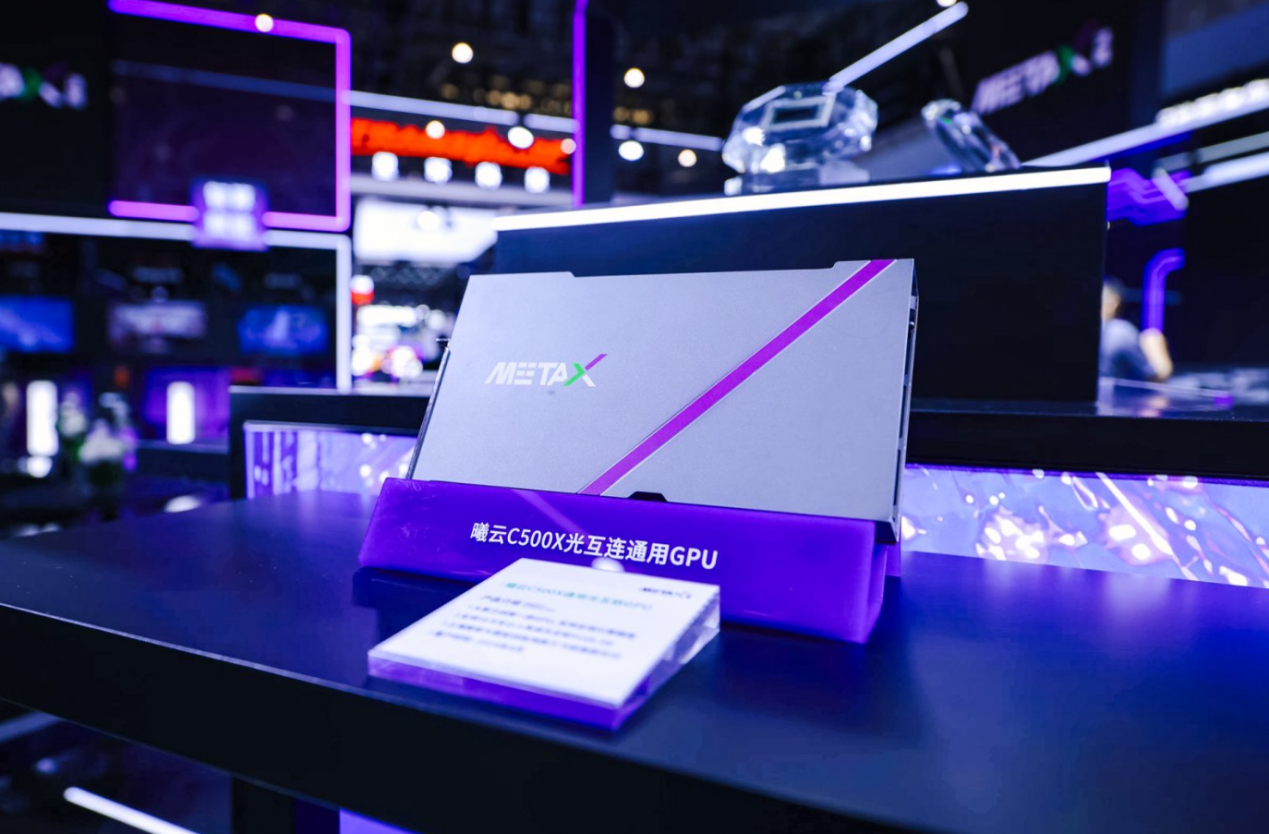
MetaX's product architecture spans three GPU lines: the Xisi N100 inference GPU, in mass production since April 2023; the Xiyun C500 training-and-inference GPU, shipping since February 2024; and the Xiyun C600, which entered mass production in May 2026 using fully domestic manufacturing processes and has passed China's national security and reliability certification. The C600's all-domestic supply chain directly addresses the geopolitical risk that U.S. export controls have imposed on advanced node procurement.
The company's proprietary MXMACA software stack — designed for native CUDA compatibility — recorded over 110 million API calls via its open-source community from its February 2025 launch through July 28, 2026. With 747 of its 1,061 employees classified as R&D personnel (70.4% of headcount, over 70% holding postgraduate degrees), MetaX is sustaining the human capital investment necessary to maintain product iteration cadence.
Market Sizing Supports the Bull Case; Valuation Demands Execution
Third-party data cited by industry participants projects global data center AI accelerator chip revenue will expand from US$9.17 billion in 2021 to US$730 billion by 2030, with the GPU segment alone growing from US$6.67 billion to US$600 billion over the same period. China's domestic AI chip market reached RMB 303.9 billion (US$42.2 billion) in 2025 and is forecast to approach RMB 1.6 trillion (US$222.2 billion) by 2030, implying a 38.6% compound annual growth rate from 2026 through 2030.
Against that backdrop, MetaX trades at approximately 131x trailing twelve-month price-to-sales and 19.5x price-to-book as of August 28, 2026. With core operations still loss-making on an adjusted basis, traditional price-to-earnings metrics are not applicable. The valuation embeds a significant premium for scarcity — MetaX's free float represents just 4.63% of total shares outstanding — and for the import-substitution macro thesis. As lockup periods expire and the float expands, the stock's sensitivity to quarterly operating results will increase materially.
Four metrics will determine whether MetaX's H2 2026 results validate the current multiple: whether non-recurring-adjusted net profit remains positive for a second consecutive quarter; the trajectory of gross margin and operating expense ratios; the recovery of contract liabilities as a proxy for forward order flow; and the revenue contribution from the newly launched Xiyun C600.
Related Coverage:
Shanghai's GPU "Big Four" Unite in Capital Markets as Third AI Chip Company Lists